“Looking back, my path has not been linear, and I changed direction more than once; however, what has stayed constant is curiosity, even when the topics and the places were changing. This is also what I like most about mathematics: there is room for many different trajectories, as long as you keep following questions that genuinely interest you.” - Mikaela Iacobelli

➡️ https://hermathsstory.eu/mikaela-iacobelli

#Academia #PhD #AssociateProfessor #MathematicalPhysics #PDEs #KineticTheory #MathsJourney #WomenInSTEM #WomenInMaths #HerMathsStory

This year, Simon Prince, Professor of Computer Science at UCL, published a series of tutorials on ordinary differential equations (ODEs) and stochastic differential equations (SDEs) in machine learning for RBC Borealis. These are intended for readers with no background in these areas and require only basic calculus.

Article 1 describes what ODEs and SDEs are and their applications in machine learning.

https://rbcborealis.com/research-blogs/odes-and-sdes-for-machine-learning

Article 2 describes ODEs, vector ODEs and PDEs and defines associated terminology. They develop several categories of ODE and discuss how their solutions are related to one another. They discuss the necessary conditions for an ODE to have a solution.

https://rbcborealis.com/research-blogs/introduction-ordinary-differential-equations

Article 3 describes methods for solving first-order ODEs in closed form. They categorise ODEs into distinct families and develop a method to solve each family.

https://rbcborealis.com/research-blogs/closed-form-solutions-for-odes

For many ODEs, there is no known closed-form solution.

Article 4 considers numerical methods, which can be used to approximate the solution of any ODE regardless of its tractability.

https://rbcborealis.com/research-blogs/numerical-methods-for-odes

This concludes their treatment of ODEs. In the coming weeks, we will focus on SDEs. They will describe stochastic processes and SDEs, and show how to solve SDEs using either direct stochastic integration or Ito's lemma. They will introduce the Fokker-Planck equation, which transforms a stochastic differential equation into the PDE governing the evolving probability density of the solution. They also consider Andersen's theorem, which allows us to reverse the direction of SDEs.

#ODEs #PDEs #SDEs #ODE #PDE #SDE #Calculus #ML #DL #VectorCalculus #LectureSeries #Tutorials
@bradheintz I feel like I had a similar attitude towards #probability in my undergrad. It wasn’t until later on in my PhD and even only as a researcher research that I came to appreciate the beauty. Especially through the connection to measure theory and through that #analysis. It is a very interesting field full of deep results and applications crossing to several fields like random #geometry and stochastic #PDEs. Many results in #numbertheory have even been proven using probabilistic methods, I.e. showing that properties hold for a set of numbers that has a positive measure in some sense.

FortranX: Harnessing Code Generation, Portability, and Heterogeneity in Fortran

#OpenCL #HIP #CUDA #OpenMP #Fortran #CodeGeneration #PDEs

https://hgpu.org/?p=29585

FortranX: Harnessing Code Generation, Portability, and Heterogeneity in Fortran

Due to its historical popularity, Fortran was used to implement many important scientific applications. The complexity of these applications along with the transition to modern high performance lan…

hgpu.org

A Distributed-memory Tridiagonal Solver Based on a Specialised Data Structure Optimised for CPU and GPU Architectures

#CUDA #OpenMP #Physics #ComputationalPhysics #PDEs

https://hgpu.org/?p=29552

A Distributed-memory Tridiagonal Solver Based on a Specialised Data Structure Optimised for CPU and GPU Architectures

Various numerical methods used for solving partial differential equations (PDE) result in tridiagonal systems. Solving tridiagonal systems on distributed-memory environments is not straightforward,…

hgpu.org

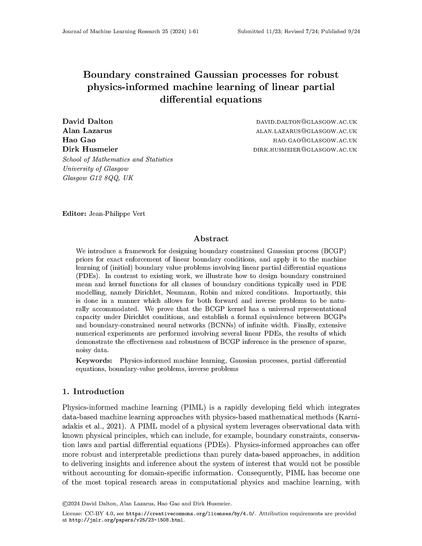
'Boundary constrained Gaussian processes for robust physics-informed machine learning of linear partial differential equations', by David Dalton, Alan Lazarus, Hao Gao, Dirk Husmeier.

http://jmlr.org/papers/v25/23-1508.html

#boundary #pdes #gaussian

Boundary constrained Gaussian processes for robust physics-informed machine learning of linear partial differential equations

LINEAR TRANSPORT EQUATION
The linear transport equation (LTE) models the variation of the concentration of a substance flowing at constant speed and direction. It's one of the simplest partial differential equations (PDEs) and one of the few that admits an analytic solution.

Given \(\mathbf{c}\in\mathbb{R}^n\) and \(g:\mathbb{R}^n\to\mathbb{R}\), the following Cauchy problem models a substance flowing at constant speed in the direction \(\mathbf{c}\).
\[\begin{cases}
u_t+\mathbf{c}\cdot\nabla u=0,\ \mathbf{x}\in\mathbb{R}^n,\ t\in\mathbb{R}\\
u(\mathbf{x},0)=g(\mathbf{x}),\ \mathbf{x}\in\mathbb{R}^n
\end{cases}\]
If \(g\) is continuously differentiable, then \(\exists u:\mathbb{R}^n\times\mathbb{R}\to\mathbb{R}\) solution of the Cauchy problem, and it is given by
\[u(\mathbf{x},t)=g(\mathbf{x}-\mathbf{c}t)\]

#LinearTransportEquation #LinearTransport #Cauchy #CauchyProblem #PDE #PDEs #CauchyModel #Math #Maths #Mathematics #Linear #LinearPDE #TransportEquation #DifferentialEquations

'Multilevel CNNs for Parametric PDEs', by Cosmas Heiß, Ingo Gühring, Martin Eigel.

http://jmlr.org/papers/v24/23-0421.html

#pdes #solvers #deep

Multilevel CNNs for Parametric PDEs

'Neural Q-learning for solving PDEs', by Samuel N. Cohen, Deqing Jiang, Justin Sirignano.

http://jmlr.org/papers/v24/22-1075.html

#pdes #pde #nonlinear

Neural Q-learning for solving PDEs