Modeling Dynamics of Affordance Actualization

Modeling Dynamics of Affordance Actualization

Modeling Dynamics of Affordance Actualization: Methodological Considerations

The most accurate carotid artery model to date — the first to capture both the soft, low-pressure behavior and the stiff, high-pressure response of the vessel.
Built on the same principles as Fung’s law, but improved: our 2014 α–β framework fits strain energy first, then derives pressure — like how \( F = \frac{dE}{dx} \) gives the force in a spring. Here \(E\) is the strain energy — the quantity Fung’s law was originally built around. Strain energy is differentiated to give force, and in the fits below that force corresponds to pressure.
The 1987 plot below (Fung-type) fits well only at high pressures; the 2019 plot fits low pressures. Ours is the first to capture both perfectly.
#Biomechanics #ContinuumMechanics #MathematicalModeling #StrainEnergy #FungsLaw #ConstitutiveModeling #Mechanics #NSFResearch #ScienceCommunication #ArterialMechanics
Grid-Free Approach to Partial Differential Equations on Volumetric Domains [pdf]
http://rohansawhney.io/RohanSawhneyPhDThesis.pdf
#HackerNews #GridFree #PDEs #VolumetricDomains #MathematicalModeling #ComputationalPhysics
📝 [Preprint] What if insecticidal bednets increased #mosquito attraction to humans? 🦟
We explored this counterintuitive effect using a transmission model for #malaria.
🧪 Available on medRxiv: https://doi.org/10.1101/2025.04.02.25325102
Introduction Recent studies suggest that insecticide-treated nets (ITNs) may actively attract malaria vectors, increasing their likelihood of coming into contact with the insecticide while potentially reducing personal protection. The impact of such attractive ITN on malaria transmission at the community level remains unclear. In this study, we developed a model to compare the effectiveness of attractive, inert and deterrent ITNs under varying levels of human usage and different degrees of physiological or behavioral resistance in malaria vectors. Methods We developed a model to simulate the host-seeking, feeding and mortality (HSFM) of mosquito vectors facing ITNs. This model allows mosquitoes to choose between two rooms based on the presence and remote influence (attractive, inert or deterrent) of ITNs. The HSFM model was then integrated into a malaria transmission model to compare the Plasmodium transmission potential (average number of infectious bites that a vector is expected to give during its lifetime) of mosquitoes exposed to these different type of ITNs under various scenarios of ITN coverage, physiological resistance (reduced ITN-induced mortality), quantitative resistance (increased indoor escape behaviors), and qualitative resistance (increased spatial-temporal avoidance of ITNs). Results The model predicts that attractive ITNs consistently reduce malaria transmission potential of vectors more effectively than inert or deterrent ITNs, even in the presence of resistant vector phenotypes. For instance, at intermediate use rate (50%), strongly attractive ITNs are expected to reduce transmission by up to 67% compared to deterrent ITNs. In resistant vector populations, attractive ITNs remained more effective overall, though the reduction in transmission were less pronounced. Conclusion Our findings suggest that both inert and attractive ITNs could enhance malaria control efforts, outperforming current deterrent ITNs, even in resistant vector populations. Shifting from deterrent to inert or attractive ITNs could significantly improve vector control strategies, warranting further research and product development to fully explore and optimize this approach. ### Competing Interest Statement The authors have declared no competing interest. ### Funding Statement This study did not receive any funding ### Author Declarations I confirm all relevant ethical guidelines have been followed, and any necessary IRB and/or ethics committee approvals have been obtained. Yes I confirm that all necessary patient/participant consent has been obtained and the appropriate institutional forms have been archived, and that any patient/participant/sample identifiers included were not known to anyone (e.g., hospital staff, patients or participants themselves) outside the research group so cannot be used to identify individuals. Yes I understand that all clinical trials and any other prospective interventional studies must be registered with an ICMJE-approved registry, such as ClinicalTrials.gov. I confirm that any such study reported in the manuscript has been registered and the trial registration ID is provided (note: if posting a prospective study registered retrospectively, please provide a statement in the trial ID field explaining why the study was not registered in advance). Yes I have followed all appropriate research reporting guidelines, such as any relevant EQUATOR Network research reporting checklist(s) and other pertinent material, if applicable. Yes All data produced are available online at <https://doi.org/10.5281/zenodo.15121769> <https://doi.org/10.5281/zenodo.15121769>
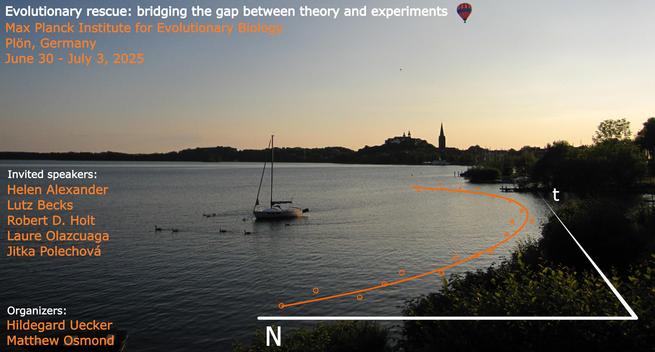
@HildegardUecker and I are excited to be running the second edition of our #EvolutionaryRescue workshop series at the #MaxPlanck Plön, June 30-July 3. This time the focus is on bridging theory and experiments.
Invited speakers: Helen Alexander, Lutz Becks, Robert D Holt, Laure Olazcuaga, Jitka Polechova.
Submit an abstract by March 15 and tell your friends.
More info: https://workshops.evolbio.mpg.de/event/128/
#Evolution #ecoevo #evol_gen #MathematicalModeling #MathematicalBiology
IMPORTANT DATES Workshop: 30 June – 3 July, 2025 The workshop starts on June 30 at 5pm and ends on July 3 in the evening. Pre-school: June 29 (afternoon) & June 30, 2025 Registration deadline: 15 March, 2025 Notification of acceptance: 22 March, 2025 OVERVIEW Evolutionary rescue is a topic of great interest, from medicine to agriculture to conservation, and from natural observations to experiments to theory. In 2023, we organised a workshop on ‘Mathematical models of evolutionary rescue’. In...
We're hiring a Research Officer at the Modelling and Simulation Hub, Africa (MASHA) at the beautiful University of Cape Town! Join our team and contribute to impactful research on infectious disease dynamics and control.
This is a 36-month contract position. Apply by March 7th, 2025!
https://uct.ac.za/sites/default/files/2025-02/sci-id901-ro-masha.pdf
#research #hiring #mathematicalmodeling #infectiousdiseases #Africa
🐘📢 New publication in PLOS ONE!
We used SIR/SEIR modeling to simulate the Antonine Plague, testing different pathogen scenarios. Our results suggest:
✔ Ancient mortality estimates may have been exaggerated
✔ Standard epidemic models do not fully reproduce historical death tolls
✔ Unmodeled factors, such as seasonality, may explain this discrepancy
📝 Open Access:
https://doi.org/10.1371/journal.pone.0313684
#Epidemiology #HistoryOfMedicine #MathematicalModeling #AntoninePlague #OpenScience
Some scholars consider the Antonine Plague to have been a major disease outbreak in the 2nd century CE that caused a significant decline in the population of the Roman Empire. Although there is currently no molecular evidence of the specific pathogen, literary evidence indicates the parameters of the disease that it caused and how significant the impact on Roman society was. One way to advance the current discussion concerning the Antonine Plague’s impact on the Roman Empire’s population is to examine the currently available sources and comparatively model the spread of different pathogens in a specific location with known demographic data for the relevant period. To accomplish this, we developed a series of dynamic ordinary differential equation models of the spread of disease in Rome between 165 and 189 CE for several pathogens. We found that daily disease deaths in the final years of the pandemic were inconsistent with estimates reported in primary sources, suggesting that either (a) the impact of the Antonine Plague may have been exaggerated in the descriptions of ancient authors, or (b) the daily deaths in ca. 189 CE were caused by a different disease event than the Antonine Plague, or (c) seasonality might have been a significant factor changing the intensity of disease spread, with the population more severely affected during the winter months. Although none of the pathogens we analyzed emerged as the likely causative agent of the Antonine Plague, the models show that the overall mortality rate would have increased maximally by 7%. This result contradicts the mortality rate accepted by historians who defend the thesis of the significant impact of this epidemic on the demography of the Roman Empire.
New Historical Perspective available ahead of print: "Georgii F. Gause’s The Struggle for Existence and the Integration of Natural History and Mathematical Models" by Topaz Halperin https://www.journals.uchicago.edu/doi/10.1086/734003
Postdoctoral Fellow in Microbial Genetics or Genomics, UTHealth Houston
University of Texas Health Science Center at Houston
Join us in our multidisciplinary research #genetics, #genomics, #molbio, #evolution, #systems, #bigdata, & #mathematicalmodeling
See the full job description on jobRxiv: https://jobrxiv.org/job/unive...
https://jobrxiv.org/job/university-of-texas-health-science-center-at-houston-27778-postdoctoral-fellow-in-microbial-genetics-or-genomics-uthealth-houston/?feed_id=81227