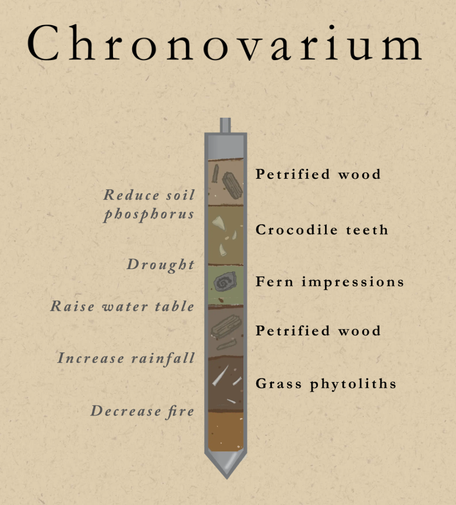
Shifts of climate implicated in change from Middle to Later Stone Age in southern #Africa
#archaeology #palaeoclimate #MSA #LSA
https://www.sciencedirect.com/science/article/pii/S0277379125005906
Shifts of climate implicated in change from Middle to Later Stone Age in southern #Africa
#archaeology #palaeoclimate #MSA #LSA
https://www.sciencedirect.com/science/article/pii/S0277379125005906
This week's #NewBooks at the library:
- I adopted a damaged copy of David Farrier's Nature's Genius: Evolution's Lessons for a Changing Planet, published by @canongatebooks.
The other two are cases of the more I read, the more I go down rabbit holes.
- After reviewing Mysteries of the Deep, I bought an ex-library copy of the classic 1995 Paleoclimate and Evolution, with Emphasis on Human Origins, published by Yale University Press, to read more on the work of Elisabeth Vrba and colleagues (this one came from the holdings of the University Library of Durham)
- After reviewing Every Living Thing, I wanted to know more about Cuvier and tracked down an ex-library copy of the classic 1987 The Cuvier-Geoffroy Debate: French Biology in the Decades Before Darwin, published by Oxford University Press (this one came from the holdings of the University of Saint Katherine Library)
#ClimateChange #Evolution #Palaeoclimate #HumanEvolution #HistoryOfScience #ScienceHistory #HistSci #Books #Scicomm #Bookstodon @bookstodon
Coming back to this at #NCKF25 where my former boss (+IPCC lead author) Jens Hesselbjerg Christensen is looking at #Eemian #SeaLevelRise
Not quite as catastrophic as the MWP1a but still large. I wonder if this has been updated recently at all?
https://fediscience.org/@Ruth_Mottram/115304238980577506
Ruth_Mottram - This plot on wikipedia was made by @RARohde based on data published in late 90s and early 00s. Wondering if this has been updated or if there is new understanding on any of these palaeo records?
#Palaeoclimate #SeaLevelRise #IceSheets
Maybe @DrEvanGowan has thoughts? Anyone else?
This plot on wikipedia was made by @RARohde based on data published in late 90s and early 00s. Wondering if this has been updated or if there is new understanding on any of these palaeo records?
#Palaeoclimate #SeaLevelRise #IceSheets
Maybe @DrEvanGowan has thoughts? Anyone else?
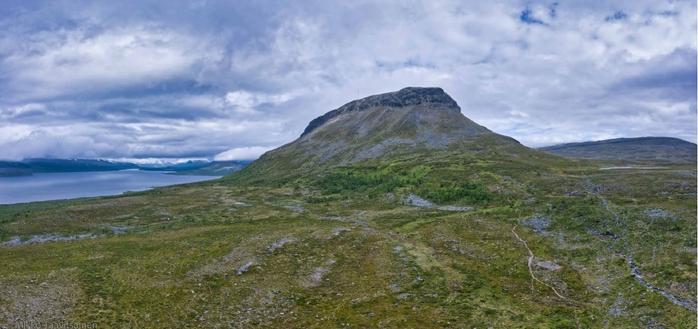
🆕Review: In the accompanying blog post, Jessica Purcell introduces us to this latest article by Järvinen et al. published in Myrmecological News.
#hybridisation #palaeoclimate #dispersal #geographic #isolation
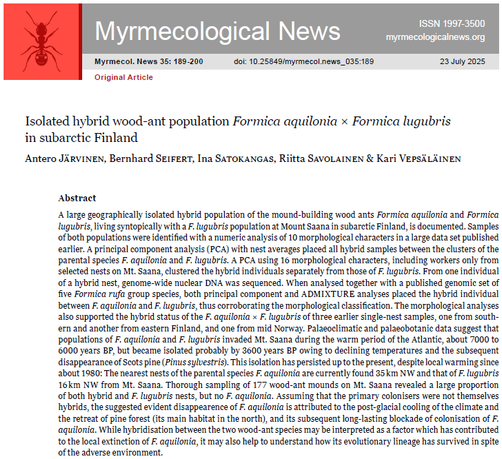
🆕 Original Article: Isolated hybrid wood-ant population Formica aquilonia x F. lugubris in subarctic Finland
Järvinen, A., Seifert, B., Satokangas, I., Savolainen, R. & Vepsäläinen, K.
#hybridisation #palaeoclimate #dispersal #geographic #isolation
https://myrmecologicalnews.org/cms/index.php?option=com_content&view=category&id=1655&Itemid=444
Very interesting #demographic model for historic #African populations reaching back 74,000 years -- that is before ancestors of everyone today began moving out of Africa. This factors in #malaria risk as contributing to movements and success of populations. Even that long ago, even with #huntergatherers.
"Our results show that humans strongly avoided or were unsuccessful in potential malaria hotspots. The effects of these choices shaped human demography for the last 74 kya, and likely much earlier, by fragmenting human societies over time and contributing to the formation of modern population structure."
The mechanisms driving the spatial organisation of early human societies in Africa are typically addressed through climate variables 1-3. However, genetic and archaeological studies have also suggested diseases as a major source of selection in the Pleistocene. Here, we explore whether P. falciparum-induced malaria, a major world disease, drove habitat choice in human societies between 74 and 5 thousand years ago (kya). Using species distribution models of three main mosquito complexes with palaeoclimatic reconstructions and combining the results with epidemiological information, we estimated an index of malaria transmission risk in sub-Saharan Africa through time. We then correlated it with an independent reconstruction of the human niche over the same time period and region. Our results show that humans strongly avoided or were unsuccessful in potential malaria hotspots. The effects of these choices shaped human demography for the last 74 kya, and likely much earlier, by fragmenting human societies over time and contributing to the formation of modern population structure. Our results highlight the importance of considering disease distributions when modelling estimates of past human demography, demonstrating that factors beyond climate underlay patterns of human habitat choice, exchange, and dispersal. ### Competing Interest Statement The authors have declared no competing interest. Lise Meitner Pan-African Evolution Research Group Leverhulme Research Grant, RPG-2020-317 Wellcome Trust Principal Fellow, 212176 Wellcome Trust Kenya Major Overseas Programme, 203077
Always a good day when friends have a good day! Out today in NATURE (!) from Monika Markowska - 8 million year record of recurrent humid phases in Arabia.
https://www.nature.com/articles/s41586-025-08859-6
#Quaternary #QuaternaryScience #speleothem #speleothems #palaeoclimate
A climatic record from desert speleothems shows that the central Arabian interior experienced recurrent humid intervals over the past 8 million years, which likely facilitated mammalian dispersals between Africa and Eurasia.
Another excellent edition of Quaternary Australasia is out! I always enjoy the post-conference student reports, especially when the students seem to have really gotten into the 'AQUA vibe'!
#AusQuaternary #QuaternaryScience #Palaeoclimate #paleoclimate
#Peerreviewed: "We interpret this #paleoclimate as summer dry and winter wet—a climate analogous to modern day warm #Mediterranean climates in the Köppen‐
Geiger climate classification system" https://doi.org/10.1029/2024PA004874
That'd be Csa. Pic: fig. 4, modern analogs 🤨
Well, thanks to #ClimateChange, they all turn Csa eventually: #OldPosts
Wladimir Köppen – a climate-vegetation genius, and what this has to do with wine
https://researchinpeace.blogspot.com/2018/02/wladimir-koppen-climate-vegetation.html