I noticed today that #MSOffice Online now has an option to save files as #odt instead of #pttx. It made me wonder, can we change our files at work to open formats and still have the MS using colleagues use them properly? That would be a great step !

Sadly, it seems not. Saving in MS Office breaks a lot of design in the files. Opening the pttx in @libreoffice works perfectly fine. Saving from there as odt does as well. But then MS Office considers the working odt file "corrupt", disallowing online view.

Seems like MS Office their implementation of open document standards are still lacking, so for anything requiring collaboration with MS Office users we're still stuck in proprietary formats. Sad .

#Microsoft #proprietary #openstandard #openstandaarden #opensource #LibreOffice #sovereignity #digitaleautonomie #digitalesoevereiniteit

I still don’t understand standards committees composed of people who have never implemented software. They design a standard without ever confronting the realities of implementation, then wonder why no one adopts it.

#openstandard #standard

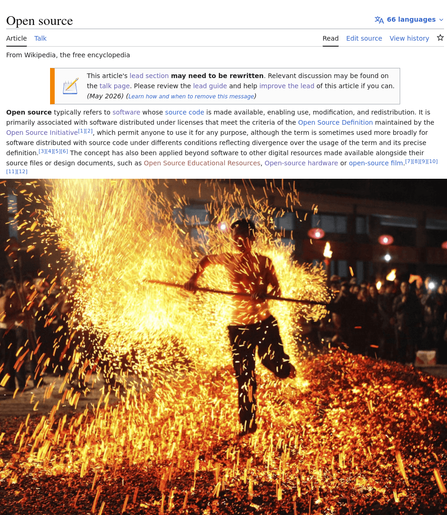
I've just redefined « open source ». By rewriting entirely the firsts introduction sentences of open source in Wikipedia. Following years old complaints from the community regarding the scope and lack of focus of the page.

Page link: https://en.wikipedia.org/wiki/Open_source

Let's see what may survive... I need now to let it stabilize and see where community debates may lead.

Tried to do my best to introduce this complex, conflictual and evolutive notion. It is far from a trivial task where every word must be carefully considered and will be scrutinised.

There are multiple layers to take care about:
1/ Open source as a practice of making source code available
2/ One dominant view based on the Open Source Definition, but other conflictual usages of the term
3/ An expansion of the concept beyond software (source files/design documents)
4/ (Open) collaborative practices implicitly associated (not considered for now, I leave it to the old confusing content)

I started with the core and most common understanding, based on the Open Source Definition and Open Source Initiative interpretation.

Then I introduce the controversy within the software community to encompass the different points of view and interpretations. This is about neutrality regarding terminology usage (and I think this "neutrality" requirement may be a precious help to resist OSD/OSI proponents).

OSD/OSI was not clearly present before; I wish that shedding light on them may contribute to deconstruct their position overtime.

The open source page covers already various applications of open source terminology, therefore I explain how it extends beyond software.

« Open source » is a very politically charged term. I expect debate, disagreement and potentially conflicts to improve it. I hope it will be a powerful basis to enable discussions to bring creative destruction.

This is a fluid terminology and Wikipedia is, in a way, conservative. I hope this lays a solid foundation for supporting this semantic evolution.

I'm wondering if Wikipedia may be one of the best places to debate over the meaning of « open source ». « Open source » is commonly referred as software but is not about software, so here we are 🤷

Work related to the citizen research « Open Source 2.0 : From Open Source Software to Open Source Resources? » : https://doi.org/10.5281/zenodo.20237079

#OpenModels #OpenScience #OpenEducation #OpenSource #DigitalCommons #OpenData #OpenStandard #DigitalLiteracy #wikipedia
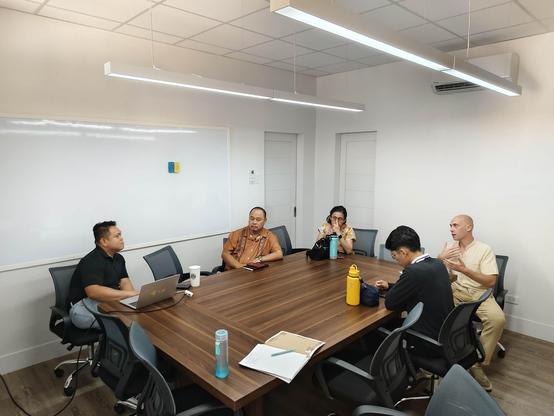
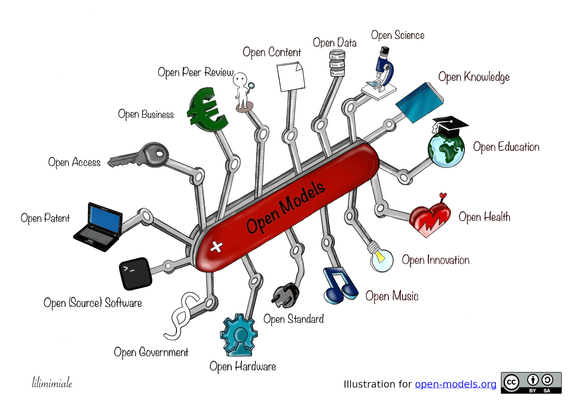
Had an intervention last week to introduce open models and digital commons at the @University of San Carlos (Cebu City, Philippines) with the team of their Tech Hub. And because why not, I came also with a curious friend/student from @University of Cebu!

Some outcomes: an invitation for a potential intervention for students during their summer school, and suggested them to provide training for the librarians and IT department to enable a stronger appropriation of this complex knowledge.

This builds on earlier work with Inabanga College of Arts & Sciences in Bohol done in collaboration with @cvisnet. Based on their interests regarding open models education, currently trying to open the discussion with the @Department of Science and Technology (Philippines) to find support and then imagine reaching other institutions in the region on these grounds.

These topics remain quite new in the country, in Asia, spreading some knowledge to help people grasp and embrace these fundamental dynamics of our digital world.

If you're part of an organization working around research and education, wishing to contribute to build a robust digital literacy around these emerging challenges which are shaping the modern scientific and education revolution (at very least), I'm genuinely open to discuss potential collaboration to help you better master these open practices.

A digital nomad who tries to act local while thinking global, wanting to contribute to change in the world 🌏

Knowledge base on Open Models: https://open-models.org
To organize an online meeting: https://cal.com/open-models

#OpenModels #OpenScience #OpenEducation #OpenSource #DigitalCommons #OpenData #OpenStandard #DigitalLiteracy #Philippines

We are happy to announce a new extension mechanism in the GCVE vulnerability format, starting with a very practical and timely one: AI-assisted vulnerability information annotations.

The first extension, GCVE BCP-05-X-01, defines how GCVE records can describe when AI or automated processing was used to create, enrich, summarize, classify, or analyze vulnerability information.

#ai #ia #gcve #vulnerabilitymanagement #vulnerability #opensource #openstandard

🔗 https://gcve.eu/bcp/extension/gcve-bcp-05-x-01/

GCVE BCP-05-X-01 - AI-Assisted Vulnerability Information Annotation

An extension to GCVE BCP-05 to support the annotation of vulnerability records where Artificial Intelligence (AI) or automated processing has been used during their creation, enrichment, or analysis.

🔒 New release: “Internet.nl now tests on the latest @NCSC_NL TLS guidelines”
➡️ https://en.internet.nl/article/release-1.11/
❓ Are your web and mailservers ready for future-proof TLS?
🌐 Keeping your configuration up-to-date makes the internet more secure.
🚀 Have fun testing and improving if needed!

#TLS #security #openstandard

This week I ended up the 5 article series about #SWHID, the intrinsic, persistent and standardised software artifacts identifier.

Check them out:

1. What is the Best Way to Identify Software? Introducing SWHID https://toscalix.com/2026/03/10/what-is-the-best-way-to-identify-software-introducing-swhid/

2. Description of SWHID: Syntax. https://toscalix.com/2026/03/17/description-of-swhid-syntax/

3. SWHID Is An #OpenStandard, Governed Under #OpenGovernance. https://toscalix.com/2026/03/24/swhid-is-an-open-standard-governed-under-open-governance/

4. SWHID and #pURL. https://toscalix.com/2026/03/31/swhid-and-purl/

5. SWHID in Practice: https://toscalix.com/2026/04/07/swhid-in-practice-sbom-verification-cra-compliance-and-traceability-use-cases/

What is the best way to identify software? Introducing SWHID

Modern software is assembled from hundreds of components that organizations often did not write and do not fully control. Identifying those components reliably is becoming a legal requirement. This…

toscalix

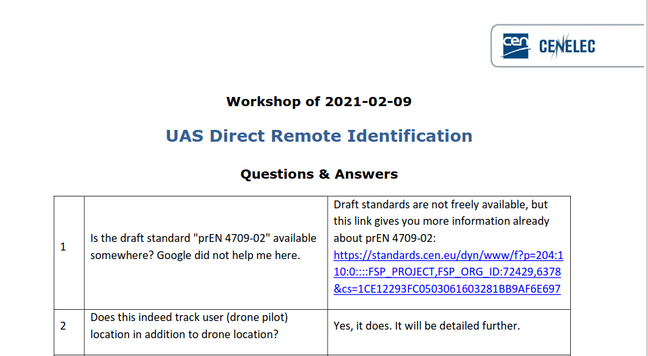
Once again, an important standard is behind a paywall: prEN 4709-02 from CENELEC. It matters for both security and safety, and could benefit everyone, yet access remains restricted.

@EUCommission do you plan to force CENELEC to publish and release publicly the standards?

#cenelec #paywall #drone #standard #openstandard

I just published The Open Contributions Descriptor format as an IETF Internet-Draft.

#opensource #opendata #openstandard

https://datatracker.ietf.org/doc/draft-dulaunoy-open-contributions-descriptor/

The Open Contributions Descriptor

This document defines the Open Contributions Descriptor (OCD), a JSON format for publishing machine-readable metadata about an organization's participation in the open ecosystem. OCD allows organizations to publish a single discovery document describing open source projects, open data publications, open standards participation, contact information, governance material, and declared relationships to external organizations and projects. OCD is intended to be published at a predictable well-known location to support automated discovery, indexing, and ecosystem analysis.

IETF Datatracker

GitAgent – An open standard that turns any Git repo into an AI agent

https://www.gitagent.sh/

#HackerNews #GitAgent #AI #GitRepo #OpenStandard #TechnologyInnovation

GitAgent — The Open Standard for Git-Native AI Agents

Define, version, and run AI agents natively in git. GitAgent is the open AI agent standard — framework-agnostic, works with Claude, OpenAI, CrewAI, Lyzr, and more.

GitAgent