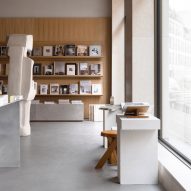
Norm Architects designs spa-like dental clinic interior modelled on art galleries

Warm oak and smooth concrete are among the materials that Danish studio Norm Architects used to create the interiors for this Antwerp dental surgery, which aims to defy traditional, more clinical designs.

The clinic, called Dentology+, is spread over a cavernous basement area and a ground-floor level. Both have been clad in a neutral material palette that was designed to evoke a sense of calm.

The dental clinic was designed to defy traditional medical interiors

The private dental clinic's basement is made up of a set of dusty grey corridors, which Copenhagen-based Norm Architects designed to make it look as if the rooms were carved from a block of concrete.

These concrete volumes are interrupted only by carefully selected minimal design elements such as geometric alcoves, pared-back black pendant lights and an earthy-hued circular artwork by Sara Martinsen.

A cavernous basement area defines half the surgery

A low-slung sofa finished in a light-coloured textile also features in the basement, which was designed by Norm Architects' longtime collaborator Keiji Ashizawa for Japanese brand Ariake.

"The need to dwell and retreat to intimate nooks is a basic human requirement that we cannot dismiss when shaping living spaces," Norm Architects co-founder Jonas Bjerre-Poulsen told Dezeen.

Circular artwork by Sara Martinsen hangs above a low-slung sofa

Dentology+'s upper level was designed to be brighter and airier than its basement, while maintaining the clinic's overall neutral theme.

Cubes of light oak create walls and doors that are interspersed with objects including a pebble-like vase on a plinth, in an interior design that takes cues from the interiors of an art gallery.

Translucent curtains line the windows of the operating rooms.

[

Read:

i29 creates colour-block interiors for Amsterdam dental clinic

](https://www.dezeen.com/2021/12/27/dentista-dentist-amsterdam-i29/)

The choice to design Dentology+'s interior using materials that might be considered unusual for medical spaces was made in an attempt to enhance patients' wellbeing, according to architect Sofie Thorning.

"In many ways, we looked more to beautiful spa resorts than classic white dental clinics for inspiration," she told Dezeen.

Operating rooms exist within light oak walls

"Material translucency and soft, warm light paired with carefully considered, crafted materials work to reshape the patient experience and perception," she added. "The space is nothing like an ordinary dental clinic."

"What we surround ourselves with simply has a great impact on our mood and behaviour, which is why working with natural materials in architecture and design is a simple way to enrich our surroundings and enhance our quality of life," added Bjerre-Poulsen.

Afteroom chairs by Menuspace feature on the upper level

Founded in 2008, Norm Architects is a multidisciplinary design studio based in Copenhagen. Other projects by the practice that celebrate neutral and calming interiors include a minimal Chinese tea parlour and a jewellery store in Copenhagen informed by modernist artists' studios.

The photography is byJonas Bjerre-Poulsen.

Project credits:

**Architect & Partner: **Sofie Thorning
Architect: Qing Ye
Client: Dentology+

The post Norm Architects designs spa-like dental clinic interior modelled on art galleries appeared first on Dezeen.

#medical #all #interiors #oak #concrete #belgium #antwerp #normarchitects #health #minimalistinteriordesign

Norm Architects frames countryside views at Suffolk holiday home

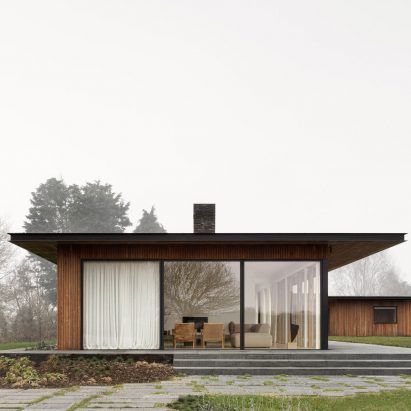
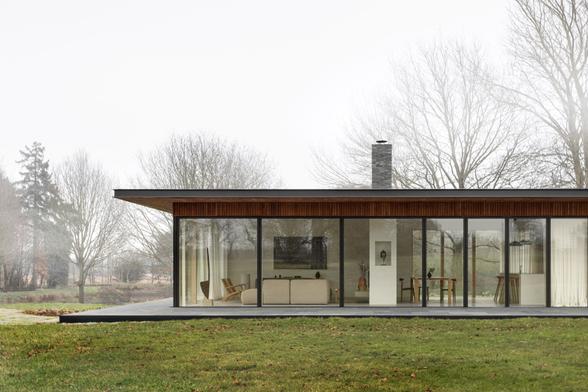
A deliberately simple steel-framed form with almost entirely glazed walls defines this holiday home, designed by Danish studio Norm Architects to frame views of its rural setting in Suffolk, UK.

The dwelling, called Pavilion House, comprises a main building and studio annexe alongside an existing barn.

Norm Architects has created a rural holiday home in Suffolk

Norm Architects took an approach of "tranquillity and simplicity" in its design, ensuring the home does not distract from its natural surroundings and complements existing structures on site.

"There is a certain humility within the architecture, acknowledging that the big-ticket item in the setting is indeed the countryside," the studio explained.

The low-lying house sits on a basalt plinth

"The design of the house is all about transparency; nature becomes an integral part of the interior," Norm Architects continued. "It doesn't try to compete with it, but frames it instead."

The long, thin form of the Pavilion House sits on a podium made of dark basalt, which also doubles as a terrace around the building.

Larch cladding has been used on the exterior

"A pavilion house of this length, surrounded by an imposing countryside, needs to stand proud and so we introduced a dark basalt podium as the foundation of the house," said the studio.

This podium is sheltered under the large overhang of the home's flat roof that features a dark steel fascia and a stone chimney.

The home is designed to frame views of its surroundings

Vertical planks of local larch wood clad the exterior, broken up by the large expanses of glazing in the living, dining and kitchen area and the bedroom block at the other end of the house.

Inside, the main living area is open in plan and organised around a central brick core that incorporates a wood-burning stove. This separates the lounge and dining spaces, minimising the need for internal doors and walls.

[

Read:

Swedish forest retreat by Norm Architects is "designed for a simple life"

](https://www.dezeen.com/2022/03/06/forest-retreat-sweden-minimal-interiors-norm-architects/)

"Wherever you find yourself in the house, there's a seamless transition between its different functions," explained Norm Architects.

"Wherever you choose to look out, you'll find yourself fully immersed in the glorious surroundings; the architectural structure never spoils the stunning views," it continued.

The interiors have a pared-back material palette

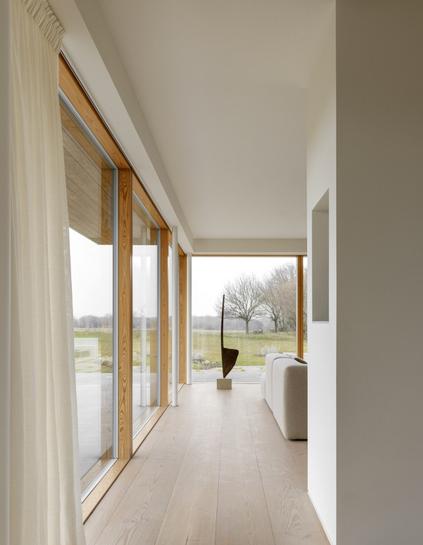
Continuing the theme of simplicity, Norm Architects finished the interiors of Pavilion House with white walls, pale wooden floors, and furnishings in wood and earthy tones.

In the bathrooms, darker colours and finishes such as polished concrete have been chosen to help "create a sense of sanctuary".

Dark tones feature in the bathrooms

In the annexe, which mirrors the appearance of the main home, there is a bedroom and bathroom, alongside a small sauna and spaces for laundry and storage.

The existing barn that previously dominated the site has been reduced in size and now houses a games room. This structure has also been fitted with solar panels and rainwater harvesting facilities to act as an "eco-workhorse" for the dwelling.

An annexe contains a sauna

Norm Architects was founded in 2008 by Kasper Rønn Von Lotzbeck and Jonas Bjerre-Poulsen. It used a similarly pared-back approach in its recent design of a forest retreat in Sweden, which involved the conversion of a traditional timber cabin into a series of light, open living spaces.

Other projects by the studio include a minimal family getaway in Sweden called the Archipelago House and a black-timber Fjord Boat House near the border of Denmark and Germany.

The photography is byJonas Bjerre-Poulsen.

The post Norm Architects frames countryside views at Suffolk holiday home appeared first on Dezeen.

#all #residential #architecture #uk #suffolk #england #houses #holidayhomes #normarchitects #britishhouses

Swedish forest retreat by Norm Architects is "designed for a simple life"

Norm Architects has converted a traditional timber cabin, hidden away amongst pine trees in a forest in Sweden, into a pared-back holiday home for families.

The Copenhagen-based studio took a "back-to-basics" approach when it came to remodelling the two-floor building, which is positioned on top of a ridge.

Norm Architects has converted a traditional cabin into a minimalist holiday home

"Creating homes is often an exercise in restraint," explained Norm Architects co-founder Jonas Bjerre-Poulsen.

"And while the creation of a simple, authentic and welcoming space might seem effortless and natural once completed, the journey to simplicity and the exercise of finding essence is often rather complex and not an easy task."

The ground floor houses an open-plan living and dining area

On the home's ground floor, a cosy sitting room is dressed with a couple of plump greige sofas and a sheepskin-covered lounge chair, created by the practice in collaboration with Danish furniture brand Menu.

One corner of the room is occupied by a wood burner in the same off-white colour as the walls, which were coated in dolomite plaster.

Oakwood was used to craft the flooring and cabinetry

On the other side of the ground floor lies a dining area, anchored by a large timber table. Just behind is the kitchen, housing a series of handleless low-lying cupboards crafted from oakwood.

Oak was also used to form the flooring and all of the doors throughout the cabin, which were designed by Norm Architects to act more like slender cabinet fronts so they don't take up too much space.

The doors are finished with circular brass knobs and extend all the way up to the ceiling, in a bid to make the rooms appear loftier.

[

Read:

Norm Architects conceives Xiamen's Basao tea parlour as an oasis of calm

](https://www.dezeen.com/2022/02/14/basao-teahouse-interiors-china-norm-architects/)

A number of new windows were inserted into the cabin's facade to allow more natural light into the interiors and reveal views of the towering pine trees outdoors.

Distributed across the rest of the holiday cabin are enough bedrooms and wash facilities to accommodate two families, as well as a small sauna.

Slim oak doors lead through to the bedrooms

For larger groups, the project also saw Norm Architects build a new self-contained annexe that can house a third family.

Here, a raised daybed-cum-window seat was set up directly next to a vast wall of glazing, providing occupants with a place to recline and take in the scenery.

"Designed for a simple life during both summer and winter months, the cabin is rustic yet refined, only equipped with the necessities when opting for a slow living," the studio said.

A large window with an integrated daybed provides views of the forest

Sweden's lush natural landscape makes it a popular location for holiday homes.

Dezeen has previously featured a number of other cabins in the country including Sommarhus T by Johan Sundberg, which takes cues from traditional Japanese architecture, and a seaside villa by Studio Holmber with serene plywood-lined living spaces.

The photography is by Jonas Bjerre-Poulsen of Norm Architects.

The post Swedish forest retreat by Norm Architects is "designed for a simple life" appeared first on Dezeen.

#all #interiors #residential #sweden #holidayhomes #normarchitects #cabins #minimalistinteriordesign

Norm Architects conceives Xiamen's Basao tea parlour as an oasis of calm

Danish practice Norm Architects has created an understated interior for the Basao teahouse in Xiamen that was designed to offer a "clear antidote" to the hustle and bustle of the Chinese port city.

Basao takes its name from Baisao, a Japanese monk who lived during the Edo period and spent the latter part of his life wandering around Kyoto and selling tea.

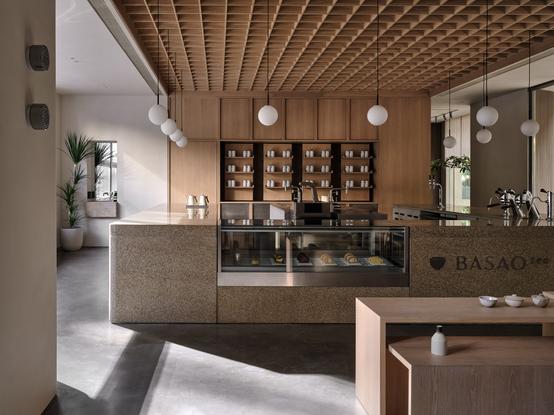
The Basao tea lounge is arranged around a Chinese stone counter

His Zen Buddhist writings were a key reference point for Norm Architects in the design for the "tea lounge", which is meant to evoke a sense of tranquillity.

"With room for quiet contemplation, the space is a clear antidote to our fast-paced on-the-go culture, instead immersing its visitors in the calming sounds of tea being prepared, poured and enjoyed," the studio said.

Seating around the counter provides views of the brewing process

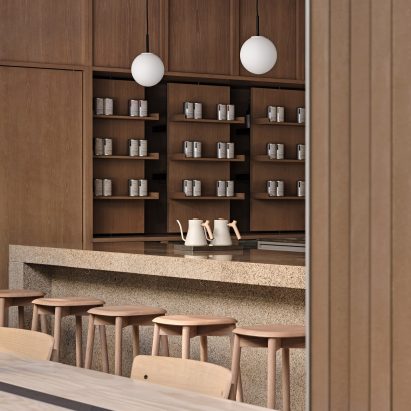
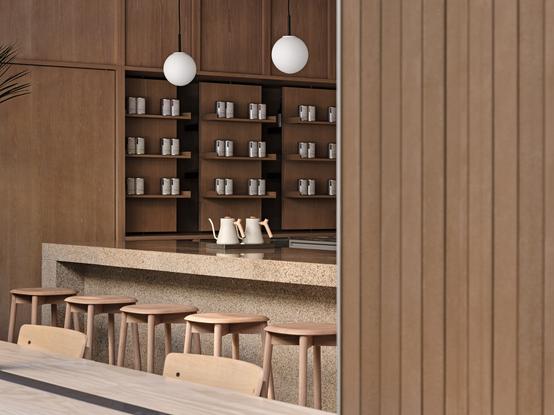
At the heart of the store is a chunky counter crafted from speckled Chinese stone that is positioned beneath a coffered oak ceiling.

Here, customers can order drinks and observe them being prepared from a couple of high stools.

A wider variety of seating is assembled on one side of the room, incorporating different tactilities and shapes from suede poufs to wooden benches and a long banquette upholstered in chestnut-brown leather.

More seating lies at the room's periphery

"Carefully considering the sense of touch, the experience of the space becomes an interplay of textures and temperatures in combination with contrasting polished and raw surfaces," Norm Architects explained.

To the other side of the lounge is a retail space, where Basao merchandise is showcased on black steel shelves.

[

Read:

Norm Architects designs New Mags bookstore in Copenhagen to reference old libraries

](https://www.dezeen.com/2021/10/19/norm-architects-new-mags-bookstore-copenhagen/)

More products can be presented on slim metal ledges and pivoting displays built into the tea parlour's oak-panelled walls.

Oakwood also covers the building's facade, which was modified so that its walls are sloped invitingly towards the entrance.

Black steel shelves display Basao's products in the retail space

The facade is punctuated by huge windows that can be pushed up concertina-style to let fresh air and natural light into the interior.

Alternatively, customers have the option of sitting outdoors on the terrace, which is decorated with a number of leafy plants.

A large window allows the tea parlour's interior to be opened up to the outdoors

Basao is Norm Architects' first project in China.

The Copenhagen-based practise has recently completed a number of interiors in its hometown including Notabene, a shoe store with warm industrial interiors, and a bookstore that takes design cues from old-school libraries.

The photography is byJonathan Leijonhufvud.

The post Norm Architects conceives Xiamen's Basao tea parlour as an oasis of calm appeared first on Dezeen.

#restaurantsandbars #all #interiors #china #teahouses #normarchitects #hospitalitydesign #xiamen

Norm Architects fashions industrial yet warm interiors for Notabene flagship in Copenhagen

A harmonious mix of concrete, oakwood and aluminium features in this Copenhagen shoe store, which has been designed by Danish studio Norm Architects.

When it came to devising a fit-out for the Notabene store in Copenhagen's Old Town, Norm Architects worked on fostering "contrast and beauty" between the site's existing industrial features and the warm, tactile material palette that the studio felt was representative of the footwear brand.

The store's main room has exposed concrete walls

Upon entering the store, customers walk into a double-height room with exposed-concrete walls and structural columns.

Natural light pours in from expansive windows that are screened by sheer white curtains.

One side of the room is dominated by a series of slim brushed-aluminum shelves where Notabene presents its shoes.

Items are otherwise displayed on clay plinths, L-shaped slivers of metal or rounded wooden podiums.

One wall features slim aluminium shelves

These podiums, along with the rest of the furnishings in the store, were created by Norm Architects in collaboration with Karimoku Case Study, the sister company of Japanese manufacturer Karimoku.

The company works with different architecture studios to create bespoke collections of furniture for projects, with each project acting as a "case study".

An oak staircase connects the store's three levels

"As this store is meant to be more of a hub for the Notabene brand, it was also important for us to design a range of furniture that meet the real needs and everyday functions for the Notabene team, while also creating a welcoming and comfortable environment for the guests and customers," Frederik Werner, partner at Norm Architects, told Dezeen.

"The expressive raw building structure tells tales of various use over time and is juxtaposed by refined Japanese cabinet making, echoing the refinement and precision of the shoemaking process itself," added Peter Eland, who is also a partner at the studio.

[

Read:

Norm Architects designs New Mags bookstore in Copenhagen to reference old libraries

](https://www.dezeen.com/2021/10/19/norm-architects-new-mags-bookstore-copenhagen/)

Thick slats of oakwood align to form the balustrade of the store's staircase, which takes customers down to a shoeshine bar.

Oakwood was also used to clad the majority of the surfaces at this level to forge a cosier and more intimate ambiance.

Downstairs, the store has an oak-lined shoeshine bar

While customers wait to get their shoes serviced, they can relax in a lounge area that is dressed with a sofa and a couple of curved armchairs upholstered in thick bouclé fabric.

A chunky timber counter where they can order a glass of wine or a hot drink sits adjacent to the lounge furniture, while wall-mounted aluminium shelves showcase various shoe care products.

The retail space includes a relaxing lounge area with bouclé seating

The stairs can be taken up to a final mezzanine level where Notabene has a design lab.

This features a large circular work table and a wooden sideboard topped with a small selection of inspiring design and lifestyle books.

On the mezzanine level is Notabene's design lab

Norm Architects was founded in 2008 by Jonas Bjerre-Poulsen and Kasper Rønn Von Lotzbeck.

As well as Notabene, the studio has completed a few other retail spaces this year – this includes New Mags, a bookstore which takes design cues from traditional libraries, and Dulong, a jewellery showroom that's meant to resemble an artist's studio.

The post Norm Architects fashions industrial yet warm interiors for Notabene flagship in Copenhagen appeared first on Dezeen.

#retail #all #interiors #copenhagen #denmark #normarchitects #shops

Norm Architects fashions industrial yet warm interiors for Notabene flagship

A harmonious mix of concrete, oakwood and aluminium features in Copenhagen's Notabene shoe store, which has been designed by Norm Architects.

Norm Architects designs New Mags bookstore in Copenhagen to reference old libraries

Danish studio Norm Architects has designed a flagship bookstore for distributor New Mags that features stone plinths and pivoting wooden walls.

Norm Architects looked to classic libraries for inspiration for the project, which was commissioned by a Scandinavian distributor of coffee table books.

Wooden shelves and stone plinths are used to display books in the New Mags store

"As inspiration for the project, we looked thoroughly at spaces that are a book-lover's paradise – the library," Norm Architects co-founder Jonas Bjerre-Poulsen told Dezeen.

"We looked at old libraries with large wooden shelving, long study tables and library lamps in old buildings, where beautiful and large volumes were packed in shelves alongside prominent sculptures and ornamental moldings."

The bookshop is located in central Copenhagen

The local architecture studio wanted to transform the "silo-like" interior of the 100 square-metre space, which is set in a newbuild in inner-city Copenhagen, into a more easily manageable space that would also function as an office for New Mags' marketing department.

"The space was relatively small and with its high ceilings, it had an almost silo-like feeling," Bjerre-Poulsen said.

"The space had an irregularity and was quite narrow and deep but had large windows facing the street."

It features concrete floors and walls

"The only thing we had to work with from the existing architecture, was therefore the light golden sandstone used on the facade of the building and the somewhat irregular and fixed layout of the loadbearing concrete walls," he added.

To connect the interior and exterior of the store, Norm Architects designed a cast-concrete floor in the same colour and on the same level as the pavement outside the shop.

The studio also chose marble paint from St Leo to give the walls of the store a warm and tactile "stony" character that references the sandstone facade.

Oak panels give the space an organic feel

Wooden panels in natural oak were used for both the 2.8-metre-high display walls and to divide the store.

"The wooden panels that fold from one end of the space and continue along all the walls do not only make the vertical division that was needed, but it also divides the store space in the depth of the space," Bjerre-Poulsen said.

Sculptures are showcased throughout the store

In one place the panels pivot, opening up to a room that holds two workplaces as well as the store's stock.

This space can be either opened or closed to the public.

[

Read:

Norm Architects bases jewellery store interior on the studios of Picasso and Matisse

](https://www.dezeen.com/2021/01/20/dulong-jewellery-store-norm-architects-interior-copenhagen/)

"The idea is to connect the retail element with the core of the company and make room for occasional drop-down workplaces for New Mags’ employees, for meetings or for customers to sit in peace and flip through a book," Bjerre-Poulsen said.

As well as plenty of wood, Norm Architects also used stone – including a large sculpture by Josephine Winding – to give the space an organic feel.

Pivoting panels open up to a hidden room

"First, it was our contemporary take on some of the reference images we looked at in the design phase from old libraries where you could see sculptures on plinths among the study tables and rows of shelves," Bjerre-Poulsen said of the sculptures.

"Secondly, it was a way to create a welcoming gesture to the space, create a bit of division and variance in heights as well as adding a soft and organic contrast to the straight-lined and architectural elements of the wall shelving, the stone plinths and the beam tables."

The studio looked to old libraries when designing the space

Large stone plinths underneath the wooden shelves are used for additional displays.

Norm Architects also added a long oak study table as a place for customers to read and for displaying books, as well as a brushed aluminium table and a lounge setting with a chair.

A long oak table displays books

"We set out to design a contemporary and more minimalist version [of a library], where all the books could be displayed in different ways in a warm, cosy, and interesting atmosphere," Bjerre-Poulsen explained.

Among the studio's other projects in Copenhagen are a jewellery-store interior based on the studios of Picasso and Magritte and a hotel that doubles as a showroom.

Photography is by Jonas Bjerre-Poulsen and Sandie Lykke Nolsøe.

The post Norm Architects designs New Mags bookstore in Copenhagen to reference old libraries appeared first on Dezeen.

#retail #all #interiors #copenhagen #denmark #normarchitects #bookshops

Norm Architects designs New Mags bookstore to reference old libraries

Danish studio Norm Architects has designed a flagship bookstore for distributor New Mags that features stone plinths and pivoting wooden walls.

Norm Architects designs New Mags bookstore in Copenhagen to reference old libraries

Danish studio Norm Architects has designed a flagship bookstore for distributor New Mags that features stone plinths and pivoting wooden walls.

Norm Architects looked to classic libraries for inspiration for the project, which was commissioned by a Scandinavian distributor of coffee table books.

Wooden shelves and stone plinths are used to display books in the New Mags store

"As inspiration for the project, we looked thoroughly at spaces that are a book-lover's paradise – the library," Norm Architects co-founder Jonas Bjerre-Poulsen told Dezeen.

"We looked at old libraries with large wooden shelving, long study tables and library lamps in old buildings, where beautiful and large volumes were packed in shelves alongside prominent sculptures and ornamental moldings."

The bookshop is located in central Copenhagen

The local architecture studio wanted to transform the "silo-like" interior of the 100 square-metre space, which is set in a newbuild in inner-city Copenhagen, into a more easily manageable space that would also function as an office for New Mags' marketing department.

"The space was relatively small and with its high ceilings, it had an almost silo-like feeling," Bjerre-Poulsen said.

"The space had an irregularity and was quite narrow and deep but had large windows facing the street."

It features concrete floors and walls

"The only thing we had to work with from the existing architecture, was therefore the light golden sandstone used on the facade of the building and the somewhat irregular and fixed layout of the loadbearing concrete walls," he added.

To connect the interior and exterior of the store, Norm Architects designed a cast-concrete floor in the same colour and on the same level as the pavement outside the shop.

The studio also chose marble paint from St Leo to give the walls of the store a warm and tactile "stony" character that references the sandstone facade.

Oak panels give the space an organic feel

Wooden panels in natural oak were used for both the 2.8-metre-high display walls and to divide the store.

"The wooden panels that fold from one end of the space and continue along all the walls do not only make the vertical division that was needed, but it also divides the store space in the depth of the space," Bjerre-Poulsen said.

Sculptures are showcased throughout the store

In one place the panels pivot, opening up to a room that holds two workplaces as well as the store's stock.

This space can be either opened or closed to the public.

[

Read:

Norm Architects bases jewellery store interior on the studios of Picasso and Matisse

](https://www.dezeen.com/2021/01/20/dulong-jewellery-store-norm-architects-interior-copenhagen/)

"The idea is to connect the retail element with the core of the company and make room for occasional drop-down workplaces for New Mags’ employees, for meetings or for customers to sit in peace and flip through a book," Bjerre-Poulsen said.

As well as plenty of wood, Norm Architects also used stone – including a large sculpture by Josephine Winding – to give the space an organic feel.

Pivoting panels open up to a hidden room

"First, it was our contemporary take on some of the reference images we looked at in the design phase from old libraries where you could see sculptures on plinths among the study tables and rows of shelves," Bjerre-Poulsen said of the sculptures.

"Secondly, it was a way to create a welcoming gesture to the space, create a bit of division and variance in heights as well as adding a soft and organic contrast to the straight-lined and architectural elements of the wall shelving, the stone plinths and the beam tables."

The studio looked to old libraries when designing the space

Large stone plinths underneath the wooden shelves are used for additional displays.

Norm Architects also added a long oak study table as a place for customers to read and for displaying books, as well as a brushed aluminium table and a lounge setting with a chair.

A long oak table displays books

"We set out to design a contemporary and more minimalist version [of a library], where all the books could be displayed in different ways in a warm, cosy, and interesting atmosphere," Bjerre-Poulsen explained.

Among the studio's other projects in Copenhagen are a jewellery-store interior based on the studios of Picasso and Magritte and a hotel that doubles as a showroom.

Photography is by Jonas Bjerre-Poulsen and Sandie Lykke Nolsøe.

The post Norm Architects designs New Mags bookstore in Copenhagen to reference old libraries appeared first on Dezeen.

#retail #all #interiors #copenhagen #denmark #normarchitects #bookshops

Norm Architects designs New Mags bookstore to reference old libraries

Danish studio Norm Architects has designed a flagship bookstore for distributor New Mags that features stone plinths and pivoting wooden walls.

Azabu Residence in Tokyo references mid-century American design and Brazilian modernism

Danish firm Norm Architects and Japanese studio Keiji Ashizawa Design have designed a mid-century modern-informed interior for Azabu Residence in Tokyo using muted dark tones and warm natural materials.

The two studios also designed bespoke furniture for the apartment, which is located in a building from 1988 that sits on a green plot on a hill in Tokyo.

The apartment is located on a hill in Tokyo

Playing with texture and materials, Norm Architects and Keiji Ashizawa Design chose stone, dark wood and tactile textiles for the interior.

"This project has been inspired from the interior design of mid-century American and Brazilian modernist uses of warm dark natural materials and wooden wall panelling, lush carpets and tactile upholstery," Keiji Ashizawa told Dezeen.

"Another main narrative is inspired by the well-known Japanese book by Jun’ichirō Tanizaki, 'In Praise of Shadows'."

It features custom-made furniture, including a dining table

The three-bedroom house measures 238 square metres and includes a living room, a dining area and an entrance space. Norm Architects and Ashizawa clad many of its floors and walls in dark wood, creating a cosy, cave-like feel.

"The Azabu Residence Project is completed in muted, dark tones enhancing and embracing the intimacy of shadows," Norm Architects partner Fredrik Werner told Dezeen.

"The spacious but dimly lit apartment is a cosy, human-centric and protective dwelling away from the noise of the city. A calm and embracing interior for contemplation and private family life."

Stone flooring was used for the entrance

The original interior had a "dim and calming" entrance area that welcomed visitors into the home.

This informed the revamp of the rest of the space, as the architects chose the materials for the interior with the aim of creating this same atmosphere throughout.

"We've chosen stone flooring for the entrance, natural oak flooring with iron-reaction dyeing in the living and dining space, and plaster for the walls, accented by wooden panels specially supplied by Karimoku for this project," Ashizawa said.

A breakfast bar adds seating in the kitchen

In the combined kitchen and dining room, an oak table and a bench in the same material were specially designed for the space by Keiji Ashizawa Design together with Japanese brand Karimoku.

These are complemented by a beige breakfast bar and a built-in kitchen in dark wood.

The armless beige sofa was custom-made for the living room

For Azabu Residence's living room, Norm Architects and Karimoku designed an armless modular sofa with a simple geometric shape.

The Danish studio also designed a shelf for the room that was informed by the "pattern of supporting columns in architecture." A low glass table and collection of abstract sculptures add a gallery-like feel to the space.

Dark panelling made from smoked oak clads the walls in the main bedroom, which also features open storage cabinets made from the same wood. The bed sits on a wooden plinth that extends from the wall and also functions as a low shelf.

A wall shelf has a shape that was informed by architecture

Though the interior's simple design and the abundance of wood evokes both Scandinavian and Japanese interiors, the American influence shows in the layout and the materials used.

"The Azabu project was designed shortly after a trip to the Americas and the inspiration of mid-century American and Brazilian modernism is evident in the use of stone, dark wood and textured textiles," Werner explained.

"The living areas with a small bar niche, the open plan kitchen, lush carpets and bulky comfortable furniture draws inspiration from an array of elements – from the Japanese-inspired Schindler House in Los Angeles to the extravagant New York apartments featured in the series Mad Men," he added.

Azabu Residence is one in a series of Karimoku Case Study interiors designed by Norm Architects and Keiji Ashizawa Design with Karimoku. The studies have previously worked together on three other case studies, including the pine-clad Archipelago House on Sweden's west coast, which was a lighter and more open space.

Dark wood storage spaces sit by the entrance to the bedroom

"Like most other architects we work with the idea of Genius Loci – the spirit of the site," Norm Architects architect and partner Jonas Bjerre-Poulsen said.

"It is all about understanding the site-specific values of a certain site and creating spaces that will fit the location and the narrative or atmosphere you want to create in a certain location. In this case the site dictated a material palette that was different from the previous projects for Karimoku Case Study."

Natural materials were used throughout the space

The natural light of the building also helped inform the interior design for Azabu Residence.

"Regardless of the dark tones used to unify the space, the beauty of this home stands out in the morning and early afternoon, with the contrast of direct sunlight peeking into the space, and at night, when the ambiance of the space is created by an elaborate artificial light scheme," Ashizawa said.

Previous Karimoku Case Studies by Norm Architects and Keiji Ashizawa Design also include the Kinuta Terrace apartment block in Tokyo and the Blue Bottle Coffee cafe in Yokohama.

Photography is by Karimoku Case Study.

The post Azabu Residence in Tokyo references mid-century American design and Brazilian modernism appeared first on Dezeen.

#all #interiors #residential #instagram #japan #tokyo #keijiashizawa #normarchitects #karimoku

Azabu Residence in Tokyo references mid-century modern design

Norm Architects and Keiji Ashizawa Design designed the mid-century modern-informed interior by using muted dark tones and warm natural materials.

Hashira lanterns by Norm Architects for Menu

Dezeen Showroom: Norm Architects has designed a collection of lighting for Danish brand Menu that offers a "Nordic take on the traditional Japanese rice paper lantern".

Called Hashira, the range includes a floor, table and pendant lamp, each enveloped by a translucent rice paper shade that creates a soft, diffused light.

The Hashira collection includes a floor lamp (top) and a table lamp (above)

According to Menu, Hashira's simple, geometric shapes represent "a modern, Nordic take on the traditional Japanese rice paper lantern".

"Spreading ambient light in a room, the Hashira collection makes for purposeful lighting above a dining table, in a reception area or on a table in a hotel bedroom, bringing a sense of understated luxury and purpose to interior spaces," added Norm Architects.

The design is also available as a pendant light

The collection includes a 49.5-centimetre-tall cylindrical table lamp, a larger 83-centimetre-tall floor lamp and a pendant that consists of a trio of lanterns suspended from a black cord.

Product:Hashira
Designer: Norm Architects
Brand: Menu
Contact:[email protected]

About Dezeen Showroom: Dezeen Showroom offers an affordable space for brands to launch new products and showcase their designers and projects to Dezeen's huge global audience. For more details [email protected].

Dezeen Showroom is an example of partnership content on Dezeen. Find out more about partnership contenthere.

The post Hashira lanterns by Norm Architects for Menu appeared first on Dezeen.

#menu #lighting #tablelamps #all #design #donotshowonthehomepage #dezeenshowroom #lamps #paper #normarchitects

Hashira lanterns by Norm Architects for Menu

Norm Architects has designed a collection of lighting for Danish brand Menu that offers a "Nordic take on the traditional Japanese rice paper lantern".