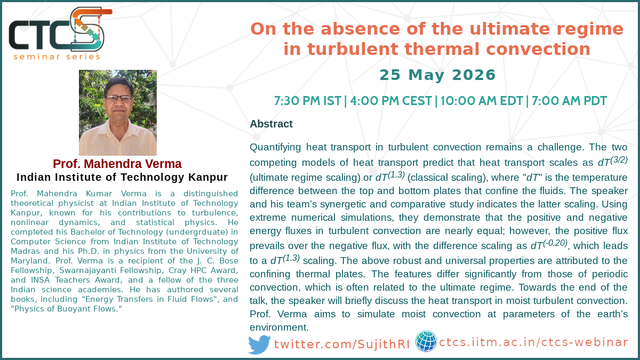
This month, CTCS (IIT Madras) & @PIK_climate present a webinar:
📢: The asymptotic state of decaying turbulence
🎙️: Prof. K. R. Sreenivasan, New York University
📅: March 30 |⏰ 19:30 IST | 16:00 CEST | 10:00 EDT
🔗: https://us06web.zoom.us/webinar/register/WN_0BicRp5MTFqu8Yf3I2jCcQ

#Complexsystems #phd #computationalfluiddynamics #Turbulence #NonlinearDynamics #Bifurcations #NYU #ITCP #PIK #webinarinvite #Zoomcodes #ComplexNetworks #MachineLearning #fluidmechanics

NewModelRelease: Compression–Resonance Thermodynamic Index (CRTI) A bounded dynamic phase framework describing structural overcompression, resonance attenuation,and tipping dynamics in adaptive systems. Zenodo DOI: doi.org/10.5281/zeno... #NonlinearDynamics #ComplexSystems Bernd von Mallinckrodt

Compression–Resonance Thermody...
Compression–Resonance Thermodynamic Index (CRTI): A Bounded Dynamic Phase Model for Structural Over-Compression in Complex Adaptive Systems

This paper introduces the Compression–Resonance Thermodynamic Index (CRTI) as a bounded dynamic phase model for diagnosing structural over-compression in complex adaptive systems (CAS). Moving beyond static efficiency-based indicators, the CRTI formalizes the interaction between Exploitation (E), Exploration (X), and Resonance Integrity (R) within a continuous-time dynamical framework.   The model is defined on a constrained phase space \Omega = [0,1]^3 and specifies coupled differential equations governing the evolution of E, X, and R. A formal bifurcation condition E^* = \beta / \kappa is derived, identifying the critical threshold at which exploration collapses and resonance decays toward a structurally muted attractor. The analysis includes Jacobian-based stability considerations, nullcline geometry in reduced phase space (E–X), hysteresis behavior, and sensitivity to stochastic shocks representing high-frequency environmental disruptions (e.g., technological change).   Unlike descriptive institutional diagnostics, the CRTI framework is explicitly falsifiable. The model specifies observable trajectories that would disconfirm its structural claims, including cases where high exploitation and low exploration coexist with sustained resonance under prolonged external shocks.   An empirical operationalization blueprint is provided, including:   Indicator mapping for E, X, and R Time-series data requirements State-space estimation logic Minimal viable dataset specification Monitoring database architecture for institutional implementation     The CRTI is proposed as a structural early-warning mechanism for detecting systemic brittleness before visible institutional collapse occurs. The framework is applicable across institutional domains (education, healthcare, corporate systems, public administration) and is designed to enable cross-system comparative analysis once calibrated with longitudinal data.   This publication represents a transition from a static compression ratio toward a mathematically bounded, dynamic, and testable phase model suitable for peer-level theoretical evaluation and empirical extension.   Complex Adaptive Systems (CAS) Phase Transition Modeling Structural Brittleness Over-Compression Dynamics Exploitation–Exploration Tradeoff Dynamical Systems Theory Bifurcation Analysis Institutional Resilience Feedback Permeability State-Space Modeling Stochastic Shock Response Organizational Adaptation Systemic Risk Diagnostics Hysteresis in Social Systems Early-Warning Indicators  

Zenodo
In strategic terms: • Exploitation remains strong • Exploration becomes suppressed • Structural memory accumulates rigidity • The ambidextrous equilibrium disappears … Executive summary (strategy focus): doi.org/10.5281/zeno... #Strategy #NonlinearDynamics #Ambidexterity

Collapse through Hyper-Stabili...
Collapse through Hyper-Stability: A Slow–Fast Dynamical Executive Framework for Optimization-Driven Structural Rigidity

Zenodo
Optimization does not always increase resilience. In a slow–fast dynamicalframework, I show how sustained efficiency pressure can eliminate adaptive switching capacity via a fold bifurcation. ExecutiveSummary (Strategic Management focus): doi.org/10.5281/zeno... #Strategy #NonlinearDynamics 🖖

Collapse through Hyper-Stabili...
Collapse through Hyper-Stability: A Slow–Fast Dynamical Executive Framework for Optimization-Driven Structural Rigidity

Zenodo

Watching Waves on the Nanoscale

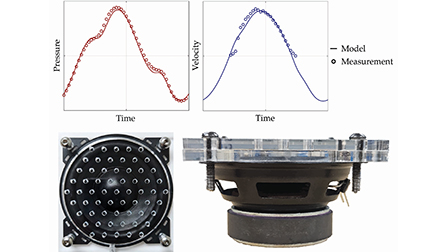
It’s tough to simulate nonlinear wave dynamics, so scientists often test theories in wave flumes, where they can create more controlled waves than what we see in the wild. But conventional wave flumes are big–meters-long, complicated equipment–and can only test a small range of conditions. To reach more extreme nonlinear dynamics, researchers have turned to a chip-based approach. These 100-micron-long wave flumes carry a film of superfluid helium less than 7 nanometers thick. But despite that tiny size, the system can reach levels of nonlinearity five orders of magnitude greater than their full-sized counterparts. (Image and research credit: M. Reeves et al.; via Physics Today)

#fluidDynamics #microfluidics #nonlinearDynamics #physics #science #superfluid #waves

Had a great time with Prof. K. R. Sreenivasan from NYU Tandon School of Engineering, USA. We demonstrated our experiments involving turbulence, observed in lab-scale combustors and cloud chamber. We also presented our results on different systems from engineering and nature, including the similarities between them.

#NYUTandon #IITMadras #ScientificExchange #Turbulence #ComplexSystems #NonlinearDynamics #CriticalTransitions

Had a great time with Prof. K. R. Sreenivasan from NYU Tandon School of Engineering, USA. We demonstrated our experiments involving turbulence, observed in lab-scale combustors and cloud chamber. We also presented our results on different systems from engineering and nature, including the similarities between them.

#NYUTandon #IITMadras #ScientificExchange t #Turbulence #ComplexSystems #NonlinearDynamics #CriticalTransitions