I am really interested in the linked.art initiative, but I’m finding it hard to wrap my head around it. What strikes me as particularly odd:

* The types-of-types pattern, which creates JSON structures that are very unlike usual JSON properties.
* The AATization of everything, including things like language tags, for which perfectly fine native RDF patterns exist.

Has anyone worked with it? Are there good Getting Started guides? #LinkedArt #CulturalHeritage

@acka47 @ink In case, I have written an "extended transcript" or a short paper of my upcoming presentation, available here: https://doi.org/10.48620/92261 #LinkedData #swib25 #iiif #linkedart
Linked Open Usable Data for Cultural Heritage: Community Building and Semantic Interoperability in Practice

This paper presents an extended transcript of a talk given online on 18 November 2025 for the 17th Semantic Web in Libraries Conference (SWIB25). It shares key findings from my PhD thesis on Linked Open Usable Data (LOUD) for cultural heritage. My research examined how LOUD specifications like IIIF APIs and Linked Art fostered collaborative knowledge creation, focusing on implementations in both the Participatory Knowledge Practices in Analogue and Digital Image Archives (PIA) project and Yale's LUX platform. Using a framework based on Actor-Network Theory (ANT), the analysis revealed three critical dimensions. First, sustainable development required continuous engagement beyond implementation, with community-led practices providing the socio-technical foundation for specification maintenance. Second, demographic homogeneity perpetuated biases that marginalised diverse perspectives, requiring the transformation of inclusion frameworks. Third, LOUD improved the discoverability of heritage data while requiring investment in accessibility paradigms that acknowledged technological differences. The research demonstrates that LOUD methodologies foster collaborative knowledge production through community engagement, confront power dynamics in inclusion frameworks, and provide mechanisms for democratising heritage access while accounting for technological disparities.

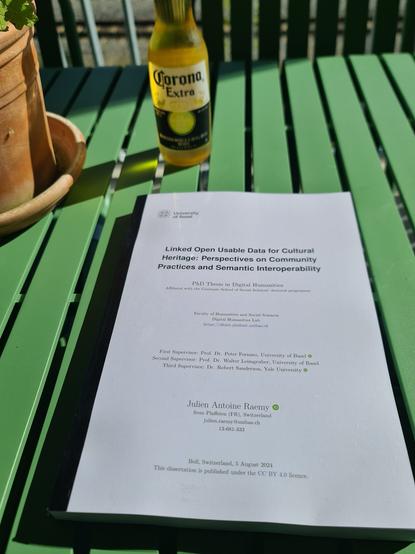
My PhD thesis "Linked Open Usable Data for Cultural Heritage: Perspectives on Community Practices and Semantic Interoperability" is now (finally) available in HTML format: https://phd.julsraemy.ch/thesis.html (not perfect I reckon)

The PDF was published in December 2024 on the University of Basel's repository: https://doi.org/10.5451/unibas-ep96807.

@IIIF
#LinkedData #LOUD #CulturalHeritage #DigitalHumanities #IIIF #LinkedArt #GLAM

Linked Open Usable Data for Cultural Heritage: Perspectives on Community Practices and Semantic Interoperability

Digital technologies have fundamentally transformed how Cultural Heritage (CH) collections are accessed and engaged with. Linked Open Usable Data (LOUD) specifications, including the International Image Interoperability Framework (IIIF) Presentation API 3.0, Linked Art, and the Web Annotation Data Model (WADM), have emerged as web standards to facilitate the description and dissemination of these valuable resources. Despite the widespread adoption of IIIF, implementing LOUD specifications, particularly in combination, remains challenging. This is especially evident in the development and assessment of infrastructures, or sites of assemblage, that support these standards. This research is guided by two perspectives: community practices and semantic interoperability. The first perspective assesses how organizations, individuals, and apparatuses engage with and contribute to the consensus-making processes surrounding LOUD. By examining these practices, the social fabrics of the LOUD ecosystem can be better understood. The second perspective focuses on making data meaningful to machines in a standardized, interoperable manner that promotes the exchange of well-formed information. This research is grounded in the SNSF-funded project, *Participatory Knowledge Practices in Analogue and Digital Image Archives* (PIA) (2021–2025), which aims to develop a citizen science platform for three photographic collections from the Cultural Anthropology Switzerland (CAS) archives. Actor-Network Theory (ANT) forms the theoretical foundation, aiming to describe the collaborative structures of the LOUD ecosystem and emphasize the role of non-human actors. Beyond its implementation within the PIA project, this research includes an analysis of the social dynamics within the IIIF and Linked Art communities and an investigation of Yale's Collections Discovery platform, LUX. The research identifies socio-technical requirements for developing specifications aligned with LOUD principles. It also examines how the implementation of LOUD standards in PIA highlights their potential benefits and limitations in facilitating data reuse and broader participation. Additionally, it explores Yale University's large-scale deployment of LOUD standards, emphasizing the importance of ensuring consistency between Linked Art and IIIF resources within the LUX platform for the CH domain. The core methodology of this thesis is an actor- and practice-centered inquiry, focusing on a detailed examination of specific cosmologies within LOUD-driven communities, PIA, and LUX. This micro-perspective approach provides rich empirical evidence to unravel the intricate web of cultural processes and constellations in these contexts. Key empirical findings indicate that LOUD enhances the discoverability and integration of data in CH, requiring community-driven consensus on model interoperability. However, significant challenges include engaging marginalized groups, sustaining long-term participation, and balancing technological and social factors. Strategic use of technology and the capture of digital materiality are critical, but LOUD also poses challenges related to resource investment, data consistency, and the broader implementation of complex patterns. LOUD should lead efforts to improve the accessibility and usability of CH data. The community-driven methodologies of IIIF and Linked Art inherently foster collaboration and transparency, making these standards essential tools in evolving data management practices. Even for institutions and projects that do not adopt these specifications, the socio-technical practices of LOUD offer vital insights into effective digital stewardship and strategies for community engagement.

@julsraemy @azaroth42 I’m really happy to see #LinkedArt 1.0 released. It’s a good reminder to look at it again more closely. To be honest, in the past I’ve been pretty overwhelmed by its “reverse classification“ approach to basic properties. I still can’t wrap my head around how to integrate the pattern "X classified_as Y classified_as Prop" into my workflow instead of the more familiar "X Prop Y". I guess I’ll have to look at a few more usage examples.

Today marks a major milestone for cultural heritage: Linked Art 1.0 is officially released! 🎉

https://linked.art/about/1.0/

This specification (data model and API) provides museums, libraries, and archives with a standardised way to share and connect their collections data, built on standards.

Proud to see major institutions already adopting Linked Art (Yale, Rijksmuseum, Getty, National Gallery of Art) which makes cultural heritage data more discoverable, accessible, and connected.

#LinkedArt #GLAM #CulturalHeritage #Museums #DigitalHumanities #SemanticWeb #KnowledgeGraphs #LinkedData #LOUD

@azaroth42

Linked Art 1.0 Released - Linked Art

Linked Open Usable Data for Cultural Heritage

Vacancy! The #rijksmuseum is looking for a new Head of Collection IT. Do you dream about museum collection technology, linked open data, and AI to connect people with art and history? Then we would love to hear from you - https://www.rijksmuseum.nl/en/careers/vacancies/head-collection-it--1141840
#musetech #semweb #lod #lodlam #libtech #linkedart #fairglam
Head Collection IT

Rijksmuseum.nl

I am thrilled to share that I successfully defended my PhD, Linked Open Usable Data for Cultural Heritage: Perspectives on Community Practices and Semantic Interoperability, at the University of Basel yesterday! 🎉 The presentation is available here: https://julsraemy.ch/prezi/loud4ch-doctoral-examination.html.

In the coming months, the dissertation will be openly accessible both as a PDF in the university library's repository and on a dedicated website in HTML: https://phd.julsraemy.ch.

A big thank you to everyone who supported me along this journey, especially my supervisors Peter Fornaro, Walter Leimgruber, and @azaroth42

#IIIF #LinkedArt #CulturalHeritage #DH #DigitalHumanities #CIDOCCRM #STS #ANT

Linked Open Usable Data for Cultural Heritage - Doctoral Examination

Presentation given in the context of the doctoral examination on 18 November 2024 at the University of Basel

Feeling a bit envious not being in Amsterdam this week for the #CIDOC2024 conference at the Rijksmuseum. Wishing everyone attending an insightful experience #FOMO #CulturalHeritage #CIDOCCRM #LinkedArt
I have just submitted my PhD Thesis! 🙂 Examination/Defence scheduled on November 18th. #PhDsubmitted #culturalheritage #loud #iiif #LinkedArt #YaleLUX