S.F. Public Library’s main ebook provider to shut down – San Francisco Chronicle

Arts & Entertainment

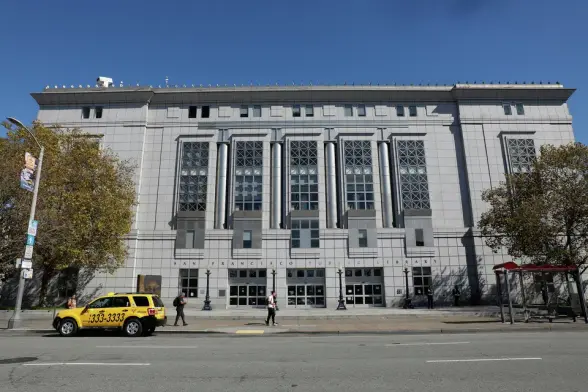
San Francisco Public Library’s main ebook service is suddenly shutting down

By Aidin Vaziri, Staff WriterUpdated Nov 17, 2025 5:50 p.m.

A San Francisco library worker helps a patron navigate digital offerings on November 17, 2021. San Francisco Public Library’s Boundless ebook service will end next month, with titles moving to a different platform. Nick Otto / Special to The Chronicle.

Editor’s note: There is an audio file in the online article, I cannot include here. –DrWeb

San Francisco’s library patrons are about to lose access to one of their most-used ebook platforms — the latest ripple effect of a crisis shaking the library supply industry nationwide.

The San Francisco Public Library announced that Boundless, its largest ebook supplier, will go offline Dec. 8 after its parent company, Baker & Taylor, said it will cease operations at the end of 2025. 

San Francisco Public Library’s Boundless ebook service will end next month, with titles moving to a different platform. Lea Suzuki / S.F. Chronicle

The closure of the nearly 200-year-old distributor has sent libraries across the country scrambling to find new vendors and digital access points for readers.

“Due to the company’s sudden closure, the Boundless platform will end,” the library said in a statement. 

Boundless users will be unable to place new holds after Monday, Nov. 17, and must check out any remaining titles by Nov. 24.

Continue/Read Original Article Here: S.F. Public Library’s main ebook provider to shut down

#200YearOldCompany #bakerTaylor #boundless #ebooks #libraryPatrons #newVendor #platform #providerShutdown #sanFrancisco #sanFranciscoPublicLibrary #uSLibraries

Love, learning, and all the rest: Fictional libraries in “Fruits Basket” and beyond

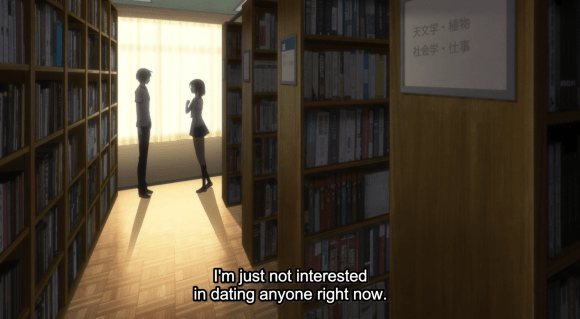
In the third episode of Fruits Basket, an unamed schoolgirl confesses to Yuki in the library and he pushes her off.

Before watching Fruits Basket, an anime which mixes the romantic comedy, slice-of-life, and supernatural genres, I knew there was a librarian character (voiced by Sayumi Watabe). I was not aware, however, that libraries would have an important role in the series, at least in a few episodes. In this post, I’ll examine the scenes in Fruits Basket, and connect it to other posts on this blog.

In the third episode of Fruits Basket, a schoolgirl confesses to Yuki Soma (voiced by Nobunaga Shimazaki) in the library and he pushes her off. She is disappointed, saying he is closed off to most people and asks why he can’t let her in. The truth is that if women hug him, then he turns into an animal, a rat to be specific. The schoolgirl, understandably runs off, sad and likely crying, leaving him standing in the library. As it turns out, Tohru Honda (voiced by Manaka Iwami ), who is living at his house, tells him later that she is happy that he let her in, making him happy. The impact of this library scene is a strong one, even though the scene is pretty short.

In some ways, I can relate this to a few issues of the romantic slice-of-life webcomic, Literary Link. The protagonist, Faye, gets a community service job at the local public library’s literary club, due to a fighter in school, and meets a girl named Atlas. As would be expected, Faye falls in love with Atlas, after she teases her a bit, and agrees to keep volunteering at the literary club. Although Atlas isn’t sure if Faye will return, she does, making her happy, especially when she brings cupcakes, and Atlas bandages Faye up from an earlier fight. [1]

Literary Link and Fruits Basket are relatively different from other depictions of romance within libraries that I’ve noted on this blog. In The Truman Show (1998) and Harold & Kumar Escape from Guantanamo Bay (2008), which I wrote about in the early days of this blog, the libraries play a big role in the stories of each film. In the first film, it is pivotal moment for Truman Burbank, as he meets the woman he loves, Sylvia, and runs out from the library with her to a secluded beach. In the second film, Harold remembers how he met his ex-girlfriend, Vanessa, in the library. Both of them, in line with the fact the film is a stoner comedy, smoke pot in the library, even though it isn’t allowed.

There are many other examples of love, and romance, within libraries, whether Luz’s crush on Amity (which is later canonized) in The Owl House, Sophia beginning to confess her love to Catarina in My Next Life as a Villainess: All Routes Lead to Doom!, an almost-kiss between Shizuma and Nagisa in the Strawberry Panic! episode “Etoile”, and Fumi and Sugimoto kissing in an episode of Whispered Words (“Adolescence is Beautiful”). There are other instances of love being expressed inside of library walls, including a bun-wearing librarian shushing male students who are expressing their romance in the library.

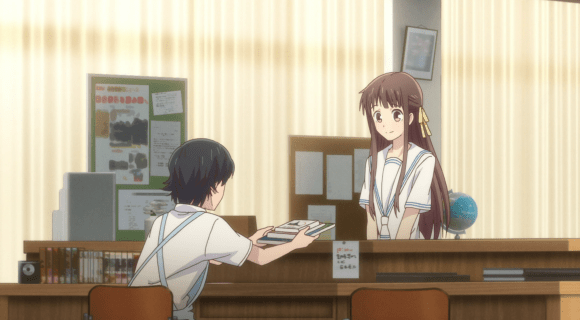
Student librarian checks out materials for Tohru

The second time that libraries appear in the series is a short scene at the end of the fourth episode, when Tohru checks out books from the library about vegetable gardens and martial arts, so she can learn about what Yuki and Kyo like and dislike. She hopes to find “hidden sides” of them. Not long after, she ends up dropping these books, dramatically, when she learns that her Grandpa’s place is now ready for her to move back in. As it turns out, she doesn’t want to go back, but she decides she has to, although she is later saved by Yuki and Kyo in the following episode. This library scene has the first librarian character in the series, the aforementioned librarian voiced by Sayumi Watabe. This librarian is a student library worker. She checks out the books for Tohru.

Such librarians are not unique in anime. I mentioned many of them in my post back in April, including one protagonist, Haruki, in the striking and moving anime film, I Want to Eat Your Pancreas. He ends up helping another protagonist, Sakura Yamauchi, who’s disabled and uses a wheelchair. He becomes her good friend and later her love interest. She works in the library alongside him. This example differs from school-age student librarians, library workers to be precise, who are almost exclusively female, shown in various series. [2]

Some of the more prominent and recurring student librarians include Hisami Hishishii in multiple episodes of R.O.D. the TV, protagonist Hanamaru Kunikida in Love Live! Sunshine!!, Yamada and Kosuda in B Gata H Kei, Azusa Aoi in Whispered Words, Fumi Manjōme in Aoi Hana / Sweet Blue Flowers, Fumio Murakumi in Girl Friend Beta, Himeko Agari in Komi Can’t Communicate, Chiyo Tsukudate in Strawberry Panic!, Sumireko Sanshokunin a.k.a. “Pansy” in Oresuki, and Anne and Grea in Manaria Friends. Of these characters, they are often said to be quiet, shy, hardworking, diligent, lonely, sweet, socially awkward, or introverted. There are exceptions like the lustful and flirtatious Yamada, or Pansy who has strong charisma and observation skills. Many also have yuri subtext integral to their characters either directly or indirectly. [3]

A unique character is Rin Shima in Laid Back-Camp. She fits with the overall theme of iyashikei, a genre of anime which is “healing,” shying away from romance or action in favor of “meaningful connections with family and friends, and finding joy in the minutiae of life,” as Marley Crusch of Polygon put it. Shima is further described by Crusch as a girl who enjoys camping, quiet, reserved personality, and an introvert, although she becomes better at talking with others by the time of the 2nd season. [4]

This differs from more professional, yet unvoiced, ones in episodes of Akebi’s Sailor Uniform, Kin-iro Mosaic, Revolutionary Girl Utena, Maria Watches Over Us, Is the Order a Rabbit, Kubo Won’t Let Me Be Invisible, and The Dangers in My Heart. Kanina Shizuka in Maria Watches Over Usis another example, but she is a supporting character. This connects to what I wrote in August, noting that within workplaces, there are unspoken/spoken “common standards of professional appearance” which penalize those with “tattoos and piercings, connecting with societally-sanctioned standards of appearance, which can be harsher on women.

In anime, all the characters, with stated or presumed professional credentials, in this post would be called librarians and assistant librarians, according to the landmark Library Act in Japan. In any case, one must continually be critical of what Fobazi Ettarh has defined as vocational awe, a set of values, ideas, and assumptions that “librarians have about themselves and the profession that result in beliefs that libraries…are inherently good…sacred, and…beyond critique.” With that, my post comes to a close. Until next week, where my post will examine the profound lack of libraries in Tom Gauld’s Revenge of the Librarians and stronger fictional depictions.

© 2023-2024 Burkely Hermann. All rights reserved.

Notes

[1] “Literary Club” [Issue 1]; Literary Link, May 6, 2023; “What’s her name?” [Issue 2], Literary Link, May 12, 2023; “Ethically Questionable” [Issue 3], Literary Link, May 27, 2023; “Careful with your face” [Issue 4], Literary Link, Jun. 10, 2023; “Overthinking” [Issue 5], Literary Link, Jun. 24, 2023.

[2] I’m referring to, in part, Nagisa Yasaka in My Roommate is a Cat, Nagisa Yasaka (episode: “Ones Who Can’t Be Controlled” and “What Connects Us”), Aoi Uribe in Myself ; Yourself (episode “The Important Melody”), Hasegawa Sumika in Bernard-jou Iwaku a.k.a. Miss Bernard said, Kamiya in Shikimori’s Not Just a Cutie (episode: “Cultural Festival I”), Sumireko Sanshokunin a.k.a. “Pansy” in Oresuki, Anne and Grea in Manaria Friends,  and Female Student B (librarian) in Azumanga Daioh (episode 19 segment “Springtime of Life”).

[3] “Hisami Hishiishii,” Read or Die Wiki, accessed Jul. 4, 2023; “Hanamaru Kunikida,” Love Live Wiki, accessed Jul. 4, 2023; “Yamada,” B Gata H Kei Wiki, accessed Jul. 4, 2023; “Fumio Murakumi,” Yuri Wiki, accessed Jul. 4, 2023; “Agari Himeko,” Komi-San Wiki, accessed Jul. 4, 2023; “Chiyo Tsukudate,” Strawberry Panic! Wiki, accessed Jul. 4, 2023; “Sumireko Sanshokunin,” Oresuki Wiki, accessed Jul. 4, 2023; “Grea,” Yuri Wiki, accessed Jul. 4, 2023; “Anne (Rage of Bagamut),” Yuri Wiki, accessed Jul. 4, 2023.

[4] “Rin Shima,” Yuru Camp Wiki, accessed Jul. 4, 2023.

#AkebiSSailorUniform #AmityBlight #AoiHana #AzumangaDaioh #beautyStandards #ChiyoTsukudate #disabledPatrons #FobaziEttarh #FruitsBasket #groomingStandards #HanamaruKunikida #HaroldAndKumar #HisamiHishishii #IWantToEatYourPancreas #IsTheOrderARabbit #JapaneseLibrarians #JapanesePatrons #JapaneseWomen #KinIroMosaic #KuboWonTLetMeBeInvisible #LaidBackCamp #LesbianLibrarians #LGBTQ #libraryPatrons #libraryWorkers #LiteraryLink #LoveLiveSunshine #MariaWatchesOverUs #MissBernardSaid #MyNextLifeAsAVillainess #MyRoommateIsACat #MyselfYourself #professionals #RevengeOfTheLibrarians #RevolutionaryGirlUtena #ShikimoriSNotJustACutie #StrawberryPanic #students #SweetBlueFlowers #TheDangersInMyHeart #TheOwlHouse #TheTrumanShow #vocationalAwe #WhisperedWords

Josee, a sea of books, and reading to library patrons

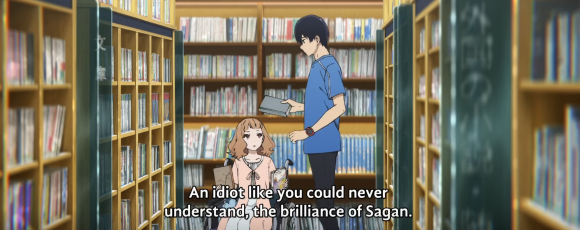
Josee (in the wheelchair) tells her caretaker that he doesn’t know the brilliance of Sagan and implies that he is missing out

When I began watching Josee, the Tiger and the Fish, a 98-minute romantic comedy film, I had no idea how central libraries, and librarians, would be to the story. I knew already that there was a librarian in the film, but I wasn’t sure how vital her role would be the story. In this post, I’ll relate scenes in the film to other fictional examples and other topics.

More than 30 minutes into the film, Josee (voiced by Kaya Kiyohara), a physically disabled girl who uses a wheelchair, goes to the public library with her caretaker, Tsuneo Suzukawa (voiced by Taishi Nakagawa). She is amazed by the sea of books. She finds some books by Françoise Sagan, an author she likes, and the librarian, Kana Kishimoto (voiced by Lynn), happily asks if she is a fan, with Josee quietly admitting what book she likes. Not long after, Kana also asks if Tsuneo is her boyfriend, causing her to blush, as she is embarrassed, as the librarian sees the romantic sparks between Tsuneo and Josee. They check out the books. Interestingly, the librarian, Kana, is 24, just like Jose’s, and they quickly become friends, waving to one another.

Before moving onto the rest of the film, one aspect that struck me was how personable Kana’s character was. Compared to many of the other librarians I have profiled on here, either those of Asian descent, or those with the common hair bun, she is a good representation of a library worker in Osaka. In some ways, I see a parallel to Isomura, a library curator in Let’s Make a Mug Too!, who is just as helpful to the protagonists. The difference is that she is much more than an information provider, but is atypical, in her character type, because she becomes friends with the protagonist and ventures outside the library, making her an important part of the film.

Even positive depictions of librarians are often stuck inside the library and are never shown outside the walls of the institution. Some exceptions include Kaisa in Hilda, many of the student librarians in anime. Whether you see the film as having “little fresh” when it comes to disability, criticize it for being primarily through the perspective of her caretaker, praise it for its perspective on disability, Kana remains a key part of the film, something which reviewers appear to miss, for the most part, except to note that she doesn’t exist in the manga. [1] However, the review in Anime Feminist, by Zeldaru notes that when Josee goes to the library she has the “opportunity to become part of a fully public community” and she is able to see, for the first time, people coming together “with a similar purpose”, resulting in her befriending Kana, allowing her to “pursue her burgeoning interest in art”!

The fact that Kana is welcoming of Josee indicates the openness of the library to all patrons, including those which are physically disabled. Kana also helps Josee realize her feelings for Tsuneo after Josee said that she didn’t need him. She even encourages Josee to read The Little Mermaid to children in the library, but she is nervous, and kids leave. Although the reading doesn’t go well, Kana encourages her to display her art online and she is nervous and embarrassed by that. She later tells Tsuneo about her reading to the children and how she did it badly. She says she wants to try harder and be an illustrator.

There are so many scenes I could have shown here, either one at minutes 40-41, and the key scene beginning at 1 hr 15 minutes, but this seemed like one of the best ones, as in this scene, more than 1 hr and 15 minutes into the film, Kana is helping Josee write a story. Right before this, she brings library books to her, presumably about writing.

This isn’t all that Kana does in the film. She helps Josee work with Kana to write a love story so as to convince Tsuneo to stay with his dream. Not long after, Josee is reading a story to those in the library, which she wrote to cheer up Tseuno. The story is her personal adaptation of a Little Mermaid, which had references to what happened in her relationship with her caretaker. It is something that gets him out of his funk and he claps at the end,after crying during the story. After everyone claps, and blushes at the praise, and smiles. This gives the caretaker the motivation to begin physical therapy so he can walk again. She watches him day after day as he gets better.

Although some have said that this story is “uncomfortably close” to the story where a disabled person teaches an able-bodied person an “important lesson”, I tend to side with what Anime Feminist says about it, that she is trying to inspire Tsuneo “and those around her,” assembling the community she built, even organizing a picture book reading time for her book with help of Kana. This reveals her “devotion to art and to community” and it is a difference between her first reading at the library as Josee is more “confident in her work and herself and everyone is enraptured, highlighting her growth.” [2]

Later on, Tsuneo asks Kana about Josee but she isn’t at the library and hasn’t seen her. They later reunite in the end and kiss. In a scene during the credits, the librarian tearfully embraces Josee. She appears to help her by teaching her computer skills. It is also shown that the book Josee made is used by the librarian to read to children. As a result, Kana has a more fully rounded characterization than is the case for other characters. As the film’s director, Kotaro Tamura, stated, Kana was added to the film to give character development for Josee:

…I figured out the themes that would be appropriate for a feature-length film…I thought that Josee’s only way to connect with society is through Tsuneo. That’s where Josee in this film starts off at as well. But because she starts to go out more because of Tsuneo, she makes a friend named Kana. Though it’s not a huge leap, she’s able to become a bit more sociable.

However, I would argue that Kana is much more of a character than that, through facilitating reading like the librarians in the Witches Crest Library in Somali and the Forest Spirit but not as directly as Amity Blight in The Owl House, to give two examples. As an aside, Kana’s voice actress, Lynn, is very talented, known for leading roles in Keijo!!!!!!!!, Fuuka, Engage Kiss, and Mobile Suit Gundam: The Witch from Mercury, along with other roles in Märchen Mädchen, Ms. Vampire Who Lives in My Neighborhood, Kandagawa Jet Girls, Manaria Friends, The Aquatope on White Sand, and Oshi no Ko, to name a few.

In the future, I would like to compare this film to the original short story by Tanabe or 2003 Japanese live-action film of the same name, noting how libraries are portrayed. With that, this post comes to a close. Until next time. As always, comments are welcome.

© 2023-2024 Burkely Hermann. All rights reserved.

Notes

[1] Osmond, Andrew. “Josee, the Tiger and the Fish fails to make a splash with a rote teen romance,” BFI, Aug. 11, 2021; Clarke, Cath. “Josee, the Tiger and the Fish review – beautiful-looking anime takes a trip to the zoo,” The Guardian, Aug. 12, 2021; Cassidy, Tom. “Josee, the Tiger and the Fish,” Common Sense Media, Jul. 29, 2022; joyousmenma93, “Firechick’s Manga Reviews: Josee, The Tiger, and The Fish,” Livejournal, Sept. 22, 2022.

[2] Zeldaru. “Overcoming Barriers: Mobility limitation; ‘inspirational’ disability; and Josee, the Tiger, and the Fish,” Anime Feminist, Aug. 26, 2022.

#AmityBlight #AnimeFeminist #atypicalLibrarians #disabledPatrons #femaleLibrarians #Hilda #informationProvider #Isomura #JapaneseLibrarians #JoseeTheTigerAndTheFish #Kaisa #LetSMakeAMugToo #LibrariansOfColor #libraryPatrons #MärchenMädchen #MsVampire #reading #SomaliAndTheForestSpirit #students #TheOwlHouse #voiceActors #wheelchairs

Fight for your libraries. Don’t let them take away your library by defunding it out of providing vital services. Don’t let them shackle the library with rules meant to prevent the right people from getting the right book to change their life. Don’t let them close the doors, because you know they will never open again. Fight for the freedom to read and explore new ideas. Fight against censorship and denying people the materials their souls need. If a library closes, it will never open again. You couldn’t create libraries today. You want to loan out books? And people will just willingly give them back? Are you mad? Naïve, perhaps? Once a library closes its doors, it’s over. The book banners have won. Do not let them win. Fight for libraries. Fight for library workers. Fight for patrons. Fight for free people reading freely. #libraries #censorship #librarians #LibraryWorkers #LibraryPatrons #BookBans

The latest thing that has set me off is an email letting me know a hold is ready for pick up. By parsimony I mean that the email seems designed to convey as little information as possible.

More on my sometime blog:

https://lagbolt.wordpress.com/2022/11/15/parsimony-and-opac-design/

#PublicLibraries #LibraryPatrons #Rant

Parsimony and OPAC design

Books and Libraries
The library of the Turtle Princess at the beginning of the Adventure Time episode, “Paper Pete.”

Following in the footsteps of my previous analyses on this blog, I decided to look at a few episodes involving libraries in Adventure Time, an animated fantasy series that ended in September 2018. This is a show that has the library as a recurring location, which is probably why Claire Ruhlin chose it as having one of the 12 best fictional libraries for Paste magazine.

In the episode “The Real You” (S2ep15), Finn and Jake want to impress Princess Bubblegum, and Finn accepts the offer to make a speech at her science event. Jake suggests they go to the place where “knowledge lives”: the library. This library has books almost stacked like bricks in a warehouse. After clearly being bored in the library, Jake suggests they leave, while Finn wants to continue and “cram” the information in a book about pigs. Hilariously, Jake is reading a book about figs. They both start performing a jig and a dance, and the Turtle Princess, who runs the library (and is basically serving as the sole librarian) kicks them out, before which Finn says they were “enthusiastic about learning” which is an utter lie. This whole scene is not even a minute long and we don’t really see much of the library, but it doesn’t look like a grand place like that depicted in various Revolutionary Girl Utena episodes. Even though this show portrays libraries as a boring place you “learn stuff,” there is one similarity: the libraries in both animations are almost deserted.

Some episodes later, in “Paper Pete” (s3ep22) they visit the library once more, with the whole episode focused just on the library. The episode begins with they both carrying a huge book to a table, which is shown at the beginning of this article. The book is a history of rainicorns, with Jake much more into the book and learning about his “heritage,” since his girlfriend is a rainicorn, than Finn. Annoyed with Jake being focused on the books, he begins walking in the stacks, goes through the books by hand, then yells out “Oh no! Damaged books. Who did this?” The Turtle Princess, apparently the only librarian of this library, tells him to “shush,” another librarian stereotype, while other beings, who are patrons, sit at desks behind her. After being shushed once again, he stumbled upon beings known as the “pagelings“:

They end up being the “secret guardians” of the library’s books. When he tries to introduce them to Jake, they hide from everyone, not wanting to reveal themselves. They fight off a bunch of leeches (I think) called “moldos,” obviously connecting to the fact that books can mold, I guess. He eventually throws them on Jake, where they begin eating his fur, but first tries to get them off by hitting them off with a book. He gives up his shirt if they don’t attack the library books, to which the leader of the “moldos,” Mildwin agrees. After leaving the library at the end of the episode, where we see the library looks like, part of which is submerged into the ground, Jake is annoyed by the actions of Finn but admits he wasn’t doing much with the book anyway. He had read the same paragraph over and over for 11 minutes, thinking he should give up in trying to learn rainicorn history, saying he will just fake it going forward. Not sure what lesson we are supposed to take away from this episode, but it’s a fun adventure inside a library.

In later episodes, the library is mentioned, with other characters adding books to it (“Gotcha!”), it is included in a flashback Finn has in the “King Worm” episodes, and the bedroom of the Turtle Princess at the top of the library is shown in “Princess Monster Wife”. All in all, this is ultimately a very positive view of a library, although it competes with the public library in Steven Universe and the family library in She-Ra in the Princess of Power at minimum. Oh, and, after watching some episodes, I came across another library, in the episode “Betty” (s5ep48), where the Ice King becomes human again, looking in his books to figure out who he is, what he needs to do.

That’s all for this post!

© 2020 Burkely Hermann. All rights reserved.

Editor note: This post was originally published on my History Hermann blog but has been re-edited and fixed before being posted on this blog. Enjoy!

https://popculturelibraries.wordpress.com/2020/08/04/what-time-is-it-library-time/

#AdventureTime #books #eating #femaleLibrarians #librarianStereotypes #libraryPatrons #NonHumanLibrarians #reading #research #reviews #shushing #WhitePatrons

Library

The Library is a location in the episodes "The Real You" and "Paper Pete." Finn and Jake first use the Library while searching for knowledge in the episode "The Real You" but are forced to leave when they make too much noise. The Library is run by Turtle Princess. There is a secret area in the Library, which is the Moldos' Secret Lair. In "Gotcha!" Lumpy Space Princess added a book she wrote for Turtle Princess in the Library. Finn is in the Library during his dream in "King Worm" for a short wh

Adventure Time Wiki