Pop Culture Library Review
Recently added titles (March 2025)
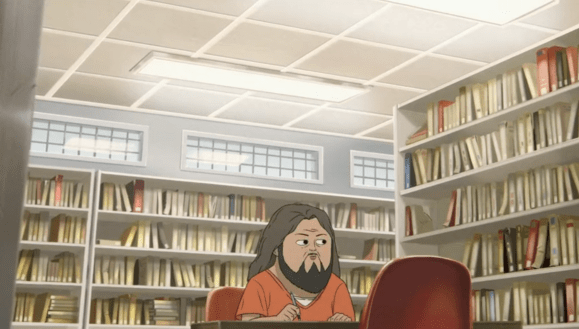
Marshall in the library, in a prison, in the Common Side Effects episode “Blowfish”, which came out this month.Building upon the titles listed for July/August, September, October, November, and December 2021, and January, February, March, April, May, June, July, August, September, October, November, and December of 2022, and January, February, March, April, May, June, July, August, September, October, November, and December of 2023, January, February, March, April, May, June, July, August, September, October, November, and December of 2024, and January and February of this year, this post notes recent titles with libraries or librarians in popular culture which I’ve come across in the past month. Each of these has been watched or read during the past month. No other entries with libraries (or librarians) to add for this past month, but I did come across some in anime, animation, films, and others in webcomics and manga. There may be spoilers for these episodes, so be aware.
Animated series recently added to this page
- Common Side Effects, “Blowfish” (s1 ep 7)
I’ve been watching this series since it came out, but I never expected there to be a library scene. In this scene, Marshall Cuso is in the library, in prison, drawing a diagram of the foot of fellow prisoner Hector, and writing down how he will try to heal it. He meets a fellow mycologist there, who volunteers at the library, and is praises the power of his magic mushrooms. She asks where the fiber is coming from and she becomes his drug dealer in a sense. Later, she gives him a book, in the library, and tells him he will be getting the drug that night, in a move that seems very cloak-and-dagger. Some time later, he thinks of how the blue-angel magic mushrooms are formed by the poop of his tortoise, Socrates, and he takes a drug given to him by the fellow mycologist so he can fake his own death.
I have written about prison libraries before, noting in March 2023, the unnamed prison librarian (voiced by Tress MacNeille) in The Simpsons episode “Dial “N” for Nerder”, when Lisa imagines herself as an older prisoner, with this librarian passing her jail cell with a trolley of books, asking whether she had Joyce Carol Oates. The librarian said she only had Danielle Steel, causing Lisa to scream in terror. At the time I said that that librarian was “perhaps the only prison librarian that I’ve ever seen in animation. Hopefully I see more in the future.” In another post in May 2023, I gave examples of prison libraries and/or prison librarians in various films, noting that such prison librarians, whether in film or TV, are “a mix of exaggeration and accuracy,” that real-life prisons are unlikely to “provide more than what is legally required” in their services, giving access to inmates, while librarians are torn between duties to the latter and their role as “information gatekeepers.” Since then, I’ve noted that libraries are said to be “key tools” for getting people out of prison, especially when it comes to prison libraries (which are little known of in countries such as Portugal), and the partnership between libraries and police departments.
I further stated, in a post in September 2024, that libraries are:
while…libraries can help those who were released from prison “re-enter” society, they serve an “instrumental role” in the criminal system, which…undoubtedly interlocks with oppressive systems…libraries are posed as something to disrupt pipelines to prison, but what if, sometimes, they support those pathways, and push people into prison? After all, libraries, especially in the U.S. South, upheld racial segregation, and denied opportunities for Black people to become librarians, leading to various protests (including sit-ins)….when books are seen as “longer fit for use at public libraries”, they are often sent to prisons or jails as “an act of charity”…arguably, libraries are within structurally racist systems,
Anime series recently added to this page
- From Bureaucrat to Villainess, “Dad Cross-dresses” (s1 ep 10)
- From Bureaucrat to Villainess, “Dad Gets into an Elegant Pickle” (s1 ep 11)
- K-On!, “Planning Discussion” (s2 ep 26 [extra])
- Love Live! Sunshine!!, “The Time Left” (s2 ep 7) [Updated]
- Love Live! Sunshine!!, “Sea of Light” (s2 ep 12) [New!]
- The 100 Girlfriends, “Peekaboy-Meets-Girl” (s2 ep 10)
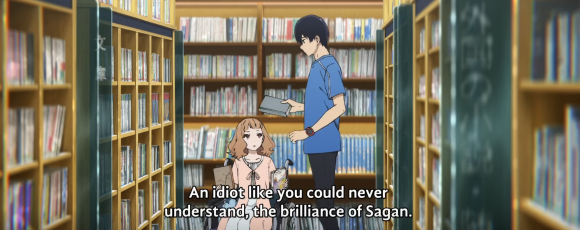
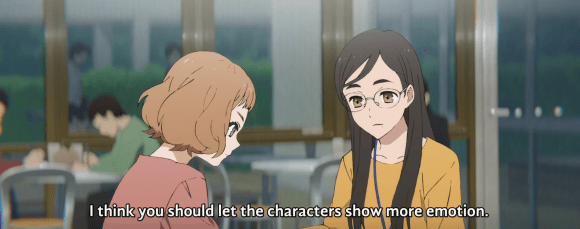
I updated the entry for “The Time Left” when writing my review for this series and added the other at the same time. In the latter episode, Hanamaru reads a book in the library briefly, a small book, and later tells Chika she wants to win, no matter what.
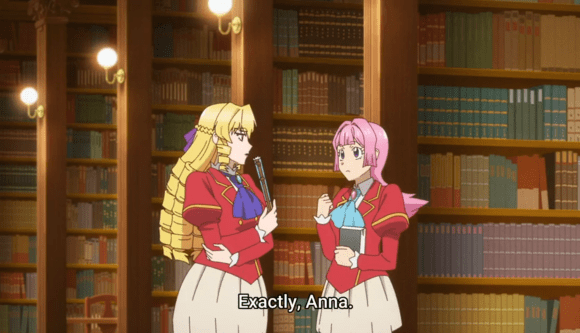
In the above noted episode of From Bureaucrat to Villainess, Grace tells Anna about the rule for the student council: it requires cross-gender casting in plays, meaning that men have to play women, and women have to play men, meaning that both genders have to crossdress, hence the title of the episode. Grace says they can’t ignore the mother because her mother made the rule, as they both talk in the Royal Academy Library, and the children of Grace/Kenzaburo, see the scene play out on their TV, and theorize that they are seeing an actual world which happens to resemble the game, not a game world. Grace worries about some of the boys crossdressing as women, while noting that there is appeal. They later talk to one of the princes, Lucas Vierge, who is on the student council, and Virgile’s younger brother, and also found out about the rule. It is decided that Grace/Kenzaburo will crossdress too, as will Anna, who wants to see Grace/Kenzaburo crossdress as a man.
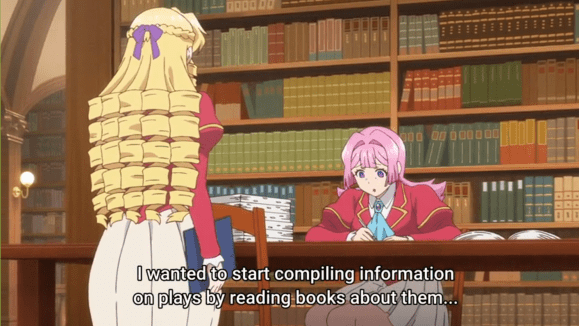
Library scene from the tenth episode of From Bureaucrat to Villainess, with Anna and Grace pictured.In another episode of the above series, episode 11, Grace finds Anna in the school library where she was compiling information on plays from library books, so they she can put together the script for the play they are putting on, and she has been there all day. She ends up being hungry and falls over, making Anna worry like no one’s business. She is later brought to the nurse’s room to rest.
Then in The 100 Girlfriends episode “Peekaboy-Meets-Girl,” Rentaro, Hakare, Karane, Kusuri, and Iku go looking in the a well-maintained, by dark, library storage room for Shizuka, as they continue their hide-and-seek game in the school. They find Nano and Shizuka inside a cardboard box and are overcome by the cuteness.
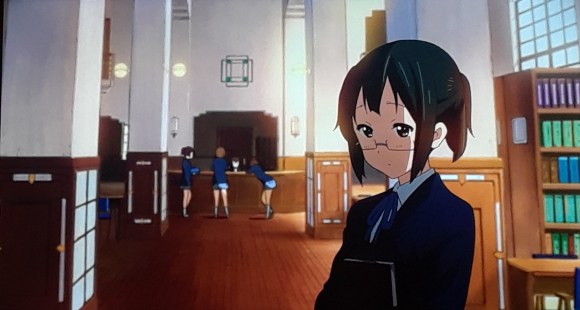
Then there’s an episode of K-On!, which I’m adding as I recently finished watching this series. In one scene of the episode, “Planning Discussion,” specifically in part of a promo video put together for the light music club, a female student blushes, saying she thinks the members of the light music club are “funny people” while she stands in the school library. The library is briefly shown, in this very short scene. However, the library comes up again in the film. Here’s a screenshot of that scene that I took:
Unnamed schoolgirl with glasses shown in the school library in the above mentioned episode of K-On!Previously, I mentioned K-On! in my posting about the fictional libraries and value of studying, which examines many other animated series, noting the only other episode in the series which features a library scene, specifically in the episode “Finals.” In that episode, Yui studies with her friends in the school library for finals. Later, her friend, Azu-nyan, brings her there so she can further focus on studying. A librarian, presumably a student librarian, is shown sitting at the information desk, during the episode.
Comics recently added to this page
- Demon ‘n’ Luv, “We Eat Fish” (ep. 43)
- Vixen: NYC Vol. 2, p. 34-38
The first comic listed here is from a boy’s love webcomic I recently started reading. In this issue, a demon sits in the great library warehouse, is asked about Norway (where he claimed he is from) from Sam, a skeptical friend of Luv, and he clearly shows he has no idea what he is talking about… not one bit. Luc tries to give him some hints to help him talk to Sam. She later asks Luv if he is okay, and he is about to say that demon is a demon, but he is cut off.
As I noted in my post noting the recently added titles last month, only a select number of issues from Vixen: NYC are available on Webtoon. So, I purchased some of the volumes as a result. Volume 2 of this comic contains issues 10-19, and I previously noted how Episode 11 (can no longer be read on Webtoon), has a library scene. I also updated what I originally wrote about the library scene, from:
Vixen talks to a guy she thinks is stalking her, the same one from episode 4, in the library but its actually Beast Boy, who is a member of the Teen Titans.
This entry has now been updated to:
Vixen, stressed from hearing about the release of Kwesi, and insisting she is fine to her parents, studies in the library. She comes across the same person who was seemingly stalking her in the library. He clarifies that he was asking “weird questions” about animals because he is Beast Boy, a member of the Teen Titans. She doesn’t believe him so he transforms into a cat. Their talk, involving Beast Boy suggesting she talk to Batman, is interrupted when he is called off to deal with “hero business.”
Films recently added to this page
- K-On! the Movie
I was actually expecting to have zero entries for this month, but this film proved me wrong. This film branches from the Japanese animated series, K-On!, which focuses on four young high school girls, Yui Hirasawa, Mio Akiyama, Ritsu Tainaka, and Tsumugi Kotobuki who are members of a light music club at their all-girls school, and are later joined by a younger member Azusa Nakano, with all of them hanging out in the club room, either having sweets and tea, or playing music, which they later perform. In the film, the four girls, Yui, Mio, Ritsu, and Tsumugi, who are soon to graduate from their school, go on a graduation trip to London, England, hoping to do sightseeing, including visiting musical sights along the way, like Abbey Road, or the homes of Jimi Hendrix and Jimmy Page, and play two live gigs, while they think of a special song they want to perform for Azusa as a going away present. Early in the film, the school library of their all-girls school, is briefly shown in passing, but later in the film they visit the King’s Library (now called the Enlightenment Gallery) where they see a replica of the Rosetta Stone (the real stone is at the another part of the British Museum under glass), remembering back to when a replica was used when their school put on a performance of Romeo & Juliet, after the gravestone of Juliet went missing.
One of the library scenes in which the girl wants to see then movie (promoting their band) shows, and this is shown early in the film. The other library scene is in Britain.Correction to the above: The Rosetta Stone is at the British Museum, not the British library. However, in the movie it is shown in a library setting, i.e. a library room. As I read more, it was clear that a replica is at the King’s Library of the British Museum, which is exactly what is depicted in the film! The latter is confirmed by the British Museum entry which says a replica is in that library, and without a cast, so people can touch it. The King’s Library is now called Enlightenment Gallery, according to the British Museum.
Other entries recently added to this page
- The Art of Amphibia
I received this in the mail this month. On one page (page 65), about the episode “Trip to the Archives,” which was part 2 of a season one episode (#13), it quotes Amphibia background designer Philip Vose, background designer, saying:
“Growing up, I knew I was never going to be a big-brained intellectual or scholar. But, as it turns out, you can just draw and paint things that make it seem like you are, like this decorative library and classy portrait. Fooled myself even. It’s one of the most satisfying episodes I had the privilege to work on, detailing all the bits that make it feel academically smart and historically interesting.”
While they say all this, the episode still confuses archives for libraries, and this quote doesn’t help matters! I have mentioned Amphibia a bunch of times on this blog, like here and here in 2020, and noted the library scene in “All In,” along with another in the episode “Lost in Newtopia,” with Marcy and King Andreas visiting a library in that episode, and they are in biggest and most comprehensive library in the kingdom, as they go through books, trying to find out more about the music box which brought Marcy, Sasha, and Anne to Amphibia, with this library likely having some form of organization and classification of individuals. As for the scene in “All In,” Marcy, while controlled by the Core and as a part of Darcy (Dark Marcy), she is in a memoryscape of sorts, and is guided to this library. There are at least 11 assistants there. She meets Aldrich, who welcomes her to the Core’s inner sanctum. Marcy wonders where she is, and it all disappears, leading her into a fantasy world which supposedly has everything she ever wanted.
However, I’ve never written about the episode “Trip to the Archives” on here. Rather, I have written about it on my sister blog, where I criticized the depiction of archives in the episode in a post I wrote in 2020, which I stand by. Since then, I mentioned it briefly in posts, like those here, here, here, here, here, here, and here, especially noting the confusion of libraries and archives, and that it could be called a repository, with no archivists shown, even though “someone has to go in there and organize the books, the scrolls, and other artifacts inside,” with it implied that this town archives is abandoned. In fact, an archivist character would have helped the protagonists find what they were looking for and would have saved them a lot of time instead of them searching for it themselves. Furthermore, the archives itself is mired in stereotypes, as it is underground and is described by one character as “dustier than Dusty’s dustbin.”
As Arlene Schmuland notes, many fictional archives are located in basements, accounting for the perception that archives are “dirty and ill-lit,” with the basement locations used “to represent a lack of status on the part of the office or activity located there” and dust is the “most pervasive motif associated with archives, even outside of fiction,” as I noted in a post back in November of last year. In fact, in the episode itself, there’s a sunlight timer which almost traps the protagonists inside, even as it filled with books and some artifacts. At the same time, the archives is unmanaged. As I noted in my interview with Susan Tucker, “writers for pop culture media I’ve come across seem to have little knowledge about how archives function in reality, leading some to falsely think they are the same as libraries.” That is surely the case for this town archives.
The book also shows background art for the episode “True Colors” on page 138, with black-and-white coloring by Joseph McCormick, and color by Amy Huang. However, the art shown for the episode “Lost in Newtopia” does not include anything about the library scene on the pages the art is displayed (pages 111-112). Even so, the library shown in the next-to-last episode of the entire series, “All In” is shown on page 197, with black-and-white coloring by Joe Sparrow, and color by Andy Gardner-Flexner.
© 2024-2025 Burkely Hermann. All rights reserved.
#Amphibia #BlackPatrons #BlackWomen #BritishLibrary #CommonSideEffects #DemonNLuv #drugDealers #drugs #FromBureaucratToVillainess #illicitDrugs #informationProvider #KOn #KOnTheMovie #lists #mushrooms #oppression #prison #protests #RecentlyAddedTitles #RosettaStone #segregation #shortBlogs #TheSimpsons #VixenNYC