 Andy Arthur - Threadinburgh
Pikes, battle rattles and Leith axes: the thread about some Scottish weapons and their role in policing the capital
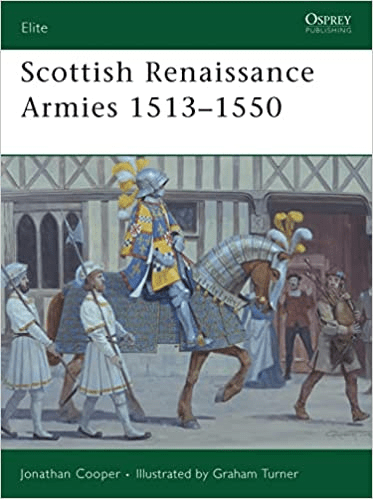
I have a very interesting little Osprey Publishing book by Jonathan Cooper called “Scottish Renaissance Armies, 1513-1550“. It is beautifully illustrated by Graham Turner.
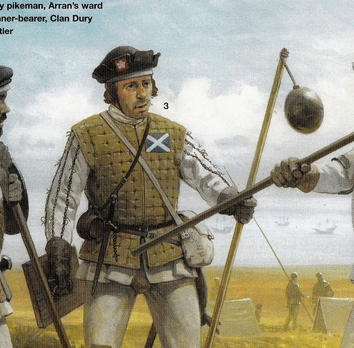
Scottish Renaissance Armies, 1513-1550I had a notion to get my hands on a copy ever since I saw this picture of some of the Scottish troops at the Battle of Pinkie Cleugh in 1547 and the man captioned as a “Rattler“. I had no idea what a Rattler was, but clearly he had brought a piece of wood and a metal balloon on a stick to a gun fight.
“The Rattler”, illustration by Graham Turner.Fortunately this book can reveal all, thanks to the meticulous observations made by an English Officer, William Patten, who was present at the battle and was taking careful notes. What I disparagingly referred to abone as “pieces of wood” were infact… pieces of wood!
They were new boards’ ends cut off being about a foot in breadth and half a yard in length; having on the inside handles made very cunningly of two cord lengths
Patten continues, “These in Gods name were their targets against the shot of our small artillery“. Targets refers to a small shield, as in the Highland Targe, from Old French targa. Patten suggests they were trying to defend themselves from gunfire with these. And as for the “rattle”?
And with these we found great rattles, welling bigger than a belly of a pottle pot covered with old parchment or double paper, small stones put in them to make a noise and set upon a staff more than two ells* long
( * = An ell was a unit of length c. 37 inches long.)
But why carry a child’s toy into battle in the first place? “This was their fine device to frighten our horses, when our horsemen should come at them.” So the rattle isn’t a toy, it’s a cunning 16th century psychological warfare device deployed by the Scots. Except, as Patten continues scathingly,
Howbeit because the riders were no babies nor their horses any colts they could neither duddle the one nor affray the other. So that this policy was as witless as their power forceless
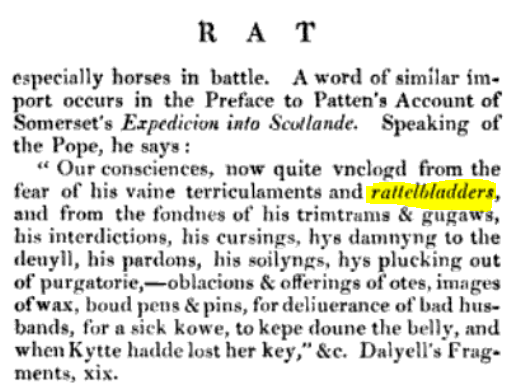
It’s still intriguing; the Scottish army at Pinkie was not that militarily backwards. It was a large and reasonably well equipped force and was used to facing the enemy with proper weapons. And would the noise of a rattle even been audible in the midst of battlefield that included many cannons and handguns? I doubt it. Patten notes that these devices were found in the Scottish camp after the battle, they weren’t recovered from the field. So perhaps it had another use? Maybe it was to create a noise to help encourage the men, or get raw levies used to the din of battle? Perhaps this was just a piece of post-war, anti-Scottish propaganda, as is very common in battle reports. As the saying goes “history is written by the victors“. He also refers to the “[Pope’s] rattelbladders” (thank you to Michael W. Pearce for this observation) and the “Etymological Dictionary of the Scottish Language” suggests that this is the root of an old term Rattlebag, for one who “bustles from place to place, exciting alarm on what account soever“
The Etymological Dictionary of the Scottish LanguageThe artist’s notes by Graham Turner for the image describe that the Rattler is “assessing his chances should be be asked to carry these items in combat” and it’s “little wonder” they were left behind in the camp. He’s basically doing a 16th century version of “Aye, Right“. Instead of rattles, the principal weapon of the Scots at Pinkie was the pike, as it had been for some 250 years.
The Scottish pike formations begin to break under English attacks at Pinkie in 1547. Contemporary print. CC-BY-SA National Galleries Scotland.Scottish pike formations loyal to the Confederate Lords at Carberry, 1567. Engraved from a contemporary painting by George Vertue, 1742While tactics had changed they still required at the most basic level a long, stout pole (mandated by the Scottish Parliament to be 5 to 6 ells – or 15.5-18.5 feet – long). These were made from ash wood and imported from the continent as Scottish trees could no longer supply them. A 10-12 inch steel head was stuck on one end (these were produced locally), and strips of steel were riveted down the head of the pole to make it harder to chop off. If you lost the tip, you were left with a long wooden stick or your small side sword to defend yourself with.
A development of the pike was the halberd. This had a spike – like the pike – but also a chopping axe head on one side and a piercing hammer spike on the other. It was a shorter, handier and more multi-purpose weapon. Crucially, in the melee of close combat, while a pike could only thrust, a halberd could chop. This included chopping pike heads off. leaving the pikeman defenceless. The English halberdiers inflicted a bloody defeat on the Scots pikes at Flodden in 1513. Indeed it was the calamity at Flodden that resulted in the first formation of a civic defence force; funds were raised for twenty-four men under arms to be commanded by one of the city’s Bailies (senior magistrates). This force however lasted all of two years and was disbanded when the immediate threat had passed.
But while the pike remained the favoured weapon of Scots armies on the field, even after firearms came along, for personal defence weapons like the halberd were more useful; “a halberd was often the weapon of choice kept in a man’s home“. Pikes were too long and too unwieldy for personal combat and really only effective when used en masse on the battlefield in what was called “Push of Pike”. In Edinburgh, burgesses and townsmen were permitted to keep a halberd in their shop or premises “for self defence and to quell the general lawlessness“. In 1633, when King Charles I eventually made his way to Edinburgh for his Scottish coronation, the burgh’s “trained band” (a sort of local military reserve, at a time when there were no standing armies) turned out in “white satin doublets, black velvet breeches and feathered hats” and were armed with halberds and muskets.
Halberds, like pikes, required a stave (shaft) and these were often imported from the Low Countries, with heads made locally. Leith reputedly had a roaring “halberd industry“, which makes sense as the wood was probably entering the country through her port and there was long a dedicated Timber Bush (from the French Bourse, an exhange). Leith’s importance as an industrial centre for putting sharp, pointy bits on the end of wooden sticks was such that a form of weapon called the Leith Axe became common in the early 16th century. It’s described as looking like a “bardische” or “glaive”
Various small forces of city guards were raised on and off in the 16th and 17th centuries, but they rarely persisted on account of having to pay for them. In 1649, a new Town Guard was formed under the Lord Provost, comprising of three officers, two sergeants, three corporals and sixty guardsmen. The sergeants were armed with halberds and the regular guardsmen were issued with muskets and carried short swords or bayonets for personal protection. They dressed in the style of Scottish soldiers at the time; Hodden grey breeches and overcoats. In 1690, the colour of the clothing switched to the red coats so associated with British soldiers. Their breeches were also red (unlike the white or light grey usually seen on soldiers) and the facings of the coats were in blue. On their heads they wore broad bicorne hats with white piping.
The Edinburgh Old Town Guard, painting attributed to William Home Lizars in 1800, but Lizars was an engraver and this is likely the work of John Kay. The sergeant carries a halberd but the men have muskets and bayonets. The drummer carries a short sword. © Edinburgh City LibrariesFor hand-to-hand skirmishing the guards now carried a weapon similar to the halberd, but distinctly Scottish; Lochaber Axe. This would have been familiar to many of the men as they were frequently elderly soldiers drawn from the Gàidhealtachd; highlanders. The Edinburgh barber, satirist and caricaturist, John Kay, had a fondness for capturing the likeness of some of the City Guardsmen, typified by Shon Dow (or John Dhu, in Gaelic this would be Iain Dubh, or John Black), a veteran of the 42nd Regiment of Foot, or Black Watch.
Shon Dow (John Black), caricature of a Highland member of the City Guard carrying a Lochaber Axe, by John Kay, 1784An altogether different artist in Edinburgh at this time was David Allan, who made a series of beautiful little watercolour sketches of people at work around the city. One of these was a guardsman, and he is brandishing his Lochaber Axe to put the fear up some mischievous boys.
“A Soldier of the Edinburgh City Guard”, David Allan, 1785. CC-by-NC National Galleries ScotlandI’m not sure where the Leith Axe stops and the Lochaber Axe begins, the two are very similar. A difference seems to be that the latter was often equipped with a hook – often it’s suggested this was to assist in dismounting horsemen, but equally plausible was this was merely to hang the weapon up in the guardhouse.
Victorian illustration of Scottish Lochaber axes and similar of 17th and 18th century. Number 7 is from the Edinburgh City Guard. From “Ancient Scottish Weapons” by James Drummond and Joseph AndersonAnyway, Shon Dow became the stereotype of the elderly, curmudgeonly, Gaelic-speaking, fond-of-a-dram Edinburgh town guardsman in Georgian caricature. He is always shown holding his Lochaber Axe close, legend had it that he could fell a rioter with a single strike from it. The Guard used their axes for tasks such as night patrols and for what we would call “public order policing“, where it was handy in the confines of the City closes and wasn’t slow to reload like a musket.
John Dow, June 1784, a satirical print. © The Trustees of the British MuseumNote to readers: unfortunately in April 2026, a third-party plug-in more than exceeded its authority and broke many of the image links on this site. No images were lost but I will have to restore them page-by-page, which may take some time. In the meantime please bear with me while I go about rectifying this issue.
If you have found this site useful, informative or amusing then you can help contribute towards its running costs by supporting me on ko-fi. This includes my commitment to keeping it 100% advert and AI free for all time coming, and in helping to find further unusual stories to bring you by acquiring books and paying for research.
Or please do just share this post on social media or amongst friends and like-minded people, sites like this thrive on being shared.
Explore Threadinburgh by map:
Travelers' Map is loading...If you see this after your page is loaded completely, leafletJS files are missing.
These threads © 2017-2026, Andy Arthur.
NO AI TRAINING: Any use of the contents of this website to “train” generative artificial intelligence (AI) technologies to generate text is expressly prohibited. The author reserves all rights to license uses of this work for generative AI training and development of machine learning language models.
#Edinburgh #JohnKay #OldTown #Pinkie #Policing #TownGuard #Weapons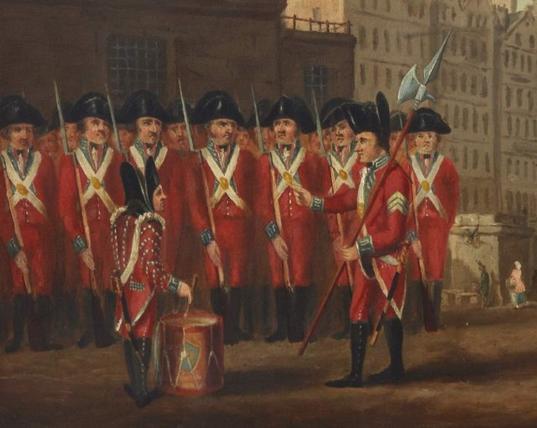


 🤘 The Metal Dog 🤘
 🤘 The Metal Dog 🤘

 Rock and Roll Garage
 José Leitão


 𝕎𝕖𝕣𝕥𝕙𝕒𝕞