The “most fortunate of the city politicians”: the thread about the life and times of Orlando Hart

This thread was originally written and published in October 2023.

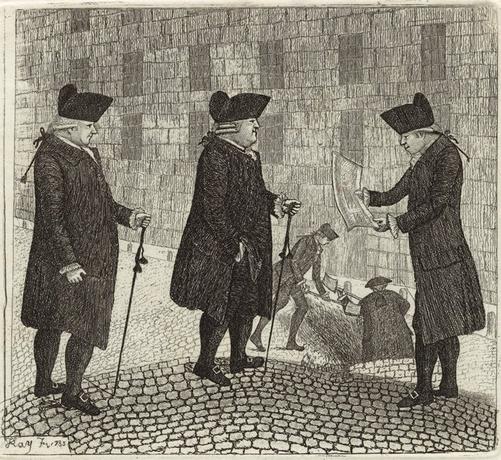
Last week’s thread about the bankers Sir James Hunter Blair and Sir William Forbes contained a caricature by the prolific John Kay that satirised the local political scandal of “The Levelling of the High Street” as part of the construction of the South Bridge. On the left is a local politician by the name of Orlando Hart.

L-R, Orlando Hart, William Jamieson (of Portobello), Sir James Hay, Sir James Hunter Blair, Archibald McDowall. CC-by-NC-ND, National Portrait Gallery, NPG D16419

Orlando? I didn’t at first believe there was a man in 18th century Edinburgh called Orlando! Lowland Scotland in the 18th and 19th century had a habit of naming their sons from a rather small pool of names – work by Richard Rodger on the 1861 Census has shown that a full 50% of boys in Edinburgh were named either John, James, William or Robert and the top 10 most popular names accounted for 79% of all boys. But it turns out I was totally wrong, and Orlando Hart was one of a population of (probably) just two Orlandos in the whole country at this time. I am informed (thank you Corpyburd on Twitter) that this seed of doubt, on my part, has a name – The Tiffany Problem. This is when people do not believe something historical is true, because it sounds modern, and takes its name from people associating the name Tiffany so strongly with the 1980s and a certain pop star that they cannot believe it was a relatively common medieval name. So I just had to try and find out a bit more about this exotically-named man.

So who was Orlando Hart? When and where he was born, I do not know, I cannot find any birth registration for him, but based on the known facts of his life he was probably born between 1720-30. Hart wasn’t a particularly common surname in Edinburgh at the time, only 12 boys and 8 girls named Hart were registered born in Edinburgh in the 20 years 1715-1735. So unless he was born under a different name as one of those 12, I assume he may not have been born in Edinburgh. In 1751 we get our first solid record of him, when a journeyman1 shoemaker of his name married Elisabeth Henderson of the Water of Leith Village at the West Kirk of St. Cuthberts.

East View of St. Cuthbert’s or Old West Kirk, as it was, by James Skene, 1827 © Edinburgh City Libraries
  • A journeyman is a craftsman who had finished their trade apprenticeship but was not their own master, i.e. he worked for another ↩︎
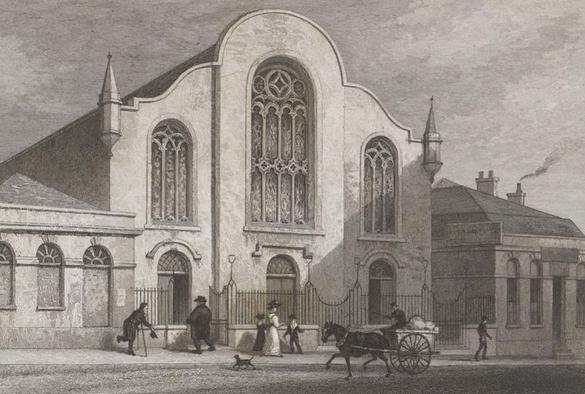
  • Children followed; (Mac)Duff in 1755 (named after a friend), Archibald in 1760 and Katharine in 1766. A son also named Orlando Hart, was buried in 1772. Like many aspiring and connected men of the time, Orlando was a Freemason; in 1755-57 and again in 1761-62 he was a Grand Steward in the Grand Lodge of Scotland – a man clearly getting somewhere in life. It is evident he was popular amongst his contemporaries, in 1757 he was elected to the Monarchy of the Jolly Sons of St. Crispin – a fraternal organisation for shoemakers and by 1760 he was noted as a “Shoemaker in Lady Yester’s Parish“. Lady Yester’s – or the South East Parish of Edinburgh – served the portion of the city south of the Cowgate and east of College Wynd. The church moved from a 17th century building in the High School Yards to a new one on Infirmary Street in 1805.

    Lady Yester’s Parish Kirk on Infirmary Street, 1820 by Thomas Hosmer Shepher. © Edinburgh City Libraries.

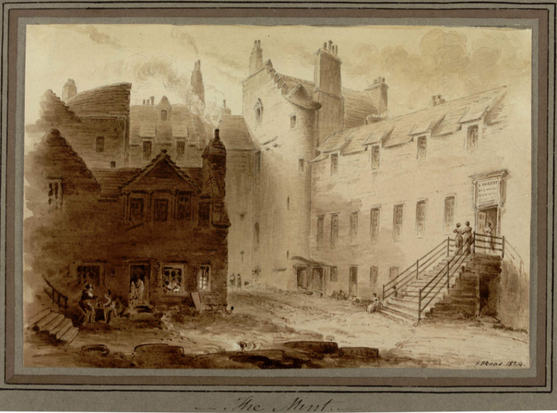
    But Orlando Hart was moving upwards in life and didn’t stay still long, 3 years later he was a “Shoemaker In the Mint” – the old Royal Mint of Scotland, north of the Cowgate where Coinyie-House Close now stands. He is recorded as being shoemaker to James Boswell in the latter’s correspondence.

    The Mint by James Skene, 1824. the mint is on the right with that same staircase. © Edinburgh City Libraries

    Successful and popular as a shoemaker and a freemason, it was natural that local politics should follow and in 1766 he was elected Deacon of his Trade Incorporation, the Cordiners. (Cordwainer was the ancient word for a shoemaker, who made shoes from new leather – Cordoba, from the Spanish city of Córdoba where the best shoe leather traditionally came from. A “cobbler” in contrast was someone who repaired, or re-made, shoes.) The Deacon was the most senior office holder of his Trade, elected by and from amongst his peers. It also conferred him a seat on the town council as a representative of his Trade. Further success followed, in 1771 he was elected Convenor of the Trades, the most senior officer of all the city’s Trade Incorporations.

    Cordiner’s Hall, “near the College” (where Old College of the University now lies). A watercolour by James Skene, 1820. © Edinburgh City Libraries

    His rise did not stop there. By 1773 he was a Magistrate – a legal officer of the Town Council in the lowest level of courts – again the Trades had a right to put forward a candidate for one of these positions. The Town Council and its officers at this time was a mixture of elected councillors and also a balance of seats held by the representatives of the Trades and the Merchants. By now, Orlando Hart’s business has moved to the centre of the Old Town, “Opposite the Guard“, meaning the old guard house lodge in the centre of the High Street, between the Tron Kirk and St. Giles. A prestigious address, in a time before the Old Town was yet to be supplanted by the New Town as the place to do business.

    Old Guard House of Edinburgh, James Skene, 1827 © Edinburgh City Libraries

    Not content to be just a successful Shoemaker, freemason, man of his Trade and local politician, he was also quite a dab hand with his golf clubs. Golf was a pastime that occupied the important men of the city and was as much a place to fraternise and do business as to improve your handicap. When the Royal Burgess Golfing Society reformed in 1773, who should be elected club captain but Orlando Hart?

    “Cock O’ The Green”, a John Kay caricature showing Alexander McKellar, an obsessive golfer on Bruntsfield Links and contemporary of Orlando Hart.

    He represented the City as a Commissioner of the Convention of Royal Burghs, where the representatives of the various Burghs would gather once or twice a year to thrash out the issues of the day, and also at the General Assembly of the Church of Scotland alongside the Lord Provost of Edinburgh (the most powerful local politician in all of Scotland). In 1775 he was once again elected Deacon Convenor of the Trades – for a good 25 years of his life he was constantly in one office of local government or another. These were positions elected from and amongst his peers, a mark of his popularity amongst them. John Kay’s brief biography says he was “Considered one of the most fortunate of the city politicians… He possessed a happy knack of suiting himself to circumstances, and was peculiarly sagacious in keeping steady by the leading men in the magistracy”. What this means was that Hart was always careful to align himself to the most senior men in the council, whomever they may be, without treading on the toes of others. He was awarded the honorific (and profitable) office of Keeper of the Town Water Works.

    “The first Waterhouse or Reservoir, Castlehill”, a John Le Conte watercolour of 1840 showing the old water reservoir and house on the Castle Hill which supplied the city, and was a convenient location for the housing of a fire engine. © Edinburgh City Libraries

    In 1787, Orlando Hart’s name appears at the back of an important book as subscriber to “Poems, Chiefly in the Scottish Dialect” – the Edinburgh reprint of Robert Burns’ sensational début publication, which saw the good and the great of the city clamouring for the author’s favour. A year later, his name pops up in another interesting place; as being called to assize as a Juror in the case of one William Brodie – Deacon Brodie to you and I. Brodie was a man who had once held an equivalent office of local government, Deacon, as Orlando, but the latter was not selected to sit on the jury.

    Stinking Edition, 1787 Poems, Chiefly in the Scottish Dialect. Robert Burns. So called because of a printing error where ‘Skinking’ became ‘Stinking’. CC-by-SA 4.0 Rosser1954

    Hart must have been well into his sixties by 1791 when he was once again elected as one of the two Town Councillors representing the Trades. By this time he must also have been exceptionally wealthy, as he bought a feu on Charlotte Square – the newest and most prestigious development in town – to build himself a house. That feu was for number 6, which he bought for £290. He spent probably spent ten times that on completing the house to Robert Adam’s plans (a total c. £490k in 2023). Number 6 Charlotte Square is of course Bute House, residence of the First Minister of Scotland.

    Bute House, 6 Charlotte Square, CC-by-SA 2.0 Scottish Government

    It is not clear if Orlando Hart ever lived in the house himself, he died on September 9th 1793, no more than a year after its completion and just months after being elected as one of the managers of the Public Dispensary of Edinburgh . His wife, Elisabeth Henderson, died exactly a week later. Macduff Hart, who was his sole surviving son by this time, inherited Orlando Hart & Sons shoemakers. It was from the estate of Orlando Hart that No. 6 was sold to the Craufurd family in 1796, Mrs Isabella Craufurd being the widow of a banker and owner of a plantation and 600 slaves in Jamaica. She took up residence there with her son.

    That was the life and times of Orlando Hart; I have yet to find his registry of death so cannot identify where Hart’s Ground, the family burial plot was. I also suspect he may have been godfather to a number of children as I can find boys born in Edinburgh during his lifetime of his name – Orlando Hart Baillie (son of a Shoemaker) and an Orlando Hart Wilson, who would go on to enjoy a relatively successful naval career.

    If you have found this useful, informative or amusing, perhaps you would like to help contribute towards the running costs of this site – including keeping it ad-free and my book-buying budget to find further stories to bring you – by supporting me on ko-fi. Or please do just share this post on social media or amongst friends.

    Explore Threadinburgh by map:

    Travelers' Map is loading...
    If you see this after your page is loaded completely, leafletJS files are missing.

    These threads © 2017-2026, Andy Arthur.

    NO AI TRAINING: Any use of the contents of this website to “train” generative artificial intelligence (AI) technologies to generate text is expressly prohibited. The author reserves all rights to license uses of this work for generative AI training and development of machine learning language models.

    #Lochend #Logan #Restalrig #StMargaret

    Milliner, Haberdasher, Caricature: the thread about Sibbie Hutton, the “Most Fantastic Lady of Her Day”

    Today (February 21st 2026) is the bicentennial of the death of John Kay, the Edinburgh barber turned artist, etcher and engraver who has become renowned for his prolific caricatures which gently lampoon the great and the good of society in the late 18th century city. But this isn’t a homage to the man himself, there are many other such pieces and indeed whole books on the subject. Rather, in Threadinburgh style, we look instead at one of his lesser-known but individually notable subjects: Miss Sibilla Hutton, “without exception, the most fantastic lady of her day“.

    John Kay, “Drawn & Engraved by Himself 1786”, etched self-portrait. National Portrait Gallery, London, D4970

    Sibbie Hutton, as she was widely known, was a renowned milliner (maker and seller of women’s hats) and haberdasher in the city, who was famed for appearance, Kay’s 1786 etching depicts her wearing a ridiculously oversized frilly-edged lampshade of a hat and decorated from head to toe in ribbon and lace. Her fine clothing and corpulence indicates her financial success. He also shows her as the equal of the man, a fellow trader and private banker by the name of Robert Johnston.

    Etching by John Kay, 1786, entitled “Mr Robert Johnston and Miss Sibilla Hutton”, no. 158. Edinburgh and Scottish Collection, Edinburgh City Libraries.

    She was born (probably) in the late 1740s in Dalkeith, the daughter of Sibella Tunnock and the Reverend William Hutton, who led a dissenting congregation (i.e. one that had rejected and had left the fold of the Kirk, the Church of Scotland) of the Associate Presbytery, of which he was also the Moderator, in that town. John Kay also hailed from Dalkeith and was of a similar age, so was perhaps well acquainted with her before she became more prominent in Edinburgh. Her mother appears to have died during or shortly after childbirth in 1752, her baby girl Grisel dying herself a few days later.

    1852 OS Town Plan of Back Street in Dalkeith showing location of the Independent Chapel and the U. P. Church, the latter being originally by the Associate Presbytery

    In Old Edinburgh Beaux & Belles by David Morison, the Reverend is said to have been “a very worthy dissenting clergyman” and one who was famed for the length of his sermons. An anecdote tells that on one occasion, when preaching to the Synod, after an hour one of his fellow ministers endeavoured to give a gentle hint as to the time by glancing obviously at his watch. “when, on the expiry of the first hour, by way of giving him a gentle hint, Mr. Sheriff held out his watch, in such a way as he could not fail to observe it. “The preacher paused for a moment, but immediately went on with renewed vigour, till another hour had expired.” The other minister again pulled out his watch and checked the time, but to no avail; he carried on as he intended and did not finish preaching until three hours in the pulpit had been reached. Hutton asked his fellow later as to why he had been monitoring the time quite so obviously, the reply being “the first hour I heard you with pleasure, and, as I hope everyone else did, with profit, the second, I listened with impatience; and the third with contempt!

    After the loss of her mother the young Sibbie was raised by her father and like him was independently minded and strong-willed. From a young age she had “been remarkable for her love of ornament“, much to his annoyance. In the 1770s she moved from Dalkeith to Edinburgh and set up in business with her sister Margarett as a milliner at the Royal Exchange. This complex of buildings, now the City Chambers, was then a centre of commerce and in a time before the New Town began to feature many shops and businesses, provided some of the most modern and prestigious shop units in the city.

    Coloured engraving after Thomas Hosmer Shepherd showing the Royal Exchange on the High Street in 1829, A Palladian building by John Adam forming a central palazzo. Edinburgh and Scottish Collection, Edinburgh City Libraries.

    It is therefore a mark of the Hutton sisters’ success in business and their station in the complex social hierarchy of the Georgian city that they carried on their trade here. The old Reverend was “scandalised” by his daughter’s tastes in fashion. “Sibbie! Sibbie!” he cried, “do you really expect to get to heaven with such a bonnet on your head?” The reply came: “And why not, father? I’m sure I’ll make a better appearance there than you will do with that vile, old-fashioned black wig, which you have worn these last twenty years!”

    On the marriage of her sister to James Kidd in 1782, Sibbie carried on the business by herself. This she did with “great purpose, and daily added to the heaviness of her purse, as well as to the rotundity of her person…” Regarding her appearance it was said “[her] silks, too, and the profusion of lace with which she was overlaid, were always of the most costly description, and must have been procured at immense expense“. Clearly business was good and Sibbie was good at business. She advertised prominently in the Caledonian Mercury newspaper in the 1770s and 1780s, often in the headline slots, giving an insight into the sorts of items she was dealing in.

    Caledonian Mercury – Saturday 12 July 1783, advert “TO THE LADIES” from S. Hutton.

    Again these are an indication of her prestige, but they also make it very clear that she was quite hard nosed and would suffer no fools or chancers:

    S. Hutton wishes to carry on business for ready money; and it is expected the accounts due will be speedily paid, as by that method she is enabled to carry on business on the most advantageous terms.

    Caledonian Mercury – Saturday 29 June 1776, advertisement for S. Hutton, Milliner

    Other averts record that she was running a sort of lottery, the prizes being wares such as cottons, muslins, tweeds, satins, laces, silks and linens: obviously she was innovative in commerce.

    Caledonian Mercury – Saturday 09 December 1786, advertisement from S. Hutton, Haberdasher and Milliner at the Exchange with details of a lottery she is running

    In another 1785 caricature “A Whim – or a Visit to the Mud Bridge” (an early iteration of what would become the Mound), Kay lampoons some of the city’s reformist men who backed that project. but features a number of women, the central and most prominent of whom is though to be Sibbie. The sign on the left reads “B’s Bridge” and most likely refers to Geordie Boyd, who reputedly conceived the whole scheme, which explains why the man on the rear of the carriage is saying “Whip harder Geordie” (thanks to Graeme Cruickshank for reminding me of this). There’s a less likely probability that it refers to a Mr. Brown, the treasurer of the project, who had been bankrupted and fled with money that were meant to have financed a grand inaugural procession. Kay is probably therefore depicting the idea that instead the gentlemen who had promoted the scheme could pull the carriages themselves, the originator egging them on from the back.

    John Kay etching, 1785, no. 173, “A Whim – or a visit to the Mud Bridge“. The woman looking straight at the artist in the middle of the carriage is though to be Sibbie Hutton. Edinburgh and Scottish Collection, Edinburgh City Libraries.

    Sibbie set the fashion trend for women of a certain social rank in Edinburgh, importing for them the latest and best items from London. On the occasions that John Kay found it necessary to lampoon women (more often his targets were the pompously self-important men about town) he depicted them beneath Hutton’s enormous hats and adorned in her laces and ribbons.

    Etching by John Kay, 1785, no. 308. “Mr Pierie and Mr Maxwell”, prominent bachelors in the city either admiring, or being admired by, some fashionably dressed women. Edinburgh and Scottish Collection, Edinburgh City Libraries.

    The ridiculousness of the hats seems to reach a peak in 1787 with one worn by Penelope Hamilton (née Macdonald), Lady Belhaven and Stenton who is shown meeting with Sir Robert Dalrymple-Horn-Elphinstone, 1st Baronet.

    Etching by John Kay, 1787, no. 303. “Sir Robert Dalrymple-Horn-Elphinstone, 1st Bt; Penelope Hamilton (née Macdonald), Lady Belhaven and Stenton”, National Galleries of Scotland collection

    Clearly those who had dressed themselves in this style were a useful visual shorthand and they are repeated in his work ever-more extravagant headgear, evolving with the fashions of the time. Notice the women below sport smaller hats but with much more elaborate feather plumes than those a decade before, and one wears a more modern cut of jacket.

    Retaliation; or the cudgeller caught“, etching by John Kay, 1801. A Porter, Captain Hew Crawford, his sister and her companion in a comedic, chaotic interaction. Edinburgh and Scottish Collection, Edinburgh City Libraries.

    These women are rarely named and are usually included in the caricatures to help set a scene; Kay’s targets being the named gentlemen. There is however a good chance some are indeed Sibbie Hutton, such as the lady on the far right of this image. But Sibbie differs from most of the other women he depicts not just in that she is named, but she is not drawn from the gentry and is not included as a wife or daughter of one of the men featured, she is included on her own merits.

    John Kay etching, 1785, “Major Andrew Fraser, the Honourable Andrew Erskine and Sir John Whitefoord, Bart.” The right group is made up of two women in elaborate dress with ornate feathered hats, the more rotund of whom on the right bears a very close resemblance to Sibbie Hutton.

    Papers in the Dean of Guilt Court of Edinburgh (the equivalent then of the modern Planning Committee) show that in the 1780s, she was involved in a dispute with a neighbouring shopkeeper. In 1782 a complaint was made by John Grieve, merchant, that she had made unauthorised alterations to her shop, removing an internal staircase and replacing it with an external one, amongst others. Grieve made the same complaint in 1787. In both instances the case was found against Sibbie and she was ordered to put back the internal stairway. Clearly that never happened the first time and it is not clear if she did it when ordered the second time. It was around this time that, tiring of the city, perhaps tiring of the legal disputes, and also of the monotony of family visits to Dalkeith, she decided to remove herself to London and re-establish her trade there. Her sister, now Mrs Kidd, took over the Edinburgh business. After this, little more is known of Sibbie’s life except that she later returned to Edinburgh and died in Dalkeith, the town of her birth, on February 19th, 1808. Her star had perhaps dwindled by this time as her passing was little remarked upon beyond very brief death notices. Her sister died the following year.

    Star of London, 4th March 1808, “At Edinburgh on the 19th ultimo, Miss Sibella Hutton, Daughter of the late Rev. William Hutton, minister of the gospel, Dalkeith

    Thank you to Threadinburgh supporter Olwyn Alexander for drawing Sibbie’s interesting life and somewhat uniquely prominent position in John Kay’s works to me. He produced a huge volume of work, which he printed and sold widely. You can find much more of his work online at:

    If you have found this useful, informative or amusing, perhaps you would like to help contribute towards the running costs of this site – including keeping it ad-free and my book-buying budget to find further stories to bring you – by supporting me on ko-fi. Or please do just share this post on social media or amongst friends.

    Explore Threadinburgh by map:

    Travelers' Map is loading...
    If you see this after your page is loaded completely, leafletJS files are missing.

    These threads © 2017-2026, Andy Arthur.

    NO AI TRAINING: Any use of the contents of this website to “train” generative artificial intelligence (AI) technologies to generate text is expressly prohibited. The author reserves all rights to license uses of this work for generative AI training and development of machine learning language models.

    #Lochend #Logan #Restalrig #StMargaret

    “Of Very Doubtful Military Significance”: the thread about The Loyal Edinburgh Spearmen

    Today’s Auction House Artefacts are a pair of silver Georgian merit medals awarded to Fletcher Yetts of the Loyal Edinburgh Spearmen. Mr Yetts (1759-1832) was the keeper of the City Water Works on the Castlehill. Britain was almost continuously at war with France for between 1793 and 1815 and the quaintly named Spearmen were one of the variety of amateur paramilitary formations raised in Edinburgh during this period in anticipation of a French invasion (or a popular revolution in the French style).

    Front and rear views of a George III silver medal of the Loyal Edinburgh Spearmen , dated 6th August 1804. The reverse is engraved “Reward of Merit, 1st Battn., Fletcher Yetts”. Move the slider to compare each side. Photo by Gorringe’s of East Sussex.

    The Volunteer Corps Act of 1794 authorised the formation of volunteer paramilitary forces for home defence; the Volunteers. These were an infantry force that generally drew their officers from petty gentry and aspirational middle-class professionals. They were distinct from the volunteer cavalry of the Yeomanry whose members were the country landowners and required to have deep pockets and horses at their disposal – and be competent in their use.

    George III silver medal of the Edinburgh Spearmen Artillery Company, dated 1805. The reverse is engraved “presented by Captain Braidwood to Serjt. [sic] Major Yetts as a mark of respect for his Unremitting Attention to the Company”. Move the slider to compare each side. Photo by Gorringe’s of East Sussex.

    In Scotland a third force was the Militia, established by the Militia Act of 1797 which empowered the Lords Lieutenant of the Counties to raise by ballot a conscript auxiliary force for service within Scotland. Its ranks were generally drawn from the lowest rungs of society and the Act was so thoroughly unpopular that it provoked widespread rioting across the country. This led to the Massacre at Tranent in August 1797 when eleven men, women and children were killed by Dragoons when protesting against it.

    “The Massacre of Tranent”, statue by David Annand in Tranent Civic Square. This represents Jackie Crookston, one of those killed during the anti-militia protests, carrying a drum to call out the slogan of “no militia”. Image via ArtUK

    In contrast to the Militia, the ranks of the Volunteers were drawn largely from the lower middle and upper working classes; an attraction of joining being it could exempt one from being drafted into the Militia. Apart from a small number of drill sergeants and drummers, the Volunteers were unpaid but received their weapons and allowances for uniforms from the Government.

    “The First Regiment of Royal Edinburgh Volunteers”, a sympathetic caricature of a parade “hereby dedicated to all the Volunteer Corps in Great Britain by their Humble Servant J. Jenkin.” 1802. National Library of Scotland

    The Volunteers allowed patriotic and aspirational amateurs to play at being military officers without facing the dangers and hardships of actual military service. There was a steady supply of men keen to sport the over-embellished uniforms – and even finance the units at their own expense – to reap the benefit of the high public status that a uniform conferred in the ballrooms and drawing rooms of the city.

    “The Grand Inspection”, caricature satirising Edinburgh volunteer officers being inspected by a lady; the inference being their patriotic service can be reduced to dressing up for her approval. By J. Jenkin, 1805. National Library of Scotland.

    By late 1803, there were some 30,000 Volunteers in Scotland (and over 300,000 in the wider UK) but their efficiency varied widely; from semi-competent to completely hopeless. Georgian satirists mercilessly lampooned them, depicting them as physically unfit; poorly equipped, trained and led; over-enthusiastic and thoroughly incompetent.

    “St. George’s Volunteers. Charging down the French Bond Street, after clearing the Ring in Hyde Park & Storming the Dunghill at Marylebone”. Colour caricature of 1797 by James Gillrary mocking the Volunteers. In common with other such pieces, the over-enthusiasm, poor training, poor physical condition and ill-fitting and low quality nature of uniforms are highlighted. British Museum 1851,0901.850

    In their distinctive blue coats the Royal Edinburgh Volunteers (REV) were one of the first established in the country and were an example of the semi-competent type of unit. A commissioned portrait of them certainly reflected this, Edinburgh caricaturist John Kay took a slightly more humours view of them.

    To see ourselves as others see us. Two very different characterisations of the late 18th century Royal Edinburgh Volunteers, both featuring Sergeant Major Patrick Gould (who in his defence was at least recognised in his time as being thoroughly competent).

    The Spearmen – in contrast to the REV – showed “all the signs of being a force of very doubtful military significance” (W. A. Thorburn, curator of the Scottish United Services Museum, writing on the subject in the Book of the Old Edinburgh Club, vol. 32). They probably formed as a result of the officer corps of the city’s other Volunteer units being fully subscribed to and thus a further unit was required for those left out. Its stated purpose was to “defend the city, liberties and vicinity of Edinburgh, in case it be found necessary to march the other forces to a distance, and to protect the lives and property of the inhabitants from injury and depredation“. This was a coded recognition that the job of the Volunteers wasn’t really to fight the (real or imagined) threat posed by French invaders but to release regular forces to do so by securing the home front. A secondary and more realistic proposition was quelling popular revolt or opportunistic disorder in the absence of the regulars: to the local authorities and certain sections of society, the Mob invoked far more fear than the French did – as evidenced by their actions at Tranent – and the Toun Rats (the Town Guard of Edinburgh) had proved of dubious worth in the past.

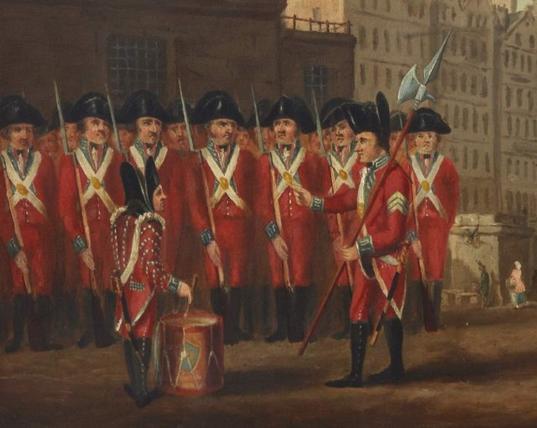
    The Edinburgh Town Guard, painting attributed to William Home Lizars in 1800, but Lizars was an engraver and this is likely the work of (or after) John Kay. The sergeant carries a halberd but the men have muskets and bayonets. The drummer carries a short sword. City Art Centre, Edinburgh Museums and Libraries

    The nascent Spearmen offered their services to the Crown, to make sure they were officially recognised and their officers Gazetted, and they were admitted as supernumeraries to the existing Volunteer establishment in the city in a letter dated 7th November 1803.

    We are well persuaded that every man who can handle a pike and who is not engaged in any volunteer corps, will chearfully [sic] embrace this opportunity of coming forward for the defence of our families and firesides

    Scots Magazine, December 1803

    The initial plan was to raise two Battallions, each of six-hundred men in ten companies; in theory over 1,200 men. In practice however only one Battallion was ever constituted and its ranks fluctuated between four to five hundred men. They wore scarlet cutaway jackets, blue breeches and a tall beaver hat decorated with feathers (as per the medal at the top of the page and in contrast to the long blue coats and white breeches of the REV). Initially they were armed with nothing more than short pikes and swords for the officers. Their ranks were drawn largely from those exempt from balloting into the militia; the Incorporated Trades of the City and those too old, too young or with too many dependent children.

    Mr John Bennet, surgeon to the garrison of Edinburgh Castle and President of the Royal College of Surgeons, was elected as the honourary Lieutenant Colonel Commandant. He had been the surgeon to the Sutherland Fencibles (an earlier, auxiliary military force in the Highlands) from 1779-83 so was an eminent choice. He was later replaced by William Inglis WS Esq. after being found dead in a field in Fife on October 10th 1805, his gun by his side, having suffered a fatal fall from his horse when hunting.

    Caricature of John Bennet in his uniform, by J. Jenkin, 1804. National Library of Scotland.

    Other officers included Robert Dundas and John Peat, Writers to the Signet (solicitors); William Ranken, a Town Councillor from the Incorporation of Tailors; the lighthouse engineers Thomas Smith and his step-son Robert Stevenson; Francis Braidwood, an upholsterer and cabinet-maker (and allegedly the first man in Edinburgh to wear shoelaces); John Cameron, Deacon of the Tailors and James Newton, Deacon of the Incorporation of Bakers. Their chaplain was the Reverend Alexander Brunton of New Greyfriars Kirk, later the Professor of Hebrew and Oriental Languages at the University of Edinburgh.

    “Mr Dundas”, caricature by J. Jenkin, c. 1803. Given the cut of the uniform, with the short coat distinct from the other Volunteer units, and the beaver hat, this may be Major Robert Dundas of the Spearmen. National Library of Scotland.RankNamesLieutenant ColonelJohn Bennet (died October 1805, later William Inglis)MajorRobert Dundas WS (resigned August 1805, replaced by James Farquharson)CaptainsWilliam Ranken; John Simpson; Thomas Smith; Francis James Braidwood; John Cameron; James Newton; Patrick Mellis; Alexander GairdnerLieutenantsJohn Peat; William Braidwood jnr; Charles Ritchie jnr; Robert Stevenson; Thomas Hamilton; Matthew Sheriff; Adam Brooks; John Yule; John Cameron EnsignsJohn Menzies; David Robertson; Andrew Wilson; John Grieve; William Woodburn; John BallantineChaplainRev. Alexander BruntonSurgeonWilliam Farquharson; Thomas Lothian (assistant)Sergeant MajorGeorge NeagleNamed officers holding commissions in the Loyal Edinburgh Spearmen, at the time of its establishment, Gazetted Nov 1803- January 1804.

    It was all very Dad’s Army, but at this time the fear of invasion was genuinely held as a result of intense newspaper speculation. Matters came to a head on January 31st 1804 when the Volunteers of Hawick and Teviotdale rose to repel an “invasion” after the lighting of the chain of hilltop warning beacons across the Borders counties. This proved to be a false alarm, the result of an inexperienced but enthusiastic watchman at Hume Castle near Kelso who saw a distant glow on the eastern horizon – actually charcoal burning at Shoreswood in Northumberland, 15 miles away – and thought it was the beacon at Dowlaw being lit.

    “A Hilltop Beacon”, William Bell Scott, 1828. National Galleries of Scotland

    It was not until the Scottish volunteer companies arrived at Berwick-upon-Tweed the following morning after marching excitedly through the night that the mistake was realised, but a celebration was held never-the-less to mark the efficacy of the warning system and the enthusiasm of the response. It was only a sceptical naval watchkeeper at the St. Abb’s Head signal station that prevented the warning being transmitted all the way to the end of the chain at Edinburgh.

    Hey, Volunteers are ye wauking yet? Ho, jolly lads, are ye ready yet? Are ye up, are ye drest, will ye all do your best? To fight Bonaparte in the morning!
    Now, brave Volunteers, be it day, be it night; When the signal is given that the French are in sight; Ye must haste with your brethren in arms to unite; To fight Bonaparte in the morning!

    Marching song of the Dunfermline Volunteers, to the tune of the traditional “Hey, Johnnie Cope”

    Despite the Government’s approval, as supernumaries the Spearmen had to finance themselves. In February 1804 a public subscription was raised to cover the expenses of fitting out the unit, the Caledonian Mercury reporting “there can be little doubt that it will soon exceed the sum required“. The Town Council voted fifty Guineas towards the cause as did the Association for the Defence of the Firth of Forth, the Incorporation of Goldsmiths and the United Incorporations of Mary’s Chapel (the Wrights and the Masons). The Incorporation of Tailors and the Bakers provided thirty each, those of The Hammermen twenty-five, The Fleshers twenty and The Hammermen of Canongate five. A number of town councillors and many of the founding officers also contributed, as did some notable local patrons. A Benevolent Society was set up by the officers to provide “mutual aid of each other in the event of sickness or death” in September of that year and which would later be extended to all the Volunteers of the city.

    Public subscriptions to the Loyal Edinburgh Spearmen (L.E.S.), giving a good indication of the demographic of the principal backers. Caledonian Mercury, 9th February 1804

    They used as their parade ground the Heriot’s Hospital green, that traditionally used by the other Volunteers in the city and seen in the background of the portrait at the top of the page of Sergeant Patrick Gould. In 1805 they were formally recognised by the Home Secretary, Lord Hawkesbury, as a full member of the Corps of Volunteers. This gave them equal status with the city’s other volunteer units and entitling them to receive Government funding, pay and arms. It is likely at this time they traded in their pikes for Government-issue muskets. To mark the occasion, “this band of citizen warriors had their stand of colours delivered to them on the 12th August 1805″ (the birthday of the Prince Regent, the Prince of Wales). These were provided and presented by the wife of the Lieutenant Colonel Bennet and her daughter Miss Scott of Logie. Chaplain Rev. Brunton consecrated them with “a most impressive prayer” after which the batallion marched out of the city to Duddingston House, the residence of the Earl of Moira, Commander-in-Chief of the Army in Scotland. The Earl inspected the formation after which they returned to the Bennet household on Nicolson Street where “they were regaled by him in a very liberal and handsome style of hospitality“.

    The Earl of Moira, Addressing the Loyal Edinburgh Spearmen. John Kay caricature, 1805. In the background is Duddingston House, Moira’s residence in Edinburgh, where the Spearmen marched for inspection following receiving their colours at Heriot’s Hospital

    In the event of the Spearmen being called out, they were to assemble upon the Mound as their chosen “alarm post in case of invasion or popular tumult“. In March 1804 a battery of artillery was added, armed with two experimental 6-pounder cannons designed and built by Mr Roebuck of the Shotts Iron Company. The guns were commanded by Captain William Braidwood jnr and were provided with two novel ammunition carts, designed to be pulled by domestic draught horses.

    Caricature of an Edinburgh volunteer artillery officer and his piece, which is similar to that shown on the medal at the top of the page. The Spearmen were not the only volunteer artillery in the city, so this may or may not represent Captain William Braidwood. By J. Jenkin, 1805. National Library of Scotland.

    The artillery would get the Spearmen into trouble with the law. On Monday 25th September 1805, eager to demonstrate their efficiency and readiness to the city after formally receiving their colours, they marched and drilled through the streets before assembling on the Mound to firing off a number of volleys in salute from the Roebuck Guns. After the third and final blast, Lieutenant Colonel Bennet was apprehended with “violent passion” by John Tait, judge of the City Police Court and superintendent of the newly instituted Police Office. Tait threatened “at your peril remain on this ground a moment and if I ever see you and your Corps on the streets of Edinburgh again, it shall be at your peril“.

    “An Eminent Judge… of Broom Besoms!!!”. While this caricature by John Kay represents a well known old peddlar of brooms, it satirises instead John Tait, the Judge of the Police Court and Superintendent of Police, who had accosted the Loyal Edinburgh Spearmen. National Portrait Gallery, London, NPG D16508

    Bennet wrote to Sir William Fettes, the Lord Provost and Lord Lieutenant of the City, to complained that he and his men had been prevented by the civilian authorities from carrying out their duties and were treated with “gross and repeated insults from an immense mob“. He threatened that he would have to disband the unit if they could not go about their business unmolested. Tait had only been in his position of authority a few months and was likely trying to publicly demonstrate that it was he, and not any Volunteers, who was responsible for law and order. He wrote back to the Lord Provost standing his ground, but making the clarification that it was only firing off cannons in public that he wished to prevent, and not their marching and drilling. This seemed to placate both sides and thereafter Spearmen got on with tier duties of playing at soldiers.

    “Guard Room Tactics, Bugs in Dander; or a Volunteer Corps in Action.” 1798 caricature lampooning the Volunteers, by Charles Ansell. The Loyal Edinburgh Spearmen were dressed in a very similar fashion. Yale Centre for British Art B1981.25.1158, via Wikimedia

    On September 1807 they changed their name to the Loyal Edinburgh Volunteers to acknowledge their changed status (which causes confusion with the Royal Edinburgh Volunteers, who they remained distinct from) and also that thanks to Moira’s intervention they had retired their spears and were now properly armed with muskets. They marked their promotion by marching to Alloa for ten days on “active duty”. The Caledonian Mercury reported that “their conduct on the march to and from Alloa, and while in quarters, was orderly and regular in the highest degree, and their attendance at drill, for seven hours every day, was unremitting“.

    “Light Infantry Volunteers on a March”. 1804 satirical cartoon by Thomas Rowlandson lampooning the physical condition of Volunteer units. Picture via Miesterdrucke.ie

    The experience must have been enjoyable as they then applied to be transferred into the Militia, an offer which was rejected. Undeterred, in December that year it was announced that the Prince of Wales had “been graciously pleased to accept an offer… of an extension of their services to any part of Great Britain” and as such they would henceforth be known as the Prince of Wales’ Loyal Edinburgh Volunteers. This was far removed from their founding aim of serving only in the city; things may have gone to their heads as in 1809 the entire Volunteer forces of Edinburgh offered their services to go to Spain and fight alongside the regulars in the bloody Peninsular War. Again the offer which was politely declined.

    “Loyal Britons Lending A Lift”, a British soldier assisting the Spanish in fighting the French. August 1808 caricature by James Gillray.

    Lieutenant Colonel Inglis remained in charge of the renamed Spearmen until the volunteer forces were officially disbanded on July 11th 1814. They have been largely forgotten about and even in their own time were in the shadow of the Royal Edinburgh Volunteers and the Yeomanry, but at least one unknown amateur poet penned a verse in their honour, although it is hardly complementary.

    It is weel Kend these guy wheen years
    I’ve praised our Royal Volunteers
    The Spearmen has appeared at last
    O’ them we should hope the best.
    There’s numbers o’ them without doubt
    They are baith souple louns and stout,
    But other o’ they I do ken
    Dude help them poor auld worn out men
    An’ I wad scorn to tell a lee
    They’re neither fit to fight nor flee
    An’ other some raw mou’d callants
    I’ve seen far better selling ballants.
    What brings them out in name of wonder
    Wer it no to make a gudly number.
    O’ them the brethern may think shame
    Far better they wad stay at hame.

    Poem to the Loyal Edinburgh Spearmen, 1804

    If you have found this useful, informative or amusing, perhaps you would like to help contribute towards the running costs of this site – including keeping it ad-free and my book-buying budget to find further stories to bring you – by supporting me on ko-fi. Or please do just share this post on social media or amongst friends.

    These threads © 2017-2026, Andy Arthur.

    NO AI TRAINING: Any use of the contents of this website to “train” generative artificial intelligence (AI) technologies to generate text is expressly prohibited. The author reserves all rights to license uses of this work for generative AI training and development of machine learning language models.

    #Army #AuctionHouseArtefact #Edinburgh #Georgian #JJenkin #JohnKay #Military #Napoleonic #Policing #Revolution #TownGuard #Volunteers

    #TheMetalDogArticleList
    #BraveWords
    Today In Metal History 🤘 April 12th, 2024 🤘 OVERKILL, STEPPENWOLF, PAT TRAVERS, RUSH, GREAT WHITE, CANNIBAL CORPSE
    HEAVY BIRTHDAYS 63rd D.D. Verni (OVERKILL) - 1961 80th John Kay (STEPPENWOLF) - 1944 70th PAT TRAVERS - 1954 51st Mark Cronin (HANGNAIL) - 1973 HEAVY RELEASES 40th RUSH's Grace Under Pressure - 1984 36th CHEAP TRICK’s Lap...

    https://bravewords.com/news/today-in-metal-history-april-12th-2024-overkill-steppenwolf-pat-travers-rush-great-white-cannibal-corpse

    #OVERKILL #Steppenwolf #PatTravers #Rush #GreatWhite #CannibalCorpse #DDVerni #JohnKay

    Today In Metal History 🤘 April 12th, 2024 🤘 OVERKILL, STEPPENWOLF, PAT TRAVERS, RUSH, GREAT WHITE, CANNIBAL CORPSE

    HEAVY BIRTHDAYS Happy 63rd   D.D. Verni (OVERKILL) - April 12th, 1961 Happy 80th   John Kay (STEPPENWOLF) - April 12th, 1944 Happy 70th   PAT TRAVERS - April 12th, 1954 Happy 51st   Mark Cronin (HANGNAIL) - April 12th, 1973 HEAVY RELEASES Happy 40th   RUSH's Grace Under Pressure - April 12th, 1984 Happy 36th CHEAP TRICK’s Lap...

    bravewords.com

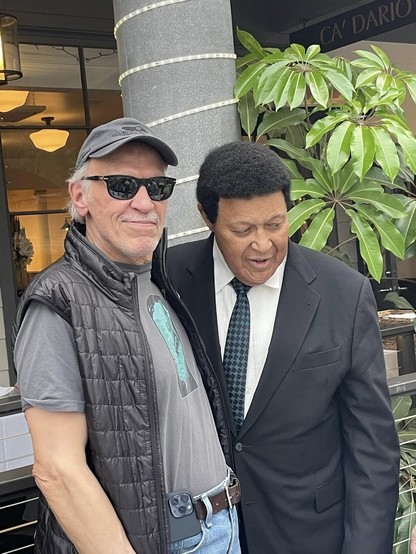
    Happy 80 birthday to the legendary Steppenwolf vocalist John Kay!

    (Yes, that's Chubby Checker with him)

    📸Teresa Kuskey

    #steppenwolf #johnkay #rock #rocknroll #rockandroll #classicrock #hardrock #music #song

    Jose L. on Instagram: "#steppenwolf #johnkay @steppenwolfband #thesparrow #vinyl #columbiarecords #recordcollector #analog #vintage #rocknroll #nowplaying"

    0 Likes, 0 Comments - Jose L. (@antipax0) on Instagram: "#steppenwolf #johnkay @steppenwolfband #thesparrow #vinyl #columbiarecords #recordcollector #ana..."

    Instagram

    New on Instagram: Last week's picks from @nu2uv2 just arrived. Got my weekend planned, how about you?

    #vinyl #rock #jazz #vinylcollection #vinylcommunity #analog #jimihendrix #johnkay #steppenwolf #countbasie #johnnycash #LP #vintage https://instagr.am/p/CpVGjeqMC0h/

    Jose L. on Instagram: "Last week's picks from @nu2uv2 just arrived. Got my weekend planned, how about you? #vinyl #rock #jazz #vinylcollection #vinylcommunity #analog #jimihendrix #johnkay #steppenwolf #countbasie #johnnycash #LP #vintage"

    1 Likes, 0 Comments - Jose L. (@antipax0) on Instagram: "Last week's picks from @nu2uv2 just arrived. Got my weekend planned, how about you? #vinyl #roc..."

    Instagram
    Take my hand sweet darlin'
    Wipe that frown off your face
    I don't love anyone but you
    No one can take your place, but
    Sometimes I worry darlin',
    the way you seem to hoard my love
    Just take what you need
    Don't empty out the store
    Just take what you need
    cuz I ain't got much more
    #GabrielMekler #JohnKay
    #Steppenwolf
    29 Jan 1968
    proto #metal #rock #blues #music #1960s

    #UpcomingBirthdays:
    #music

    #JohnKay , singer, 12 April 1944

    #Steppenwolf - #BornToBeWild (1969)

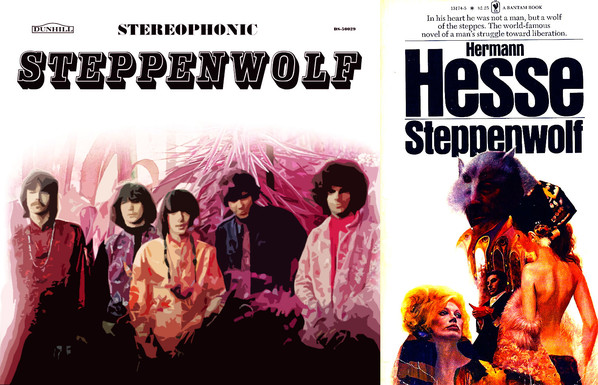
    Steppenwolf is a Canadian-American rock band, prominent from 1968 to 1972. The group was formed in late 1967 in Los Angeles by lead singer John Kay, keyboard...

    https://www.youtube.com/watch?v=41cFf9N5F-A

    Steppenwolf - Born To Be Wild (1969)

    YouTube