 Steven Carneiro
3D-printed ion trapping:
#iontrap #3dprinting #quantumcomputing #innovation #scienceandtechnology
⚛️

 Mainz University
Green light for Europe's first ion-trap-chip pilot line: Milestone for the stabilization and strengthening of quantum technology fabrication, bolstering Europe's technological sovereignty 👉 https://press.uni-mainz.de/green-light-for-europes-first-ion-trap-chip-pilot-line/ @bmftr_bund
#QuantumTechnology #QuantenComputer #IonTrap #QuantumProcessor #QuantumSensing #QuantumCommunication #QuantumComputing #IonTraps
 Rick Altherr
How to bring quantum computer parts to DEFCON

 Tech Chilli
China Leads Quantum Computing with Largest Ion Trap Simulation, Led by Duan Luming.
#QuantumComputing #China #DuanLuming #Innovation #Technology #QuantumTech #Research #IonTrap #TechAdvancements #FutureOfTech #CuttingEdge #TechRevolution
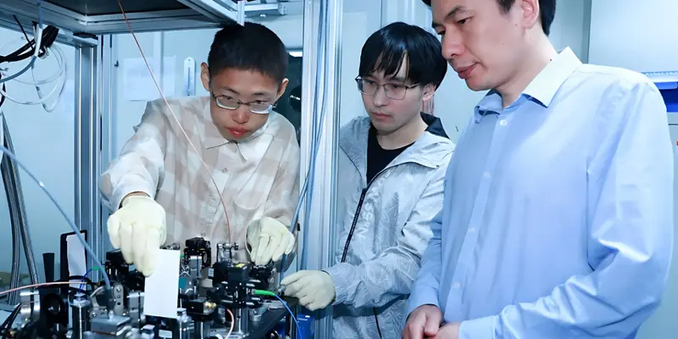
China Leads Quantum Computing with Largest Ion Trap Simulation, Led by Duan Luming
China takes a major step in quantum computing with the largest ion trap simulation, achieving new heights in the field. Led by Duan Luming, this breakthrough showcases China's advancements in quantum technology, pushing the boundaries of innovation and research.
 Quantum Observer
RIKEN Selects Quantinuum System Model H1 for Large-Scale Hybrid Quantum–Supercomputing Platform in Japan https://thequantuminsider.com/?p=2360110 #Quantum_Computing_Business #Research #iontrap #Quantinuum #RIKEN #trapped_ion #quantumdaily Insider Brief Quantinuum will install its H1-Series ion-trap quantum computing technology at RIKEN’s campus in Wako, Saitama. The deployment will be part of RIKEN’s project to build a quantum-HPC hybrid platform. The integrated hardware platform will support a

Trapped-Ion Quantum Computer Now Available in Munich Quantum Valley https://thequantuminsider.com/?p=2359505 #Quantum_Computing_Business #Research #Alpine_Quantum_Technologies #AQT #BAdW #Bavarian_Academy_of_Sciences_and_Humanities #iontrap #Leibniz_Supercomputing_Centre #Munich #trapped_ion #quantumdaily Insider Brief The Leibniz Supercomputing Centre is adding another quantum computer for its Quantum Integration Centre. The new 20-qubit ion trap computer was developed by the Austrian-based st

Russian Scientists Present 16-Qubit Quantum Computer https://thequantuminsider.com/?p=2356570 #Uncategorized #iontrap #LPI_Laboratory_of_Optics_of_Complex_Quantum_Systems #photonic #russia #trapped_ion #Vladimir_Putin #quantumdaily Insider Brief Russian scientists say they built a 16-qubit quantum computer, according to information from the country’s nuclear energy corporation. The device was reviewed at the Forum for Future Technologies in Russia. Work on the device started as far back as 2015

 Philipp Schindler
We have analyzed the error correction properties of various fault tolerant circuit constructions under various noise models in our #iontrap #quantumcomputer. @uniinnsbruck collaboration with @fzj
https://arxiv.org/abs/2301.10017
https://arxiv.org/abs/2301.10017
Strategies for practical advantage of fault-tolerant circuit design in noisy trapped-ion quantum computers
Fault-tolerant quantum error correction provides a strategy to protect information processed by a quantum computer against noise which would otherwise corrupt the data. A fault-tolerant universal quantum computer must implement a universal gate set on the logical level in order to perform arbitrary calculations to in principle unlimited precision. We characterize the recent demonstration of a fault-tolerant universal gate set in a trapped-ion quantum computer [Postler et al. Nature 605.7911 (2022)] and identify aspects to improve the design of experimental setups to reach an advantage of logical over physical qubit operation. We show that various criteria to assess the break-even point for fault-tolerant quantum operations are within reach for the ion trap quantum computing architecture under consideration. We analyze the influence of crosstalk in entangling gates for logical state preparation circuits. These circuits can be designed to respect fault tolerance for specific microscopic noise models. We find that an experimentally-informed depolarizing noise model captures the essential noise dynamics of the fault-tolerant experiment, and crosstalk is negligible in the currently accessible regime of physical error rates. For deterministic Pauli state preparation, we provide a fault-tolerant unitary logical qubit initialization circuit, which can be realized without in-sequence measurement and feed-forward of classical information. We show that non-deterministic state preparation schemes for logical Pauli and magic states perform with higher logical fidelity over their deterministic counterparts for the current and anticipated future regime of physical error rates. Our results offer guidance on improvements of physical qubit operations and validate the experimentally-informed noise model as a tool to predict logical failure rates in quantum computing architectures based on trapped ions.