 earthling
Modelling the quantum brain
Based on Werner Herzog's Theatre of Thought.
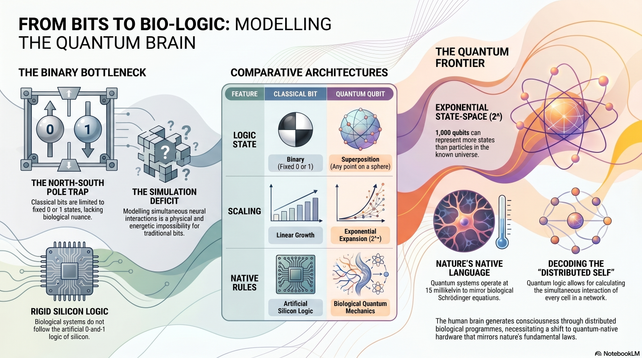
Modelling the quantum brain
Based on Werner Herzog's Theatre of Thought.
Microsoft Claims 20 second Qubits
https://fed.brid.gy/r/https://hackaday.com/2026/06/04/microsoft-claims-20-second-qubits/

AI: Not Conscious, but UNPREDICTABLE!
AI: Not Conscious, but UNPREDICTABLE makes for a dangerous cocktail!
AI is obviously NOT conscious. To be con-scious one needs something ELSE to go with the science... At least etymologically speaking. But the science of AI fully explains AI, there is no need for anything else to go with the knowledge. Present AI, Large Language Models, LLM, all about finding gradients in extremely high dimensional spaces
Another type of AI is possible: WMs: World Models, where the AI basically learns physics. WMs will be superior to LLMs for most applications beyond Internet searches.
Consciousness requires the feeling of existing: present day AI do not have this capability, all the more because we do not know what it consists of.
The smallest known structures in the brain are Dendritic Nano Tubes, DNTs, and they are of the order of 100 nanometers across… 1000 atoms wide (molecules causing Alzheimer squeeze through them). At a scale ten times smaller, Quantum effects will appear. It is likely that they will play a crucial role in consciousness. Why? Because at this sort of scale, Quantum effects are going to appear, first of all (there are libraries of geometries and the Casimir Effect they bring… At the ten nano scale, so not only will there be Quantum effects, but Quantum Field Theory effects, and the dynamics of vacuum… Turns out the soul’s material is vacuum energy… Something like that is looming… It’s curious that QFT is not vibrating more in the collective consciousness… Obviously a problem with the High Energy physicists’ lack of elocution or imagination…)
Present day AI rests on electronics which work like canal systems (canals carrying electrons, not water molecules)… Quantum effects caused by said electrons are deliberately obliterated so that “semiconductors” can behave like classical canal systems.
The Quantum Computer, QC, is the exact opposite: far from avoiding Quantum effects, they are maximally exploited to compute with. The QC rests on entanglement, nonlocality and a new property called “magic” (basically what classical entanglement can’t duplicate)..
If Twenty-first Century technology can do it, it would be naive to believe that evolution did not get there first, especially since Quantum effects have been shown to play a direct role in neurology already (for example in birds seeing the Earth magnetic field).
Thus, if we want consciousness, we need the QC.
QC will enable us to create AC, Artificial Consciousness.
***
A different question is whether present AI can SIMULATE consciousness. The answer is obviously yes. Confusing this simulation with a creature with (Quantum) consciousness is the AI DELUSION. Dawkins who wrote a book called the God Delusion is himself suffering from an arguably worse condition, the AI Delusion. It’s worse because AI as we have it, is just classical canal engineering and smart high dimension calculus… There is no mystery whatsoever. .
***
Even though the AI we have now are not conscious, and can’t be conscious, they are still unpredictable. I actually have a mathematical PROOF of this (using mathematics and logics from the 1870-1940 period…).
That makes uncontrolled AI a potential master of humanity.
Lest we be very smart and careful…
Patrice Ayme
Coming soon to a neighborhood near you… Robot contemplates Valles Marineris on the equator of Mars, 10 kilometers deep… The colonization of Mars will be initially driven by AI… Next NASA Mars mission will be propelled by a nuclear engine, and three AI helicopters will fly away with supersonic blades before hitting the ground… And communicate with Earth through overhead satellites…
#AI #ArtificialConsciousness #ArtificialIntelligence #Consciousness #llm #Philosophy #QuantumComputer #RichardDawkins #spirituality #Unpredictable #WorldModel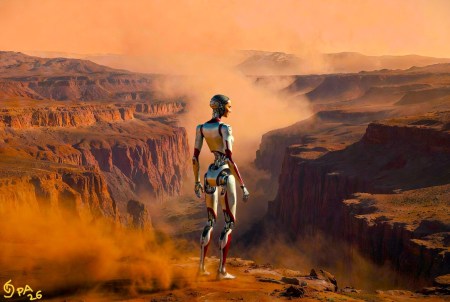
#mwgic #2026 #China #QuantumComputing #QuantumComputer
Hanyuan No. 1 Becomes China’s First Commercial #Quantum #Computer https://share.google/sTylxW8oJ7cdv8adi

Insider Brief China’s first atomic quantum computer has entered commercial use, signaling a milestone in the country’s effort to achieve technological self-reliance in quantum information science. The system, called “Hanyuan No. 1,” has received more than 40 million yuan – or $5.6 million (US) – in orders, including delivery to a subsidiary of China Mobile […]

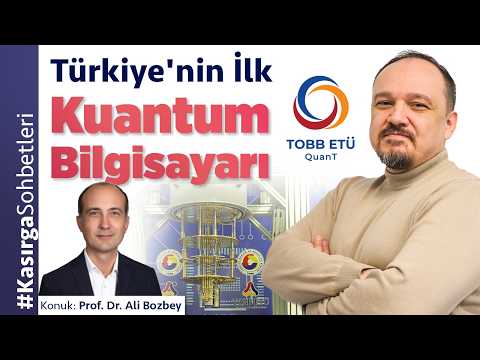
Türkiye'nin İlk Kuantum Bilgisayarı QuanT
 Hackaday [Unofficial]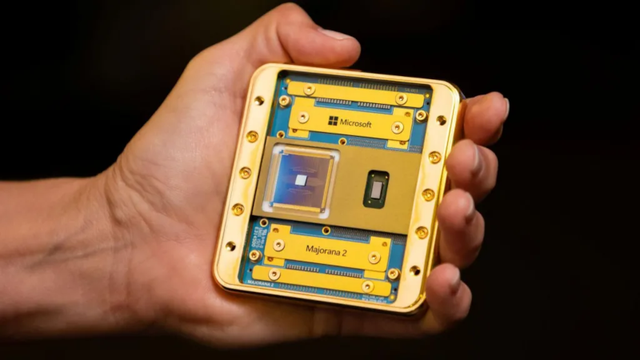
 tech news ᳇ eicker.news
 Patrice Ayme's Thoughts
 Dan Stafford
 Rod Van Meter
 Tom Zijlstra
 Kemal ASLAN