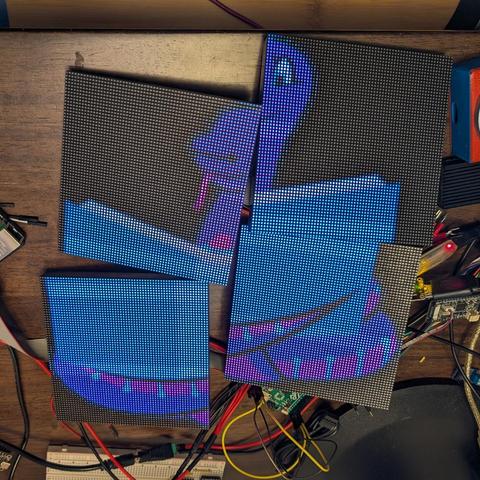
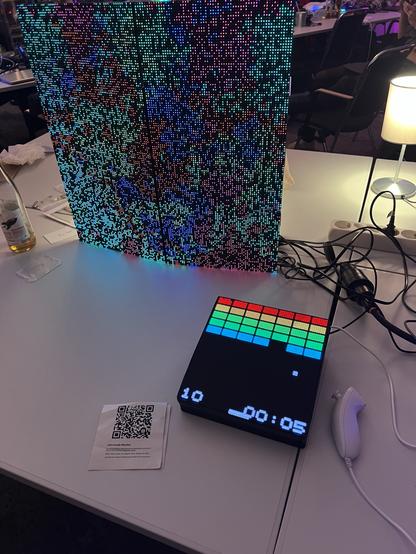
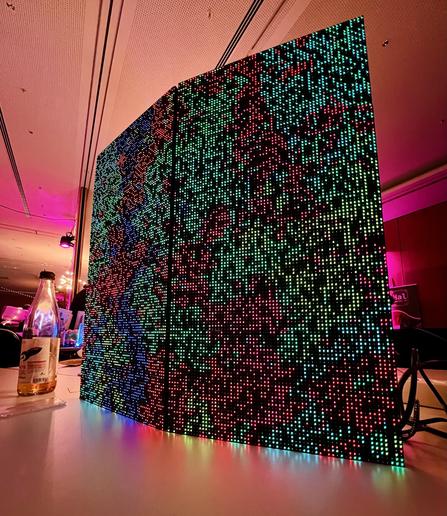
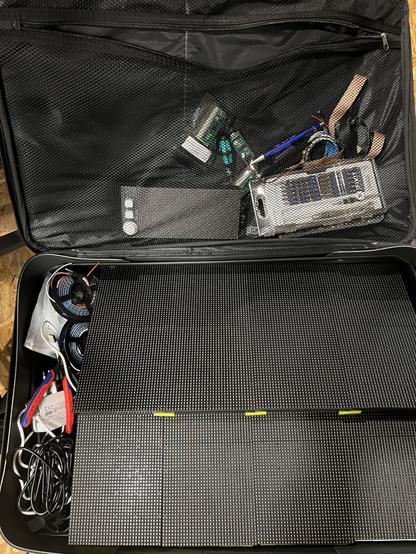
My hub75 based display has started having rendering issues lately. After messing around for a while and getting nowhere I believe I've finally fixed it by reducing the power supply voltage to 4.7V instead of 5V. I guess some of these displays don't really like 3.3V logic and reducing the difference helps.

#ESP32 #hub75 #LEDs

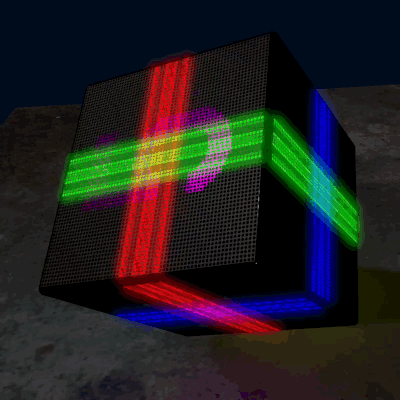
The new Steam Machine is a cube measuring 160mm on a side. In completely unrelated news, Adafruit is still selling 64x64 LED matrices that measure 160mm on a side.

https://www.adafruit.com/product/3649

#Steam #SteamMachine #HUB75 #LEDs

64x64 RGB LED Matrix - 2.5mm Pitch

Winter time can be rough in the city. The sky is gray. The weather is unpredictable. So slough off those seasonal blues with some Times Square razzle dazzle from this sweet, ...

@PaulaMaddox Wow, this brings back memories. I had an almost identical bug in my own #FPGA #Hub75 driver.

Your bottom-most (in the photo) column looks correct; is this the first one that gets clocked out of the driver?

When do you update the ABCD mux signals? I had a bug here; I realised that you have to hold them steady until you've clocked out the entire next row, then update them at the same time as you pulse the LATCH and /OE signals.

Dunno if that helps - it was a few years ago!

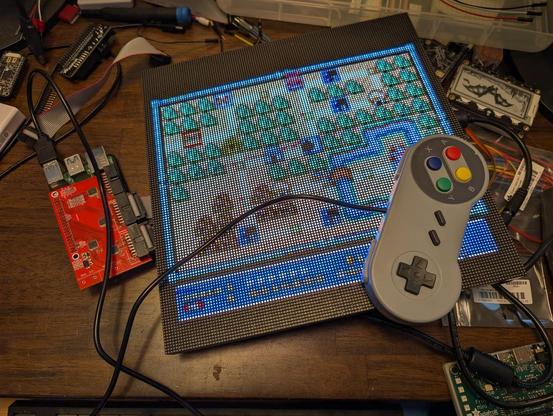
Just playing Super Mario All Stars on an RGB matrix panel as you do.

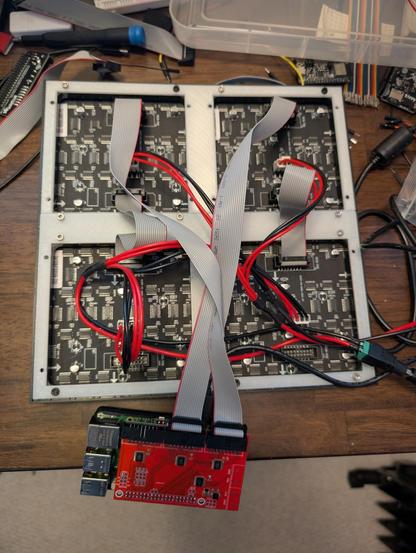
To keep things together better, I 3D printed a bracket in two pieces, the subject of a work in progress playground note: https://adafruit-playground.com/u/jepler/pages/3d-printed-bracket-for-4-64x64-2mm-rgb-matrix-panels

This is using a 3rd party breakout board with 3 HUB75 connectors. I recently added the ability to drive up to 3 connectors to Adafruit Piomatter, as well as temporal dithering.

In this specific interest, I'm using 2 connectors to drive a total of 4 64x64 panels. --num-planes=6 --num-temporal-planes=2 means I'm getting effective 18 bit color, albeit with the least significant 2 bits being shown on alternate refreshes, creating a tiny amount of 44Hz color shimmer.

All these "go faster" tricks together give me about 88Hz refresh rate on the panel, despite that we're still limited to about 10MB/s of data between the PI's main CPU and the PIO peripheral that's acting as the LED controller.

#Adafruit #RaspberryPi #Pi5 #HUB75 #LEDs
3D printed Bracket for 4 64x64 2mm RGB matrix panels

Adafruit Playground

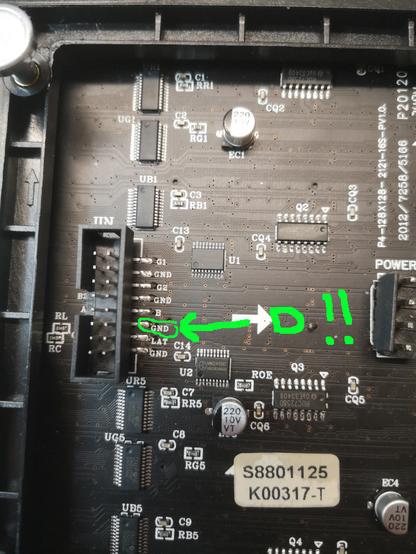
Rhaaaaa c'est D et pas GND.

Rhaaaaaaaaaa, bon je vais me coucher tiens.

Si vous achetez ce panneau de LEDs

https://fr.aliexpress.com/item/1005006875145275.html?spm=a2g0o.order_list.order_list_main.38.7fee5e5bRm1MPA&gatewayAdapt=glo2fra

Faites attention ! Évidemment, après y a pas toutes les leds qui s'affichent !

#electronic #aliexpress #led #matriceled #HUB75 #erreur #silkscreen

Panneau d'écran LED polychrome, technologie HD, écran publicitaire intérieur, SMD, RVB, écran d'affichage LED, balayage 1/16, 128x128mm, 32x32, P4 - AliExpress 30

Smarter Shopping, Better Living! Aliexpress.com

aliexpress.

Capping my work for @adafruit this week with the first working demo for pi5 with the "active3" RGB matrix adapter.

This adapter lets you push out about 3x as many pixels per unit of time, which mean you can either improve your refresh rate or drive more pixels with the same refresh rate.

Mapping these pixels is more complicated than with a single matrix connector, so the open pull request punts and just makes you write the pixel map in Python. This is evaluated just once at your program startup, keeping the pixel mapping part of the code fast when you update the screen contents.

I hope that a future improvement will supply some standard mappers for 2- and 3-connection display setups; at a minimum, I'd like it to work when each strand is a single panel or string of linear panels, and they're in horizontal or vertical stripes.

#hub75 #raspberrypi #pi5 #pio #rp1 #piomatter #python

Allow defining geometries (including more than 2 color lanes) via Python code by jepler · Pull Request #27 · adafruit/Adafruit_Blinka_Raspberry_Pi5_Piomatter

as a part of this, reorganize the code so that the code has package structure, and move the click options handling code into the package as well. This also adds support for more than 2 color lanes ...

GitHub

49152 LEDs! @adafruit

https://github.com/adafruit/Adafruit_Blinka_Raspberry_Pi5_Piomatter

These 64x64 panels worked, except my samples have R and B channels swapped so it did need some new code. I took the opportunity to turn the pinout & framebuffer format into constructor parameters, to avoid a combinatoric explosion with the original design, in which there was a separate constructor function for each (pinout, framebuffer) pair.

PR is open at
https://github.com/adafruit/Adafruit_Blinka_Raspberry_Pi5_Piomatter/pull/14

#Python #HUB75 #RaspberryPi #Pi5

GitHub - adafruit/Adafruit_Blinka_Raspberry_Pi5_Piomatter: Python package to drive HUB75 rgb matrices on pi5

Python package to drive HUB75 rgb matrices on pi5. Contribute to adafruit/Adafruit_Blinka_Raspberry_Pi5_Piomatter development by creating an account on GitHub.

GitHub
Letzte Chance, schaut vorbei, Science Communication Center
Assembly, M7, Saal X, 1. OG https://38c3.c3nav.de/l/scc/ #38C3 #Hub75 #ws2812 #rp2040
Science Communication Center

Assembly, M7, Hall X, Level 1

c3nav
ca. 150.000 LEDs bereit für die morgige Zugfahrt nach Hamburg.
#38C3 #LED #hub75 #ws2812 #rp2040

Haven't seen this discussed anywhere so

Some #hub75 panels use an ASIC instead of a simple shift register for driving the LEDs to prevent burn-in etc - which means the chip expects a certain regular timing on its pins, else it goes dark. So if your simple test code isn't frigging latching and you've been debugging for hours, check your panel ICs!
#embedded #led