 Allpoints
@th @Illithilich
I recall watching this get built at our local maker space.
http://projecthexapod.com/blog/
#Hexapod #ArtisansAsylum #Somerville #Allston #Boston
 WolfgangGraef
 Maurice
After a bit of fettling, hand stitching stress cracks in the #3dprinting and a couple of snapped legs, our Make Your Pet #hexapod is finally moving.
 Meki
MekiCan anyone help me with designing a control board for a #hexapod ?
Got 18xMG996 servos and the original idea was to use 2xPCA9685PW boards to distribute the power load, but it didn't work out 😅
The brains would be an #arduinonanorp2040
 Patrick Chadwick
 Samcritter (He/they)
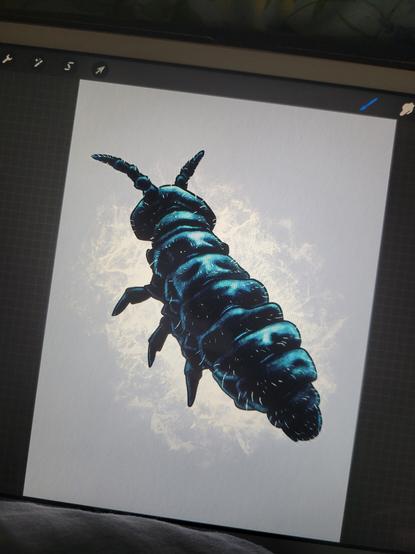
My springtail is done! I love how chonky he came out❄️✨️
#science #sciart #illustration #art #painting #digitalpainting #nature #ScienceMastodon #ArtMasto #springtail #invert #arthropod #hexapod

Finished a Patreon print for January, featuring Hypogastrura nivicola, the snow flea springtail! I just love springtails, I definitely want to draw more in the future💖
#science #sciart #illustration #art #painting #watercolor #nature #ScienceMastodon #ArtMasto #hexapod #springtail #snowflea #arthropod #invert #bugs
 André Stricker
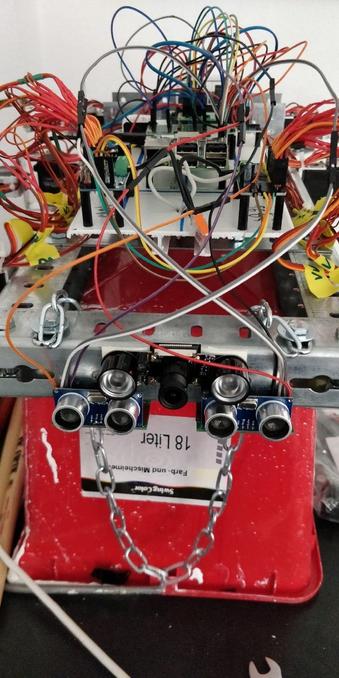
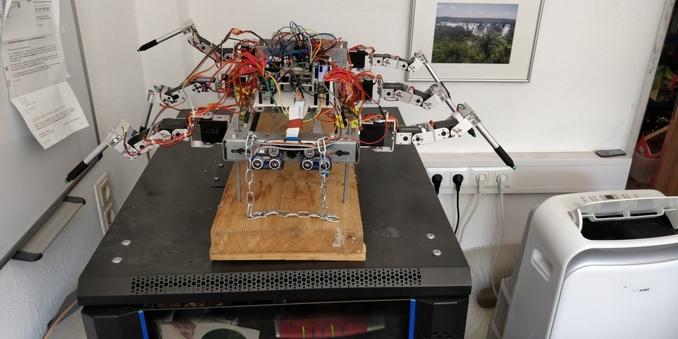
Noch mehr von Garfield Version 2
 hackaday unofficial
Working Model Reveals Amazing Engineering of Webb’s Mirror Actuators
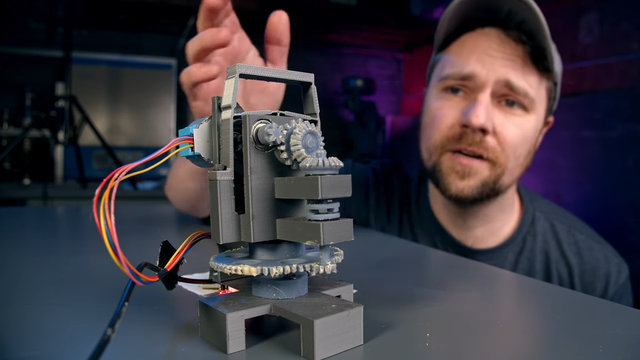
We end up covering a lot of space topics here on Hackaday, not because we're huge space nerds -- spoiler alert: we are -- but because when you've got an effectively unlimited budget and a remit to make something that cannot fail, awe-inspiring engineering is often the result. The mirror actuators on the James Webb Space Telescope are a perfect example of this extreme engineering, and to understand how they work a little better, [Zachary Tong] built a working model of these amazing machines.
The main mirror of the JWST is made of 18 separate hexagonal sections, the position of each which must be finely tuned to make a perfect reflector. Each mirror has seven actuators that move it through seven degrees of freedom -- the usual six that a Stewart platform mechanism provides, plus the ability to deform the mirror's curvature slightly. [Zach]'s model actuator is reverse-engineered from public information (PDF) made available by the mirror contractor, Ball Aerospace. While the OEM part is made from the usual space-rated alloys and materials, the model is 3D printed and powered by a cheap stepper motor.
That simplicity belies the ingenious mechanism revealed by the model. The actuators allow for both coarse and fine adjustments over a wide range of travel. A clever tumbler mechanism means that only one motor is needed for both fine and coarse adjustments, and a flexure mechanism is used to make the fine adjustments even finer -- a step size of only 8 nanometers!
Hats off to [Zach] for digging into this for us, and for making all his files available in case you want to print your own. You may not be building a space observatory anytime soon, but there's plenty about these mechanisms that can inform your designs.
Thanks to [Zane Atkins] for the tip.
#space #actuator #flexure #hexapod #jameswebbspacetelescope #jwst #mirror #stepper #stewart

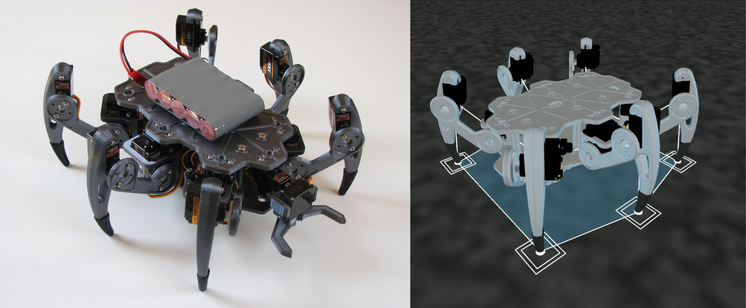
ZeroBug: From Simulation To Smooth Walking
Thanks to 3D printing and cheap hobby servos, building you're own small walking robot is not particularly difficult, but getting them to walk smoothly can be an entirely different story. Knowing this from experience, [Max.K] tackled the software side first by creating a virtual simulation of his ZeroBug hexapod, before building it.
Learning from his previous experience building a quadruped, ZeroBug started life in Processing as a simple stick figure, which gradually increased in complexity as [Max.K] figured out how to make it walk properly. He first developed the required movement sequence for the tip of each leg, and then added joints and calculated the actuator movements using reverse kinematics. Using the results of the simulations, he designed the mechanics and pulled it back into the simulation for final validation.
Each leg uses three micro servos which are controlled by an STM32F103 on a custom PCB, which handles all the motion calculations. It receives commands over UART from a python script running on a Raspberry Pi Zero. This allows for user control over a web interface using WiFi, or from a gamepad using a Bluetooth connection. [Max.K] also added a pincer to the front to allow it to interact with its environment. Video after the break.
The final product moves a lot smoother than most other servo-driven hexapods we've seen, and the entire project is well documented. The electronics and software are available on GitHub and the mechanics on Thingiverse.
The HackadayPrize2021 is Sponsored by:
#robotshacks #thehackadayprize #2021hackadayprize #3dprinted #hexapod #processing #simulation