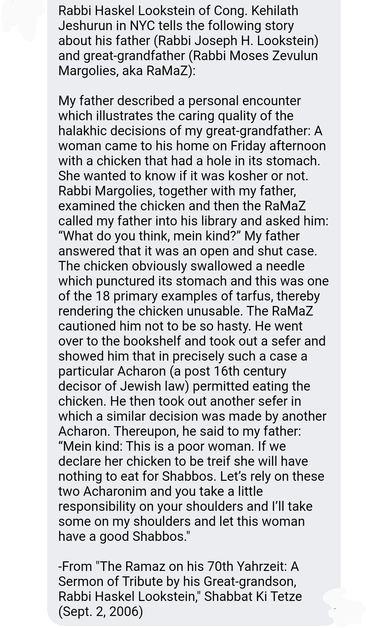
Traditional Judaism, based on our religious beliefs and #halakhah, got caught in a tug of war between people moving to the religious far left or far right. In some communities Jewish law was eliminated, while in others it became too strict. But this story here shows the Judaism that most of our ancestors had; a warm, loving #Judaism still taught by the many wonderful #rabbis I have learned from in all of our denominations.

#Kashrut

@chaimbenaharon @rochelle
@mazeldon

Consider the hidden assumption - many Jewish people think that eating kosher requires eating only food with a heksher. Turns out that this has never been a requirement. In fact most Orthodox Jews who lived before 1960 have never heard of such an idea. They would have regarded such a view as extreme, and such stringencies violate the Mishnah in Yadayim and numerous other rules.

More details here -

https://merrimackvalleyhavurah.wordpress.com/2016/12/24/does-kosher-food-really-need-a-hechsher/

#kashrut #halakhah

Does kosher food really need a hechsher

Merrimack Valley Havurah
Many thanks for any and all thoughts, insights, references, debate, etc.! #halakhah #RuralJudaism /end
Looking to start a discussion of #halakhah around the challenges of #RuralJudaism. By discussion I mean to say that I’m not looking for an authoritative responsum, I’ll continue discussing these things with my rabbis, but looking for people’s understanding of the tradition. #mazeldon #RuralJews 1/
God in Search of Man

Abraham Joshua Heschel was one of the most revered religious leaders of the 20th century, and God in Search of Man and its companion volume, Man Is Not Alone, two of his most important books, are classics of modern Jewish theology. God in Search of Man combines scholarship with lucidity, reverence, and compassion as Dr. Heschel discusses not man's search for God but God's for man--the notion of a Chosen People, an idea which, he writes, "signifies not a quality inherent in the people but a relationship between the people and God." It is an extraordinary description of the nature of Biblical thought, and how that thought becomes faith.

Google Books

In #halakhah there never was a mandatory 6 hour wait time between eating milk and meat. That idea is a more recent (1500's) chumra חומרה (stringency.) People of course may follow this, but they should also know the history. Ashkenazi Orthodox insist on this waiting time as binding. Other Jews disagree.

Details here. Iyun Halacha, Vol. 4, Issue 2, 5782/2021, Denver Kollel

https://www.denverkollel.org/wp-content/uploads/2021/10/waitingbetweenmeatandmilk.pdf

@mazeldon #kashrut #chumrot #Jewishlaw #kosher

@sheepchase @imstilljeremy @mazeldon

The difference between Reform's view on halakhah and Conservative Judaism's is big. Even the most tradition respecting Reform rabbis (e.g. Washofsky ) hold that halakhah is subject to personal autonomy, i.e. Jews always have total autonomy over what to believe, or do, if anything.
In Conservative (and #Sephardic, and #ModernOrthodox) we see #halakhah as our understanding of God's will and thus obligatory, even when differing on interpretations

There are a range of Jewish views on suicide, assisted suicide, and euthanasia. There is a surprising amount of agreement on the issue from across the denominational range.

https://merrimackvalleyhavurah.wordpress.com/2022/01/14/jewish-views-on-suicide-assisted-suicide-and-euthanasia/

@judaism
@mazeldon
#Jewdiverse #Mazeldon #Jewniverse
#Jewish #Judaism #Jews #JewishStudies #Babka #Torah #halakha #halakhah

Jewish views on suicide, assisted suicide, and euthanasia

Merrimack Valley Havurah