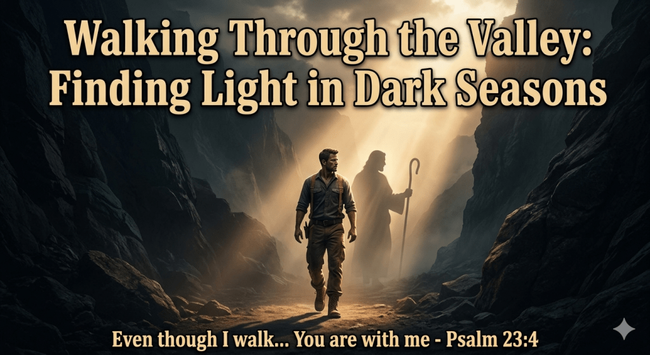
Walking Through the Valley: Finding Light in Dark Seasons

1,568 words, 8 minutes read time.

Even though I walk through the valley of the shadow of death, I will fear no evil, for you are with me; your rod and your staff, they comfort me.
Psalm 23:4 (NIV)

The principle is simple but rock-solid: The valley doesn’t mean God has left you. It means He’s walking right beside you as your Shepherd, ready to guide, protect, and comfort you through the darkest stretch.

The Illustration

Listen, brother.

You walked down that aisle, heart slamming in your chest, tears cutting tracks down your face. The music hit hard, hands went up, and for the first time in a long time you felt something real—Jesus had you. They cheered, hugged you tight, baptized you, slapped you on the back and said “welcome to the family.” It felt like you’d finally come home.

Then the silence hit. No follow-up. No one pulled you into a men’s group. No one showed you how to actually live this out when the high wore off and real life came crashing back in. You’re still the same guy clocking in as foreman, still carrying the load for your wife and two young kids, but now the anger flares easier at home, the porn pulls harder when stress piles up, and trying to read the Bible leaves you confused and frustrated. You feel guilty as hell because you thought all the old battles were supposed to disappear the moment you got saved.

You’re not weird. You’re not broken or a fake Christian. You’re just a new believer learning the hard truth every man eventually faces: the real walk with Christ isn’t lived under the bright lights of the altar call. It’s lived down in the valley where the shadows are deep and the ground feels unsteady.

David knew this grind. He wasn’t some soft-handed poet when he wrote Psalm 23. This was a warrior who had spent years on the run, hiding in caves, betrayed by his own people, leading under pressure, and fighting to hold it together. He understood valleys. He understood what it feels like when the excitement fades and you’re left wondering if God is still there.

Right in the middle of the lowest place he made a straight-up declaration: “Even though I walk through the valley of the shadow of death…”

He didn’t say “if” I walk through the valley. He said “even though.” Valleys come with the territory. The pressure of providing, the tension at home when you’re short with your wife and kids, the lust that hits when you’re exhausted after a long day, the awkwardness of trying to lead your family when you still feel like a rookie—that’s valley territory.

But here’s what the seeker-friendly church sometimes forgets to tell new guys like you: the valley is not where God ghosts you. It’s where He proves He’s with you. David didn’t say “for I feel Your presence strongly.” He said “for you are with me.” That’s the anchor, brother. Not your emotions. Not the warm fuzzy feeling from the altar. The solid fact that the Shepherd is right there beside you.

Your rod and your staff, they comfort me. In the old days, the shepherd’s rod was a weapon—to beat back wolves and to correct a stubborn sheep heading for danger. The staff was for guidance, hooking a wandering lamb and pulling it back to safety. That’s Jesus with you right now. When anger starts boiling up, His rod checks you before you say something that wounds your family. When lust tries to drag you into the dark, His staff redirects you. When you don’t know how to lead or how to make sense of the Bible, He’s guiding.

The church may have dropped the ball after that warm welcome, but Jesus never ghosts His own. He never promised you a life without valleys. He promised He would never leave you in them. The same Jesus who met you at the altar is the One walking beside you when the bills are tight, the marriage feels heavy, and the old sins keep knocking.

This is where real Christian manhood gets forged—not in the emotional high, but in the daily grind of choosing to trust the Shepherd when you don’t feel Him. You keep showing up for work with integrity. You keep opening the Bible even when it feels confusing. You keep choosing to pray instead of escaping into porn. You keep leading your wife and kids the best you can while asking Jesus to teach you as you go. That’s how a new believer becomes a solid man—step by gritty step through the valley.

You’re not alone down here. The shadows are real, but so is the Man walking next to you. He’s got the rod to protect you and the staff to guide you. The valley isn’t the end of your story. It’s where your faith stops being mostly feelings and starts becoming bedrock you can build your life on.

The Takeaway

Today, do this one hard, masculine thing: When the valley presses in—whether it’s anger rising, lust calling, confusion about the Bible, or the heavy weight of providing—stop for thirty seconds and say out loud, “Jesus, You are with me right now. Walk with me through this.” Then take the next right step as a man: speak calmly instead of snapping, shut the phone off and pray instead of giving in, read one verse and ask the Lord to teach you, or get on your knees with your kids for a quick prayer before bed. One deliberate step of obedience while reminding yourself the Shepherd is present. That’s how you walk through the valley without fear.

Prayer

Jesus,

I’m walking through the valley right now and some days it feels dark and heavy. The excitement from when I first came to You has faded, and the old struggles are still here. But I know You haven’t left me. You are my Shepherd. You are with me. Help me stop trusting how I feel and start trusting Your presence. Use Your rod to correct me when I’m heading toward sin and Your staff to guide me when I don’t know how to lead my family. Give me the guts to keep walking, keep working, and keep following You even when it’s hard. I choose to fear no evil because You are with me.

Amen.

Reflection

  • Where in your life right now feels like the “valley of the shadow”—maybe anger at home, the battle with porn, confusion when reading the Bible, or the pressure of providing?
  • When the initial excitement of your salvation faded, what lie did you start believing about God or about yourself?
  • How can you remind yourself today that Jesus is with you even when you don’t feel Him?
  • What’s one specific situation this week where you need the Shepherd’s rod for correction or His staff for guidance?
  • If David could declare “I will fear no evil” while walking through his valley, what would it look like for you, as a husband and father, to make that same declaration this week?

Call to Action

Stay in the fight, brother. The Shepherd is faithful. Keep walking. He’s building something solid in you right where you are.

Now rise up like the man God is making you. Today, refuse to stay stuck in the shadows. When the valley presses in—anger, lust, confusion, or the weight on your shoulders—stop, speak His name out loud, and take one gritty step of obedience. Lead your family even when you feel unqualified. Fight the sin even when you’re tired. Open the Word even when it doesn’t make sense. Pray like a warrior instead of hiding like a rookie.

The high may be gone, but the real work has just begun. Jesus is with you. Grab your rod and staff from Him and move forward. This valley is forging you into a stronger husband, father, and follower.

Stay in the fight, brother. The Shepherd is faithful. Keep walking. He’s building something solid in you right where you are.

SUPPORTSUBSCRIBECONTACT ME

D. Bryan King

Sources

Disclaimer:

The views and opinions expressed in this post are solely those of the author. The information provided is based on personal research, experience, and understanding of the subject matter at the time of writing. Readers should consult relevant experts or authorities for specific guidance related to their unique situations.

#angerManagementChristian #bibleStudyPsalm23 #bibleVersesForHardTimes #buildingFaithOnTheRock #ChristianDevotional #ChristianEncouragement #ChristianEncouragementForMen #christianHopeInValleys #ChristianManhood #ChristianMenDevotional #comfortInTrials #dailyChristianLiving #darkNightOfTheSoul #darkSeasons #encouragementForNewChristians #fearNoEvil #fearNoEvilPsalm23 #fightingSinAsAMan #findingLightInDarkness #fromEmotionalHighToDailyObedience #godIsWithMe #godNeverLeavesYou #goodShepherd #grittyFaith #hopeInDifficultTimes #jesusWithYou #leadingFamilyAsAChristianMan #masculineChristianity #newBelieverDevotional #overcomingFear #overcomingPornAddictionChristian #practicalChristianFaith #psalm23Devotional #psalm23Explained #psalm234 #realTalkChristianity #seekerFriendlyChurchStruggles #shepherdPsalm #shepherdSRodAndStaff #spiritualGrowthForBeginners #spiritualValley #trustingGodInHardTimes #valleyOfTheShadowOfDeath #valleySeasons #walkingThroughTheValley #walkingWithJesusThroughTrials

The True Shepherd and the Thieves — Silvio José Báez, ocd

In the world of Israel and throughout the Bible, everyone understood the work of shepherds—men who carefully fed, protected, and led their flocks. That’s why Scripture so often uses the image of the shepherd and the flock to describe God’s loving relationship with his people. The psalms pray this way: “Shepherd of Israel, hear us—you who lead Joseph like a flock” (Ps 80:1). And with deep trust, the believer can say: “The Lord is my shepherd; there’s nothing I shall want. He makes me rest in green pastures and leads me beside still waters” (Ps 23:1–3).

In today’s Gospel, Jesus presents himself as the shepherd who brings God’s work to fulfillment—feeding us, caring for us, and leading us into life. Between Jesus the shepherd and us, his flock, there unfolds a relationship of deep intimacy and loving knowledge. He calls his sheep “one by one” (Jn 10:3). Each of us is unique and unrepeatable, known by name and by our personal history. He loves us personally, just as we are. To him, we’re not an anonymous crowd. Turning people into a faceless crowd stands in direct opposition to love, and depersonalization only fosters despotic domination.

After calling his sheep, Jesus “leads them out” (Jn 10:3)—like a new exodus—and once he has brought them out, he “goes ahead of them” (Jn 10:4). He does not leave his sheep confined to closed spaces; he does not want them to live as captives, burdened by fear, sadness, or despair. Jesus calls us to set out from the refuges that suffocate us, from the little nooks of habits that have gone stale and moldy, and he leads us toward new and surprising pastures. He doesn’t allow his sheep to be trapped by any human power either—any power that would threaten their dignity or strip them of their freedom. He brings us out of the enclosures that enslave us and leads us into new lands of abundant life.

Jesus is the shepherd of a “flock that goes forth,” and he goes ahead of them, showing the way. He’s a shepherd of freedom, not of fear. He invites us to trust what lies beyond; he knows that along the journey there are many misleading paths, yet he helps us remain on his path by guiding us with his unmistakable voice. Jesus, “the good shepherd” (Jn 10:11), is followed by his sheep “because they know his voice” (Jn 10:4). His voice is unlike any other. He knows us, and when he speaks, he understands the deepest longings of our hearts and leads us to their fulfillment.

His voice is unlike any other. Jesus doesn’t impose rigid commands; he says nothing that instills fear and speaks no words of deception. His voice sets us free, awakens hope within us, and helps us walk through life with joy and dignity. We can trust him and trust in his love. He isn’t a thief who steals our happiness or a tyrant who tramples our freedom. Jesus has come so that we may have life—“life in abundance” (Jn 10:10). The best thing we can do in life is to listen to his voice and follow him.

Jesus shows us the true shepherd, who enters through the door of the sheepfold with respect, in contrast to “thieves and bandits” who climb over the fence, hide themselves, and resort to violence (Jn 10:1). They “come only to steal, kill, and do harm.” Jesus knows that the enclosure that safeguards our dignity and our life is threatened by such thieves and bandits and remains fragile. We must learn to recognize them and remain on guard against them.

The first enclosure we must care for is the enclosure of our own heart. It’s the most intimate and the most important. If we’re not attentive, our heart can be invaded by relationships, ideas, and feelings that do us great harm. There are relationships that rob us of the joy of living and suffocate our freedom; there are ways of life that trap us in mediocrity; there are distorted ideas that breed prejudice against others or stir up false fears that keep us from living with freedom and joy. There are negative thoughts that enter the heart and erode our sense of self-worth, create deep divisions between ourselves and others, and imprison us in the sadness of selfishness or isolation. We must care for the enclosure of our heart.

We must also care for the social enclosure in which we live, because as a people we too are threatened by “thieves and bandits” who come only to steal, kill, and do harm. In Jesus’ day, the “thieves and bandits” he speaks of were, first of all, the religious leaders of Israel—meticulous in observing the law of Moses, yet treating the people with contempt, even though they were largely simple and poor, often without access to education or led astray morally. “Thieves and bandits” are those religious leaders who become authoritarian, who enrich themselves in the name of God, and who neither care for the people nor stand up for them. We must also be on guard against them.

In Jesus’ day, “thieves and bandits” also included messianic leaders who deceived the people, filling them with false hopes through empty promises of liberation. Today, the “thieves and bandits” are the powerful who seize control of the freedom and the future of entire peoples; dictators and their accomplices who present themselves as politicians but who, in reality, are crooks and criminals. They’re especially dangerous today because, in a blasphemous way, they portray their abuses, corruption, and injustices as if they were a blessing from God. They’re also deeply cynical, constantly speaking of peace while maintaining oppressive systems that leave people without initiative or freedom.

All of these are “thieves and bandits.” Jesus says, “they don’t care for the sheep at all,” because when they “see the wolf coming, they abandon the sheep and flee” (Jn 10:12–13). Jesus, “the good shepherd,” stands in contrast to these “thieves and bandits.” He doesn’t come to take away our freedom, but to free us from all that holds us back and weighs us down; he doesn’t cloud our conscience, but enlightens it; he doesn’t take away our true joys, but multiplies them.

Jesus, the good shepherd, has come so that we may have life—and have it in abundance (Jn 10:10). Life is everything we long for in the depths of our hearts: breath, strength, health, beauty, love, relationships, joy, freedom, and peace. Jesus has come so that we may have not just the bare minimum, without which life isn’t life at all, but life that’s abundant and overflowing—one that reaches others and will one day open into life without end beyond death. “The Lord is my shepherd; I shall not want (…). Even though I walk through dark valleys, I will fear no evil; for you are with me” (Ps 23:1, 4).

Bishop Silvio José Báez, o.c.d.

Auxiliary Bishop of Managua
Homily, 26 April 2026

Translation from the Spanish text is the blogger’s own work product and may not be reproduced without permission.

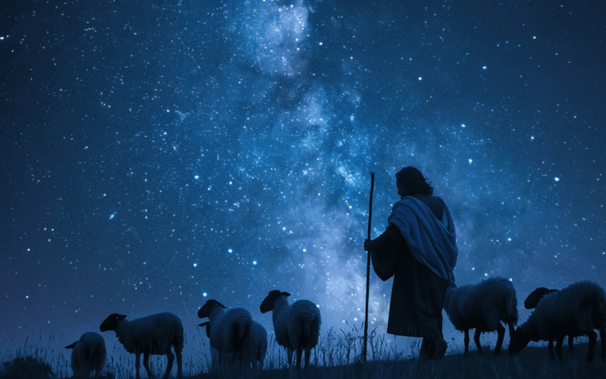
Featured image: A contemplative depiction of Christ as the Good Shepherd standing beneath a star-filled night sky. Image credit: sticker2you / Adobe Stock.

#BishopSilvioJoséBáez #discernment #freedom #goodShepherd #spiritualWarfare

The Fourth Sunday in Easter

Today’s readings

What would you give for just five minutes of peace and quiet? We are all probably sadly familiar with the many loud distractions our world puts before us. And we’ve become quite conditioned to accepting it, even needing it on some primitive level, I think. How often do we get out of bed and flip on the radio or television right away, or check our text messages or email before our feet even hit the floor? Can we even get through a car ride without having the radio going? Is the television always the background noise in our homes? I know I’m guilty of those myself. There’s a whole lot of noise out there and it’s become so that we are very uncomfortable with any kind of quiet.

And the noise doesn’t lead us anywhere good. The Psalmist talks about walking through death’s dark valley. I think some of the noise out there resembles that dark valley pretty closely. There are voices out there tempting us to all sorts of evil places: addictions, selfishness; pursuit of wealth, prestige, or power. Those same voices call us to turn away from the needy, from family, God and the Church. Those same voices tell us that we are doing just fine on our own, that we don’t need anyone else to make us whole, that we are good enough to accomplish anything worthwhile all by ourselves. And those voices are wrong, dead wrong.

Those are the voices of those Jesus mentions in the Gospel who circumvent the gate and come to “steal and slaughter and destroy.” The frightening thing is, we have become so used to these distracting voices that many of us have turned away from God, turned away from the Savior we so desperately need, and have been led astray. That’s the heart of why our pews aren’t filled, why people call themselves “spiritual but not religious”, why the likes of Oprah and Doctor Phil and Joel Osteen have become so popular in this day and age.

So maybe we have to become a little more like sheep. Now I want to be careful about saying that, because being like sheep has a pretty negative connotation. To be clear: I don’t mean that in the sense of cultivating blind obedience. Because, as it turns out, sheep aren’t as dumb as we often think they are.

Here’s the backstory on today’s Gospel image of the sheep, the shepherd, and the sheepfold: In Jesus’ day, the shepherds would gather several flocks in the same fenced-enclosure. The sheepfold might be constructed in a pasture using brush and sticks; or, it would adjoin a wall of a house and have makeshift walls for the other sides. Owners of small flocks of sheep would have combined them in the secure enclosure at night. Someone – the gatekeeper – would then guard the flocks. The “gate” would have been a simple entrance, but the gatekeeper might even stretch out across the opening and literally be the “gate.” The shepherds would arrive early in the morning and be admitted by the gatekeeper. They would call out to their sheep and the members of the flock would recognize the voice of their own shepherd, and that shepherd would “lead them out.” The shepherd then walks in front of the flock and they follow. (cf. Jude Sicilliano, OP)

We, like the sheep, have to cultivate the silence and the ability to hear our shepherd’s voice and follow him, being led to green pastures, and not be distracted by all the noise out there. We are a people in great need of a Savior, of the Good Shepherd. When we deny that, we’ve already lost any hope of the glory of heaven. We desperately need the guidance of the one who is the Way, the Truth and the Life; the one who leads us to eternity, laying down his own life to keep us out of the eternal clutches of sin and death. Jesus came into this world and gave himself so that we might “have life and have it more abundantly.” We just have to stop settling for the noise out there and tune in to our Savior’s voice.

Here’s a way to pray with this in the coming week. Take five minutes, or even just five seconds if that’s all you can find, and consciously turn off the noise: whether it’s the physical noise of the television or radio, or the internal noise of distractions in your head. And then reflect on what voices are out there distracting you from hearing the voice of your Good Shepherd. Ask the Good Shepherd to help you tune them out so that you can more readily discern his voice and follow the right path. Jesus can do amazing things even with a small space of peace and quiet.

Because Christ is risen! He is risen indeed! Alleluia!

#GoodShepherd #sheep

Quote of the day, 26 April: St. John of the Cross

1. A lone young shepherd lived in pain
withdrawn from pleasure and contentment,
his thoughts fixed on a shepherd-girl
his heart an open wound with love.

2. He weeps, but not from the wound of love,
there is no pain in such affliction,
even though the heart is pierced;
he weeps in knowing he’s been forgotten.

3. That one thought: his shining one
has forgotten him, is such great pain
that he bows to brutal handling in a foreign land,
his heart an open wound with love.

4. The shepherd says: I pity the one
who draws herself back from my love,
and does not seek the joy of my presence,
though my heart is an open wound with love for her.

5. After a long time, he climbed a tree,
and spread his shining arms,
and hung by them, and died,
his heart an open wound with love.

Saint John of the Cross

Poem 7, Stanzas applied spiritually to Christ and the soul

John of the Cross, St 1991, The Collected Works of St. John of the Cross, rev. edn, Kavanaugh, K & Rodriguez, O (trans.), ICS Publications, Washington DC.

Featured image: The Good Shepherd is an oil on canvas painting by American artist Henry Ossawa Tanner, dated 1902. This image comes from the Zimmerli Art Museum at Rutgers University. Image credit: Zimmerli Art Museum / Google Art Project (Public domain).

#goodShepherd #poetry #sadness #StJohnOfTheCross #woundOfLove

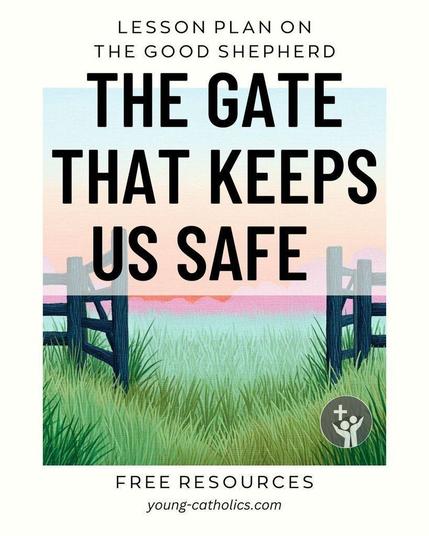
Jesus is the gate who keeps us safe.

This Good Shepherd lesson helps youth reflect on the voices they trust and the choices they make. It shows how following Jesus leads to peace, protection, and a life that grows in faith. ✝️🐑🚪

https://young-catholics.com/94948/the-gate-that-keeps-us-safe-lesson-plan-john-101-10/

#GoodShepherd #CatholicYouth #FaithFormation #EasterSeason

The 4th Sunday of Easter Year A reminds us that Jesus is our Shepherd. He leads, protects, and calls us by name. When we listen to His voice and follow Him, we find peace, safety, and new life. ✝️🐑🌿

https://young-catholics.com/5503/4th-sunday-of-easter-year-a/

#GoodShepherd #EasterSeason #CatholicFaith #YearA

Good Shepherd in Hamilton continues tradition of free Easter dinner on Monday
Dinner will be offered Monday, April 6, from 3 to 4:30 p.m. at the Good Shepherd Centre, 135 Mary St.
https://www.cbc.ca/news/canada/hamilton/good-shepherd-easter-dinner-9.7152904?cmp=rss
You are never alone—the Lord is your Shepherd, leading and restoring your soul. Share this promise of comfort today. #Psalm23 #GoodShepherd #Comfort #BibleVerse

Known, Chosen, and Gathered

DID YOU KNOW

Did you know that the hunger to be known is a spiritual signal, not just a cultural trend?

We live in an age where reality shows and social media promise visibility. People compete for attention as if recognition were oxygen. Yet long before modern celebrity culture, Scripture recognized the deeper ache beneath it. When human beings disconnect from their Creator, they begin seeking affirmation from substitute sources. The Jewish audience in John 10 felt displaced and spiritually scattered. They had religious structure, but many had lost touch with the Shepherd. Into that confusion, Jesus declared, “I am the good shepherd, and I know my own, and my own know me” (John 10:14).

That word “know” carries covenant depth. It is not casual awareness; it reflects intimate recognition and relational commitment. Jesus compares His knowing of us to the mutual knowledge between the Father and the Son. That is staggering. The longing to be known is not wrong—it is misplaced when detached from God. When we chase visibility in the world, we often find exposure without intimacy. But in Christ, we are fully known and fully loved. The affirmation we crave is not found in applause but in the Shepherd who says, “You are mine.”

Did you know that when Jesus called Himself the Good Shepherd, He was claiming to be God in the flesh?

In John 10, Jesus echoes Ezekiel 34, where God rebukes Israel’s failed leaders and promises, “I myself will search for my sheep and seek them out.” When Jesus says, “I am the good shepherd,” He is not offering poetic imagery; He is stepping into that divine promise. He does not merely represent God—He embodies God’s shepherding presence. And He adds something even more startling: “I lay down my life for the sheep” (John 10:15).

This is where reality truly bites. A shepherd risks his life for sheep, but Jesus willingly surrenders His. He explains, “Because of this the Father loves me, because I lay down my life so that I may take possession of it again” (John 10:17). No reality show demands that kind of cost. The world celebrates fame; Christ embraces sacrifice. His shepherding authority is proven through self-giving love. He does not guide from a distance; He leads through death into resurrection. If you ever wonder whether you matter, remember that the Shepherd did not merely speak comforting words—He walked into the valley for you.

Did you know that you are part of a larger flock than you can see?

Jesus continues, “And I have other sheep which are not from this fold. I must bring these also, and they will hear my voice, and they will become one flock—one shepherd” (John 10:16). Those words shattered narrow expectations. His mission extended beyond one ethnic boundary or cultural identity. He was gathering a global flock. In Leviticus 23–25, Israel’s sacred calendar reminded them of God’s covenant rhythms—Sabbaths, feasts, and jubilees. These celebrations reinforced belonging. Yet Jesus points to a deeper unity, one grounded not in geography but in His voice.

This unity matters for our walk with God today. We may feel isolated in faith, especially when culture prizes individualism and self-promotion. But the Shepherd is forming one flock. Every believer who hears and responds to His voice becomes part of a redeemed community. Song of Solomon 8:6 speaks of love as strong as death, unquenchable like mighty waters. That imagery finds fulfillment in Christ’s love for His gathered people. You are not wandering alone; you are called into a shared story. The Shepherd’s voice gathers, aligns, and unites.

Did you know that being chosen by Christ reshapes how you seek affirmation?

At the heart of John 10 is an assurance: “I chose you.” That affirmation changes the way we navigate a culture obsessed with image. When the Shepherd knows you and calls you by name, your value is no longer dependent on trending approval. The need to obsess over who is known—or to strive desperately to be known—begins to loosen its grip. Reality television may promise visibility, but it cannot promise belonging. Jesus offers both identity and intimacy.

This truth recalibrates our daily decisions. When temptation whispers that popularity equals worth, the Shepherd’s voice counters with covenant love. When insecurity urges us to perform, Christ reminds us that we are already received. The Apostle Paul later writes that our lives are “hidden with Christ in God” (Colossians 3:3). Hidden does not mean insignificant; it means secure. The affirmation of heaven outweighs the applause of earth. And when we grasp that, the frantic search for recognition begins to quiet.

As you reflect on these truths, consider where you seek validation. Are you looking sideways at others for affirmation, or upward to the Shepherd? Reality can bite when we chase illusions. But the reality of Christ heals. He knows you, chose you, and gathered you. His voice calls you not to spectacle but to security. Today, pause and listen. Let His words define you more than any platform or comparison ever could.

FEEL FREE TO COMMENT, SUBSCRIBE, AND REPOST, SO OTHERS MAY KNOW


#biblicalAffirmation #GoodShepherd #identityInChrist #John10Devotion #spiritualBelonging