 Chuck Darwin
“This is the most complicated thing that you could possibly imagine,” said Mike Williams, a physicist at the Massachusetts Institute of Technology.
“In fact, you can’t even imagine how complicated it is.”
The proton is a quantum mechanical object that exists as a haze of probabilities until an experiment forces it to take a concrete form.
And its forms differ drastically depending on how researchers set up their experiment.
Connecting the particle’s many faces has been the work of generations.
“We’re kind of just starting to understand this system in a complete way,” said Richard Milner, a nuclear physicist at MIT.
Proof that the proton contains multitudes came from the Stanford Linear Accelerator Center (SLAC) in 1967.
In earlier experiments, researchers had pelted it with electrons and watched them ricochet off like billiard balls.
But SLAC could hurl electrons more forcefully,
and researchers saw that they bounced back differently.
The electrons were hitting the proton hard enough to shatter it
— a process called deep inelastic scattering
— and were rebounding from point-like shards of the proton called quarks.
“That was the first evidence that quarks actually exist,” said Xiaochao Zheng, a physicist at the University of Virginia.
After SLAC’s discovery, which won the Nobel Prize in Physics in 1990,
scrutiny of the proton intensified.
Physicists have carried out hundreds of scattering experiments to date.
They infer various aspects of the object’s interior by adjusting how forcefully they bombard it and by choosing which scattered particles they collect in the aftermath.
Even SLAC’s proton-splitting collisions were gentle by today’s standards.
In those scattering events, electrons often shot out in ways suggesting that they had crashed into quarks carrying a third of the proton’s total momentum.
The finding matched a theory from Murray Gell-Mann
and George Zweig,
who in 1964 posited that a proton consists of three quarks.
Gell-Mann and Zweig’s
“quark model” remains an elegant way to imagine the proton.
It has two “up” quarks with electric charges of +2/3 each and one “down” quark with a charge of −1/3,
for a total proton charge of +1.
But the quark model is an oversimplification that has serious shortcomings.
It fails, for instance, when it comes to a proton’s #spin,
a quantum property analogous to angular momentum.
The proton has half a unit of spin,
as do each of its up and down quarks.
Physicists initially supposed that
— in a calculation echoing the simple charge arithmetic
— the half-units of the two up quarks minus that of the down quark must equal half a unit for the proton as a whole.
But in 1988, the European Muon Collaboration reported that the quark spins add up to far less than one-half.
Similarly, the #masses of two up quarks and one down quark only comprise about 1% of the proton’s total mass.
These deficits drove home a point physicists were already coming to appreciate:
The proton is much more than three quarks.
The Hadron-Electron Ring Accelerator ( #HERA ),
which operated in Hamburg, Germany, from 1992 to 2007,
slammed electrons into protons roughly a thousand times more forcefully than SLAC had.
In HERA experiments, physicists could select electrons that had bounced off of extremely
low-momentum quarks,
including ones carrying as little as 0.005% of the proton’s total momentum.
And detect them they did:
HERA’s electrons rebounded from a maelstrom of
low-momentum quarks and their antimatter counterparts, antiquarks
The results confirmed a sophisticated and outlandish theory that had by then replaced Gell-Mann and Zweig’s quark model.
Developed in the 1970s, it was a quantum theory of the “strong force” that acts between quarks.
The theory describes quarks as being roped together by
force-carrying particles called #gluons.
Each quark and each gluon has one of three types of “color” charge, labeled red, green and blue;
these color-charged particles naturally tug on each other and form a group
— such as a proton
— whose colors add up to a neutral white.
The colorful theory became known as #quantum #chromodynamics, or #QCD.
According to QCD, gluons can pick up momentary spikes of energy.
With this energy, a gluon splits into a quark and an antiquark
— each carrying just a tiny bit of momentum
— before the pair annihilates and disappears.
It’s this “sea” of transient gluons, quarks and antiquarks that HERA,
with its greater sensitivity to
lower-momentum particles,
detected firsthand.
HERA also picked up hints of what the proton would look like in more powerful colliders.
As physicists adjusted HERA to look for lower-momentum quarks,
these quarks
— which come from gluons
— showed up in greater and greater numbers.
The results suggested that in even higher-energy collisions, the proton would appear as a cloud made up almost entirely of gluons
https://www.quantamagazine.org/inside-the-proton-the-most-complicated-thing-imaginable-20221019/
Inside the Proton, the ‘Most Complicated Thing’ Imaginable
The positively charged particle at the heart of the atom is an object of unspeakable complexity, one that changes its appearance depending on how it is probed. We’ve attempted to connect the proton’s many faces to form the most complete picture yet.
 Tom Zijlstra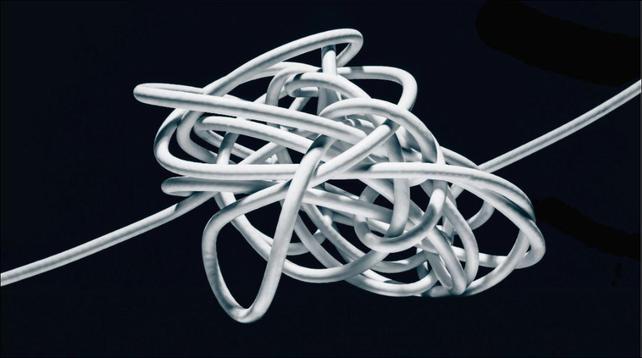
 Knowledge Zone
 formuchdeliberation
 Benjamin Carr, Ph.D. 👨🏻💻🧬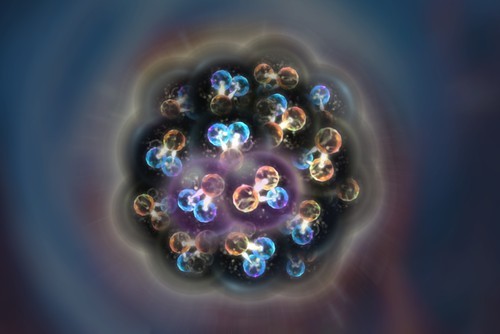


 Nico brettagoge


 Elon Muksis 🇺🇦 🇵🇸 🇪🇺

