https://doi.org/doi:10.1016/j.ydbio.2026.03.001
https://pubmed.ncbi.nlm.nih.gov/41791450/
#Gastrulation
#Drosophila #Embryo
An outstanding question in eukaryotic biology is the mechanistic connection between events occurring at (sub)cellular levels (time scales of milliseconds to minutes) to those at the tissue levels (tens of minutes to months). Deciphering such mechanisms requires imaging approaches capable of simultaneously achieving high spatial and temporal resolutions for large samples over long periods of time. Here, we demonstrate Airy beam-based light sheet microscopy of organelles in tens to hundreds of cells in a few hundred micrometre-wide tissue environments. We achieve a typical resolution of 320 nm over 266 by 266 by 100 micrometer cubed volumes at a temporal rate of 0.05 Hz, typically with generally used fluorophores such as Green Fluorescent Protein, over extended periods of time that allow tracking of organelle and protein dynamics. We validated our approach across different length and time scales by imaging mitochondria and endosome dynamics in very large fields of view in zebrafish tissue, molecular assemblies of myosin as gastrulation proceeds in Drosophila embryos, 3D mitochondrial streaming in mouse oocytes, pressure-driven motility and protrusions in amoebae, mitochondrial dynamics in cancer spheroids, 5-colour fast imaging in iBlastoids, and endosomal dynamics in single cells. Through these model systems, we demonstrate the versatility of Airy beam light sheet microscopy to image large tissues at unprecedented high resolution; to capture dynamics in photosensitive, delicate samples; and to screen 3D samples. We anticipate that our Airy beam-based approach will represent a pivotal advance in cellular biology - especially developmental biology - as it provides, for the first time, true subcellular resolution over large imaging volumes with high temporal resolution. ### Competing Interest Statement The authors have declared no competing interest.
Contractile forces are necessary to sculpt tissue structures and organ shapes during morphogenesis. In the early embryo, this presents an engineering challenge as the deforming tissue can be relatively large, while the forces thus generated might be poorly compartmentalized, generating tensile stresses that can cause damage if unmitigated. Here we show that during Drosophila gastrulation, the squamous morphogenesis of the extraembryonic amnioserosa functions mechanically to release tensile stresses yielded from the neighboring ectodermal convergent-extension and mesodermal invagination. Amnioserosa master regulator Zen transcriptionally silences shroom to endow it with low junctional actomyosin stresses, thereby ensuring high mechanical compliance. Loss of Zen, or targeted ectopic expression of Shroom in the amnioserosa using a novel optogenetic Gal4 system, leads to increased junctional myosin, thereby causing load-dependent tissue ruptures. Our data establish a previously unknown function for the Drosophila extraembryonic tissue, whereby cell-intrinsic mechanical compliance prevents tissue rupture to mitigate inter-tissue mechanical conflicts. ### Competing Interest Statement The authors have declared no competing interest. Japan Society for the Promotion of Science, 20K15810, 22H05167 International Human Frontier Science Program Organization, RGY0082/2015
Gastrulation involves multiple, physically-coupled tissue rearrangements. During Drosophila gastrulation, posterior midgut (PMG) invagination promotes both germband extension and hindgut invagination, but whether the normal epithelial rearrangement of PMG invagination is required for morphogenesis o β¦
Convergent extension of epithelial tissue is a key motif of animal morphogenesis. On a coarse scale, cell motion resembles laminar fluid flow; yet in contrast to a fluid, epithelial cells adhere to each other and maintain the tissue layer under actively generated internal tension. To resolve this apparent paradox, we formulate a model in which tissue flow in the tension-dominated regime occurs through adiabatic remodeling of force balance in the network of adherens junctions. We propose that the slow dynamics within the manifold of force-balanced configurations is driven by positive feedback on myosin-generated cytoskeletal tension. Shifting force balance within a tension network causes active cell rearrangements (T1 transitions) resulting in net tissue deformation oriented by initial tension anisotropy. Strikingly, we find that the total extent of tissue deformation depends on the initial cellular packing order. T1s degrade this order so that tissue flow is self-limiting. We explain these findings by showing that coordination of T1s depends on coherence in local tension configurations, quantified by a geometric order parameter in tension space. Our model reproduces the salient tissue- and cell-scale features of germ band elongation during Drosophila gastrulation, in particular the slowdown of tissue flow after approximately twofold longation concomitant with a loss of order in tension configurations. This suggests local cell geometry contains morphogenetic information and yields experimentally testable predictions. Defining biologically controlled active tension dynamics on the manifold of force-balanced states may provide a general approach to the description of morphogenetic flow.
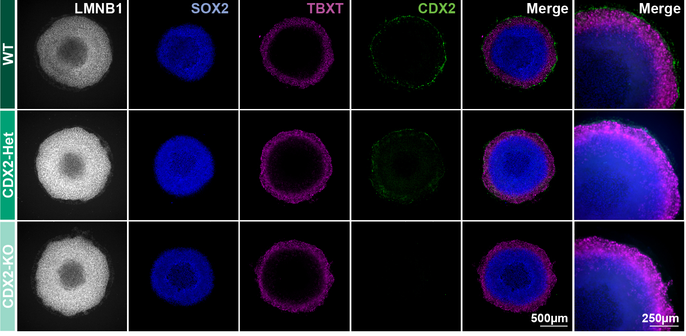
Emily Bulger, Todd McDevitt and Benoit Bruneau show how CDX2 dose-dependently regulates #gene expression in the extraembryonic mesoderm in a #2D gastruloid model.
βThis model allows us to investigate how specific genes active during early gastrulation augment cell identity and how changes in adjacent tissues influence cell-cell communication and the gene regulatory networks underlying lineage emergence.β
Summary: Using 2D human gastruloids, CDX2 is shown to dose-dependently influence genes related to tissue permeability, cell-cell adhesions, and cytoskeletal architecture during extraembryonic mesoderm development.