My 25 years of palaeoart chronology... and it's FossilFriday!

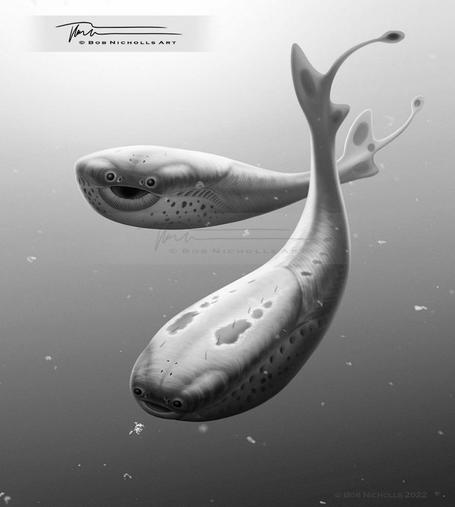
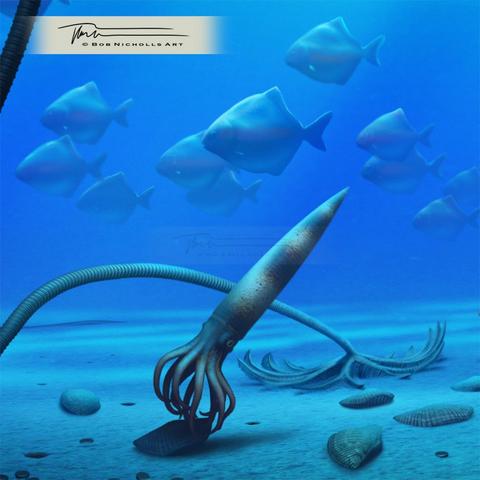
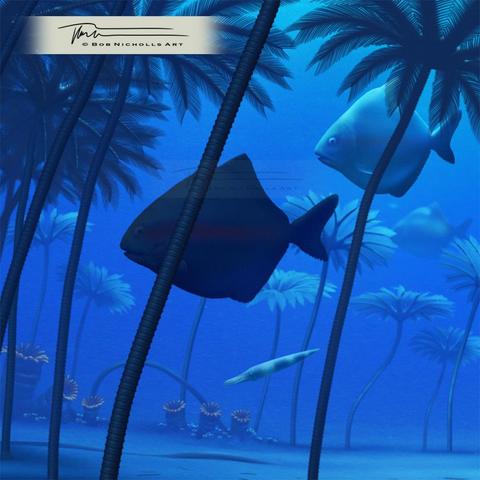
Here's a 2022 painting of Sacabambaspis, a jawless fish from the Ordovician Period. I can't yet say anything about the project is was created for (big news soon).

#Art #Painting #PaleoArt #PalaeoArt #SciArt #SciComm #DigitalArt #Illustration #Dinosaurs #Birds #Pterosaurs #Reptiles #MarineReptiles #Palaeontology #Paleontology #Fish #FossilFish #FossilFriday #JurassicWorld

My 25 years of palaeoart chronology...

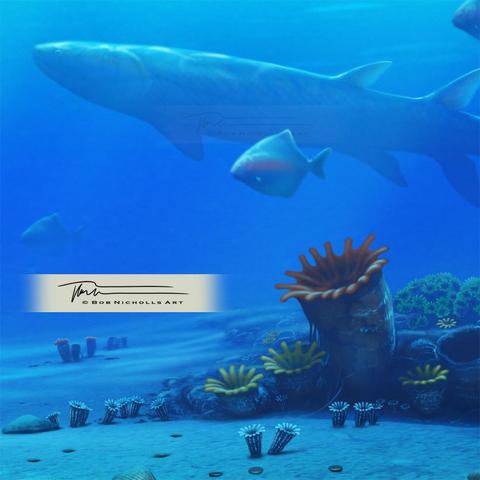
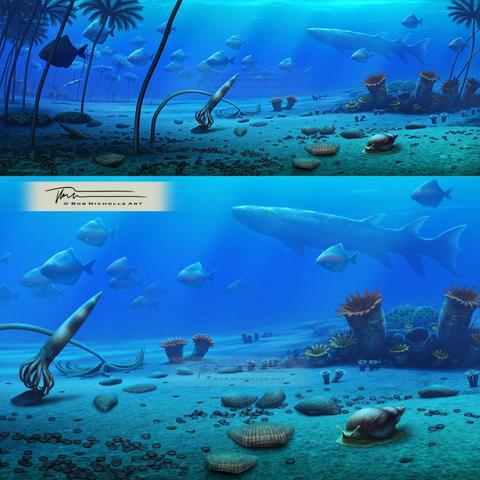
Some zooms into my "Primeval Clevedon Bay" painting (2022), depicting fish, crinoids, othrocones, corals, gastropods, and brachiopods in an Early Carboniferous shallow sea. This painting was the first winner of the Marsh Palaeoart Award.

#Art #Painting #PaleoArt #PalaeoArt #SciArt #SciComm #DigitalArt #Illustration #Dinosaurs #Birds #Reptiles #Palaeontology #Paleontology #Carboniferous #FossilFish #JurassicPark #JurassicWorld

My 25 years of palaeoart chronology...

Here's a second painting of the Severn Estuary, this time during the Early Carboniferous. Called "Primeval Clevedon Bay," it features fish, crinoids, othrocones, corals, gastropods, and brachiopods. This painting was the first winner of the Marsh Palaeoart Award.

#Art #Painting #PaleoArt #PalaeoArt #SciArt #SciComm #DigitalArt #Illustration #Dinosaurs #Birds #Reptiles #Palaeontology #Paleontology #Carboniferous #FossilFish #JurassicPark #JurassicWorld

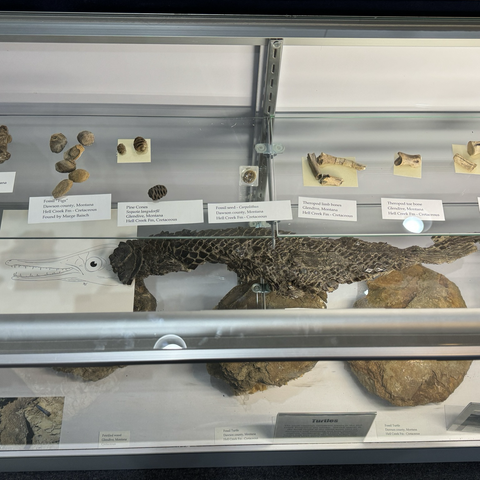
I was asked by the museum director to make supplementary #paleoart for the previously headless #fossil #gar #fish at the Earth Experience #Museum in Murfreesboro!

#fossilfish #fossilgar #Montanafossils #HellCreek

#NewPaper #Paleontology #Paleoichthyology #FossilFish

Greif M, Ferrón HG, Klug C. 2022. A new Meckel’s cartilage from the Devonian Hangenberg black shale in Morocco and its position in chondrichthyan jaw morphospace. PeerJ 10:e14418 https://doi.org/10.7717/peerj.14418

A new Meckel’s cartilage from the Devonian Hangenberg black shale in Morocco and its position in chondrichthyan jaw morphospace

Fossil chondrichthyan remains are mostly known from their teeth, scales or fin spines only, whereas their cartilaginous endoskeletons require exceptional preservational conditions to become fossilized. While most cartilaginous remains of Famennian (Late Devonian) chondrichthyans were found in older layers of the eastern Anti-Atlas, such fossils were unknown from the Hangenberg black shale (HBS) and only a few chondrichthyan teeth had been found therein previously. Here, we describe a Meckel’s cartilage from the Hangenberg black shale in Morocco, which is the first fossil cartilage from these strata. Since no teeth or other skeletal elements have been found in articulation, we used elliptical Fourier (EFA), principal component (PCA), and hierarchical cluster (HCA) analyses to morphologically compare it with 41 chondrichthyan taxa of different size and age and to evaluate its possible systematic affiliation. PCA and HCA position the new specimen closest to some acanthodian and elasmobranch jaws. Accordingly, a holocephalan origin was excluded. The jaw shape as well as the presence of a polygonal pattern, typical for tessellated calcified cartilage, suggest a ctenacanth origin and we assigned the new HBS Meckel’s cartilage to the order Ctenacanthiformes with reservations.

PeerJ

#NewPaper #Paleontology #MarineReptiles #FossilFish #Paleoecology

Leuzinger, L., Kocsis, L., Luz, Z., Vennemann, T., Ulyanov, A., & Fernández, M. (2022). Latest Maastrichtian middle- and high-latitude mosasaurs and fish isotopic composition: Carbon source, thermoregulation strategy, and thermal latitudinal gradient. Paleobiology, 1-21. doi:10.1017/pab.2022.38

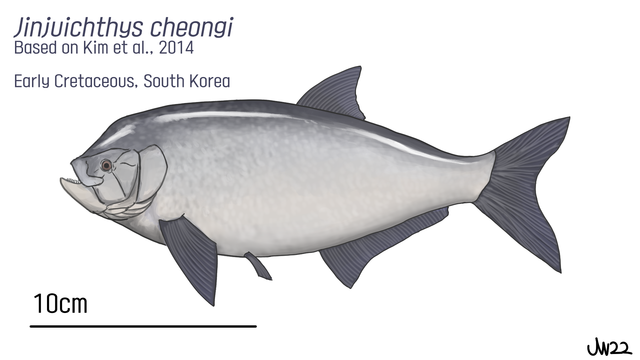
#Sciart #Paleoart #FossilFish Jinjuichthys. Maybe I am the first person who did the reconstruction.