The Empire’s New Enforcers: ICE and the Birth of Trump’s Praetorian Guard
Cliff Potts, WPS News
You can tell a lot about a government by the agency it empowers. Under Trump’s second term, the clearest signal of the administration’s intentions isn’t in the laws Congress passed—none of the big changes came from Congress—but in the agency Trump elevated: Immigration and Customs Enforcement. ICE has always been large, always aggressive, and always controversial. But it was never explicitly political. Not until now.
Since January 20, 2025, ICE has undergone a transformation that should worry anyone who still thinks the Constitution—not the presidency—sets the limits of federal power. What we’re seeing is not the creation of a secret police force or a cartoonish dictatorship. It’s something older, quieter, and historically far more accurate: the emergence of a Praetorian Guard—a force inside the state whose loyalty bends toward the leader instead of the law.
Administrative Power Becomes Personal Power
Most Americans don’t realize ICE carries its own version of a warrant. It’s called an “administrative warrant”—signed not by a judge, but by an ICE officer. These forms were originally intended for limited, civil immigration operations. Under Trump 2.0, they’ve become a shortcut around the Fourth Amendment and a license to act on political priorities.
In practice, these warrants now function like imperial seals: documents used to justify raids, interrogations, and detentions without the inconvenience of judicial oversight. Anyone in the crosshairs—immigrant communities, sanctuary officials, journalists documenting abuse—can be swept into these operations. The paperwork is clean. The legality is gray. The real purpose is pressure.
Fear as a Policy Tool
One of the oldest tactics of the Praetorian Guard was not violence but presence—showing up, unannounced, where the emperor wanted fear to travel. ICE has adopted the same strategy. “Knock-and-talks” now appear in neighborhoods known not for immigration violations, but for political opposition: immigrant-rights organizers, city council members resisting federal mandates, faith groups hosting asylum seekers.
These operations often rely on residents not knowing their rights. No judicial warrant. No obligation to open the door. But the implication of consequences—vague, undefined, and intimidating—is usually enough. The power isn’t in what ICE does; it’s in what people fear it might do.
The Fusion of Agencies
The Praetorian Guard didn’t operate alone. They blended with other forces, pulling power from their proximity to the emperor. ICE today follows that same arc. “Fusion” teams with U.S. Marshals and select state police blur lines of accountability, allowing operations in areas where local officials refuse cooperation.
This blurring isn’t a bureaucratic accident—it’s a feature. When authority becomes cloudy, loyalty, not law, becomes the deciding factor. That’s why Rome fell into the hands of emperors the Guard preferred. And it’s why ICE’s growing fusion culture is so dangerous now.
Surveillance as the New Sword
Instead of daggers, ICE has something more powerful: data. Through partnerships with Palantir, Clearview AI, DMV databases, and utility companies, ICE now holds one of the most comprehensive domestic intelligence networks in the country. Originally sold as tools to track criminals, these databases increasingly sweep in activists, observers, and critics.
This is the new Praetorian playbook: keep a list—not of enemies of the state, but enemies of the ruler’s narrative.
Detention as a Message
ICE’s detention powers allow weeks or months of confinement without criminal charges. Transfers to remote facilities. Restricted access to counsel. Long waits for hearings. Families separated through bureaucratic inertia. These are not accidents. They are soft weapons.
Rome’s Praetorian Guard detained senators to “send messages.” ICE detains asylum seekers, green-card holders, and activists under civil authority. The message lands just as clearly.
The Warning Embedded in History
America is not Rome. But power behaves the same way across centuries. A Praetorian Guard doesn’t take over a nation. It makes sure the person who does take over is never challenged.
ICE is not that far gone. Not yet. But its trajectory—the centralization of discretion, the political alignment, the quiet intimidation, the surveillance apparatus—matches a pattern recognizable to anyone who studies collapsing republics.
If this continues, we won’t wake up in a dictatorship.
We’ll wake up in something worse:
a democracy where power answers to the president first, and the people second.
And once a Praetorian Guard forms, it almost never un-forms.
#AmericanDemocracy #Authoritarianism #CivilLiberties #ErosionOfRights #ExecutivePower #federalOverreach #historicalParallels #HomelandSecurity #ICE #immigrationEnforcement #PoliticalIntimidation #PraetorianGuard #SoftAuthoritarianism #Surveillance #TrumpAdministration WIST Quotations
 The Democracy Advocate
 WPS News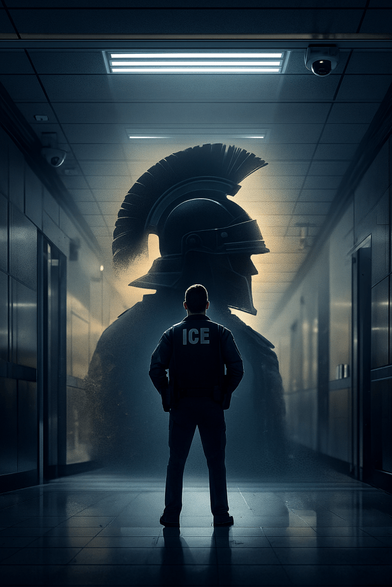

 Techdirt [Unofficial]
 HoosLeft w/ Scott Aaron Rogers
 NewsletterTF