Macroscopic Theories Of Matter And Fields A Thermodynamic Approach ( Advances in Science and Technology in the USSR)

Advances in Science and Technology in the USSR
Mathematics and Mechanics Series

This is a collection of articles by Soviet scientists on current issues of building macroscopic models of matter and fields. Based on thermodynamics concepts the papers develop general variational techniques of modeling material continuous media and fields allowing for their interactions in reversible and irreversible processes. The book is intended for researchers, engi­neers, graduate and postgraduate students interested in the mechanics of continuous media.

Translated from the Russian by Eugene Yankovsky

You can get the book here and here.

Twitter: @MirTitles
Mastodon: @[email protected]
Bluesky: mirtitles.bsky.social

Contents
Preface, L. I. Sedov 7
A Thermodynamic Approach to the Basic Variational Equation for Building Models of Continuous Media, L. I. Sedov 19
Applying the Basic Variational Equation for Building Models of Matter and Fields, L. I. Sedov 43

Introduction 43
Definitions 43
Variations of Tensors for Which Scalar Invariants Retain Their Form 46
Special Types of Tensor Components Qlj 48
Defining Variations and Their Interrelationship in the Comoving and the Observer’s Reference Frame 50
Auxiliary Formulas for Variations 55
Given Scalar and Tensor Parameters Characterizing Models of Material Media and Fields 56
The Determining Parameters in the Characteristics of a Continuous Medium as a Whole and the Characteristics of Individual World Lines 60
The Basic Variational Equation and Identities Following from the Scalar Nature of the Lagrangian Density 62
The Euler Equations for the Basic Variational Equation (2.8.1) 66
The Conditions at Strong Discontinuities 71
On Models of Fluids 74
An Elastic-Body Model 79
Constructing Models of Fields 81
A Model of Interacting Material Medium and Electromagnetic Field 83
Examples 90
Transition from Relativistic to Newtonian Mechanics in the Presence of Irreversible Processes, L. T. Chernyi 98
The Basic Vibrational Equation 98
The Euler Equations and Conditions on Discontinuities 102
Transition to Newtonian Mechanics 106
Irreversible Processes 108
Conclusion 114
Models of Ferromagnetic Continuous Media with Magnetic Hysteresis, L. T. Chernyi 116

Introduction 116
The Determining Parameters 118
The Variational Principle and the Main Equations 121
A Phenomenological Theory of Irreversible Processes 126
Some Corollaries of the General Theory 130
Examples of Models of Magnetizable Media 137
Magnetizable and Polarizable Media with Microstructure, V. A. Zhelnorovich 141

The Determining Parameters of Magnetizable and Polarizable Media with Microstructure 141
Relaxation Models of Magnetizable and Polarizable Media Without Microstructure 150
Models of Magnetizable Liquids with Intrinsic Moment of Momentum 156
Couette Flow of an Incompressible Viscous Magnetizable Liquid 156
Poiseuille Flow in Cylindrical Channel 157
Magnetoacoustic Waves in Magnetizable Liquids 160
On Exact Solutions for Interacting Gravitational and Electromagnetic Fields, G. A. Alekseev 168

Introduction 168
The Einstein-Maxwell Equations in Matrix Form 169
Building the Associated Linear System and the Reduction Conditions 172
Soliton Solutions of the Einstein-Maxwell Equations 176
One-Soliton Solutions with Minkowski’s Space-Time as Background 180
Interaction of Solitons with a Uniform Electromagnetic Field 184
Neutrino Fields in General Relativity, N. R. Sibgatullin 187

Introduction 187
Canonical Equations of Neutrino Fields and Waves 188
On the Infinite Dimensional Algebra and the Lie Group of Neutrino Vacuum Equations 199
Exact Solutions of Neutrino Vacuum Equations 208
Rotation of the Polarization Vector of Gravitational Waves in a Burst of Neutrino Radiation 220
Tensor Representation of Spinor Fields, V. A. Zhelnorovich 224

Introduction 224
Dirac Matrices 224
The Spinor Representation of the Lorentz Group 226
Spinors in Four-Dimensional Pseudo-Euclidean Vector Space 231
Conjugate Spinors 233
The Relation Between Even-Rank Spinors and Tensors 234
The Relation Between First-Rank Spinors and Systems of Complex Tensors 234
Real-Valued Tensors Determined by a Spinor 238
Rotations in Four-Dimensional Space and Spinors 240
Invariant Spinor Subspaces 243
Spinors in Three-Dimensional Euclidean Space 244
Tensor Representation of Spinors in Three-Dimensional Euclidean Space 246
Rotations in Three-Dimensional Space and Spinors 248
Tensor Representation of Differential Spinor Equations in the Minkowski Space 250
Some Solutions of Differential Equations for Relativistic Models of Magnetizable Fluids with Intrinsic Angular Momentum in an Electromagnetic Field 254
Index 26

#elementaryParticles #generalRelativity #mirPublishers #physics #quantumMechanics #sovietLiterature #variationalPrinciples

Vera Chernogorova – Conversations About The Atomic Nucleus (Eureka Series)

The book discusses issues related to the study of the atomic nucleus and its structure, nuclear forces, and the components of the nucleus. It also describes the achievements of Soviet scientists in the field of nuclear energy.

About the Author

After graduating from the Faculty of Physics and Mathematics at university, Vera Aleksandrovna entered postgraduate studies and later became a research fellow at the Joint Institute for Nuclear Research in the town of Dubna. For nearly twelve years, she participated in experiments conducted on a particle accelerator — the synchrocyclotron. Vera Aleksandrovna is a co-author of many scientifi c papers on the study of the properties of mu-mesons.

In recent years, she has published over ten articles in journals such as Znanie — Sila (Knowledge Is Power), Science and Life, Technology for the Youth, and others.

The topics of these articles include problems in nuclear physics, high-energy physics, astrophysics, controlled thermonuclear fusion, the application of scientific achievements in The human practice, and the future of science. Many of these articles have been reprinted in foreign journals.

In 1973, our publishing house released her book Mysteries of the Microworld, which discussed some current problems in the physics of elementary particles. Conversations About the Atomic Nucleus is the author’s second book to appear in the Eureka series.

Illustrations: K. Moshkin
Translated from the Russian & typeset in LaTeX by Damitr Mazanav

You can get the book here and here

This book is an Open Educational Resource (OER).

Released under Creative Commons by ShareAlike 4.0


Twitter: @MirTitles
Mastodon: @[email protected]
Bluesky: mirtitles.bsky.social

#Ccbysa #Oer #elementaryParticles #eurekaSeries #nuclearPhysics #physics #plasmaPhysics #popsci #popularScience #scipop #structureOfMatter

Mysteries of the Mircoworld Vera Chernogorova (Eureka Series)

Translated from the Russian and typeset in LaTeX

A popular science book on particle physics.

CC by SA 4.0

https://archive.org/details/vera-chernogorova-mysteries-of-the-microworld-2025/mode/2up

#soviet #books #popularscience #physics #quantummechanics #elementaryparticles #OER

Mysteries Of The Microworld (Eureka Series) : Vera Chernogorova : Free Download, Borrow, and Streaming : Internet Archive

About the BookThe world of elementary particles is currently in a state similar to that of chemical elements before D. Mendeleev’s discovery of the periodic...

Internet Archive
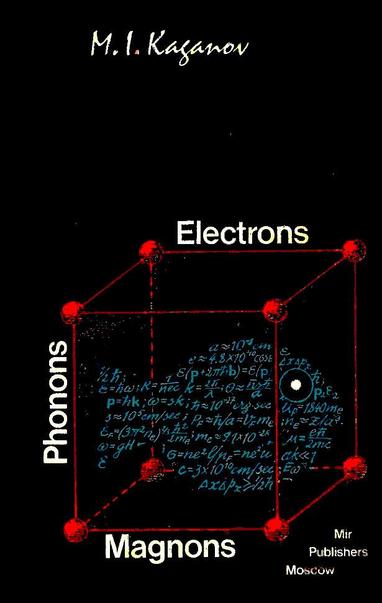
Electrons, Phonons, Magnons : M. I. Kaganov : Free Download, Borrow, and Streaming : Internet Archive

It is a book about the methods of interpreting macroscopic effects, about the  relationship between solid state physics and quantum mechanics, about the...

Internet Archive
White Dwarf Stars May be Shrouded in Extremely Light Particles Called Axions

Since the 1960s, astronomers have theorized that the Universe may be filled with a mysterious mass that only interacts with “normal matter” via gravity. This mass, nicknamed Dark Matter (DM), is essential to resolving issues between astronomical observations and General Relativity. In recent years, scientists have considered that DM may be composed of axions, a … Continue reading "White Dwarf Stars May be Shrouded in Extremely Light Particles Called Axions"

Universe Today
How the Higgs Field (Actually) Gives Mass to Elementary Particles | Quanta Magazine

In this article adapted from his new book, “Waves in an Impossible Sea,” physicist Matt Strassler explains that the origin of mass in the universe has a lot to do with music.

Quanta Magazine
AI Starts to Sift Through String Theory’s Near-Endless Possibilities | Quanta Magazine

Using machine learning, string theorists are finally showing how microscopic configurations of extra dimensions translate into sets of elementary particles — though not yet those of our universe.

Quanta Magazine
Visualizing the mysterious dance: Quantum entanglement of photons captured in real-time

Researchers at the University of Ottawa, in collaboration with Danilo Zia and Fabio Sciarrino from the Sapienza University of Rome, recently demonstrated a novel technique that allows the visualization of the wave function of two entangled photons, the elementary particles that constitute light, in real-time.

Phys.org

Watch the latest episode of our series NewIn with Lukas Heinrich, our newly appointed Professor for #DataScience in #Physics. He develops methods which help discover new #elementaryparticles based on huge amounts of data: http://go.tum.de/200052

#Higgsboson #machinelearning

📷 A. Eckert
https://youtu.be/eB_DRAyMEuc
🎥 @prolehre

Search for elementary particles with the help of artificial intelligence

As Professor for Data Science in Physics Lukas Heinrich develops methods which help discover new elementary particles based on enormous amounts of data.

A card game about elementary particles. Pre-order via https://elementarythegame.com #elementaryparticles #particleinabox
Elementary The Game - A Physics Game

Elementary The Game