 The Brevity Blog
Obstacle, Desire, Destination: Create Drama from Your Fragments with Spiral Structure
By Allison K Williams
“My story doesn’t have one climactic moment!” wailed a frustrated essayist. “How am I supposed to arrange all these pieces in my collection if not chronologically? And my younger self and my older self are both protagonists—how do I balance that?”
Dramatic structure is one of our most powerful tools for crafting writing, from essays to full-length memoir. For plotters, outlining our story in a preexisting structure creates a map of where our story can go. For writers flying by the seat of their pants, structure can be a tool to shape our wild, free first draft, helping us find the moments of tension, building conflict, and emphasizing turning points where major decisions or discoveries are made.
Yet we often think of dramatic structure as purely linear. Certainly, some of the most common structures, like Five Act, Three Act, Save the Cat, or The Hero’s Journey are largely chronological, a steady series of peaks and valleys rising left to right. Even if the story is told out of chronological order, these typical structures are so present in human stories from mythology and folklore to present-day mass media, their very linearity is ingrained in our creative minds.
But for essayists and those building essay collections, for writers working in fragments or vignettes, and for creators in hybrid forms that mix prose and poetry or fact and fiction, linear just doesn’t cut it.
Consider instead the spiral structure. Not simply a twisted staircase, but a pattern anchored by three points:
Obstacle
Desire
Destination
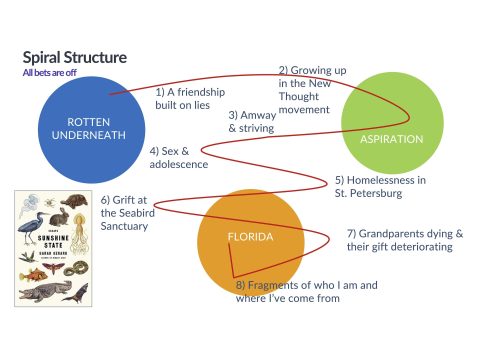
In Sarah Gerard’s collection Sunshine State, essays around and about Florida, the Desire is aspiration; to raise her circumstances, to have “made it.” The Obstacle is that everything in Florida is rotten underneath a shiny surface. The eventual destination is the Sunshine State of the title, acceptance of the imperfect self.
Gerard’s first essay shows a friendship built on lies, rotten underneath. She and a friend have linking hip tattoos reading “forever / & ever” but Sarah’s “& ever” appears to spell “Beaver.” The second essay is about growing up in the New Thought movement, an environment of aspiration after her parents’ battles with alcoholism. The third shows young adult sex and relationships—aspirational, and rotten underneath.
The collection swings between Desire and Obstacle, some essays more on one side and some on the other, until we reach the Destination: who the author is in Florida, and what Florida is, in the author.
Spiral structure effectively creates thematic conflict. Each essay rooted in the Desire contains anything from a hint to a full intrusion of the Obstacle: alcoholism, bad relationships, betrayal. Each essay about the Obstacle holds a moment of hope, or is at war with the Desire: the unfortunate tattoo began as an aspiration.
Even without direct character conflict like a fight or opposing points of view, tension between Obstacle and Desire creates drama, both in individual essays and in the collection. And this drama can power your essay or book in fragments, or drive your collection, bringing to life the whole while creating more interplay between pieces.
Reality TV and documentaries work on this same, spiral structure. The principal characters have a Desire: to win the prize, show themselves, change the world. They face a primary Obstacle: the other contestants, their own shortcomings, a system stacked against them.
Clever film editing creates dramatic rhythm:
- Some scenes focus on Desire: “Winning this title would mean so much to my family!”
- Some on Obstacle: “We spent three hours at the Senator’s office but she wouldn’t see us.”
- Scenes of Desire include the Obstacle: “You’ve made it to the semi-finals! But Sam has won four challenges so far, do you really think you can beat them?”
- Scenes focusing on Obstacle include the Desire: “We have six more congresspeople to talk to this week, and we only need one of them to bring our bill to the floor.”
In your own work, assess the overall themes. What is the Desire, the longed-for outcome for the narrator or character? What is the primary Obstacle, within them or an outside force? And what Destination signals the resolution of the quest or the end of the road?
For each fragment, vignette, essay or scene, notice whether the content is more focused on the Desire or the Obstacle, and revise to strengthen that focus. Perhaps an Obstacle moment needs more despondency, and the stormy weather that day gets another sentence. Maybe a Desire section needs more achievement, and the last paragraph about a later failure gets deleted, ending the section on a joyful note. Look for the tension created by opposites—a hint in a Desire scene that all is not well, shown by someone picking up a bottle of wine they swore off. An image in an obstacle scene that sustains hope, shown by the protagonist’s awareness of the birds outside her window.
Writers working in fragments or building a collection already know: it’s hard to string all the writing together in a way that feels naturally connected and makes deeper meaning. Applying spiral structure can solve that problem, spark connections between disjointed pieces, and bring the drama of the whole to life.
________
Allison K Williams is Managing Editor of The Brevity Blog.
Bring your writing back to life this season! Join Allison & Brevity‘s Editor-in-Chief Dinty W. Moore for Midsummer Memoir, a 3-day virtual intensive July 10-11-12. With craft classes on scene, character and dialogue, morning “café time” for casual chat and networking, and our legendary live editing, you’ll reconnect with your work and energize your practice for the long hot summer ahead. We appreciate our blog readers! Use code BREVITYBLOG before July 1 for $50 off. Find out more/register now.
#dramaticStructure #essayCollections #findTheTension

 Writers Digest (unofficial)
 C.L. Irwin

 김윤미 Kim Yoonmi (Surname first)