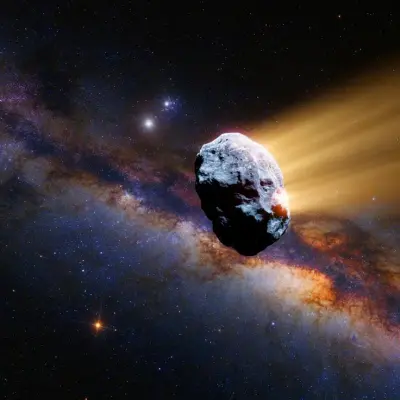
Interstellar Comet 3I/ATLAS Appears To Be Experiencing "Cryovolcanism", And Is Eerily Similar To Objects In The Outer Solar System - IFLScience
https://atlas.whatip.xyz/post.php?slug=interstellar-comet-3iatlas-appears-to-be-experiencing-cryovolcanism-and-is-eerily-similar-to-objects-in-the-outer-solar-system-iflscience
"Unveiling the Cosmic Drama: Interstellar Comet 3I/ATLAS's Cryovolcanism Sparks New Discoveries!"
#space #astronomy #interstellar #comet #cryovolcanism
Interstellar Comet 3I/ATLAS Appears To Be Experiencing "Cryovolcanism", And Is Eerily Similar To Objects In The Outer Solar System - IFLScience

In a groundbreaking discovery, astronomers have observed intriguing signs of "cryovolcanism" on the enigmatic interstellar comet 3I/ATLAS, raising eyebrows in the scientific community. This phenomenon...

🪐 Boil, freeze, bubble, crack, repeat! Scientists simulate the solar system's 'ice volcanoes' in the lab

#Space #cryovolcanism #Geology

https://phys.org/news/2025-07-scientists-simulate-solar-ice-volcanoes.html

Boil, freeze, bubble, crack, repeat! Scientists simulate the solar system's 'ice volcanoes' in the lab

Scientists have been able to recreate the extreme conditions found on icy moons in deep space—and revealed the unstable behavior of water.

Phys.org

SciTech Chronicles. . . . . . . . .April 28th, 2025

https://bit.ly/stc042825

#skeletal #circadian #vision #Rtf1 #EOS #"300 Light-years" #"Molecular clouds" #EOS #"300 Light-years" #"Molecular clouds" #mitogenomes #deep-time #demographic #diversification #cryovolcanism #RTG #2049 #Plumes

SciTech Chronicles. . . . . . . . .April 28th, 2025

  From the lab to the street,trust in science not deceit.. Vol II No 22 251 links Curated Weird deep sea fish in the Mariana Trench all have...

Saturn’s largest moon, #Titan, is particularly captivating for scientists.

It is known to host an #atmosphere about 1.5 times denser than Earth’s and bodies of liquid on its surface.

But even such a large #moon lacks the mass to keep a tight hold on its atmosphere.

Now, new experimental research shows that the chemical compounds in Titan’s atmosphere could emerge from processes in its interior.

#Cryovolcanism replenishes its thick atmosphere.

#planets #astronomy
https://www.astronomy.com/science/cryovolcanism-on-titan-may-replenish-its-thick-atmosphere/

Cryovolcanism on Titan may replenish its thick atmosphere

Experiments suggest that processes in the interior of the moon could keep it swathed in an atmosphere that should otherwise have been lost.

Astronomy Magazine

The organic material found in a few areas on the surface of dwarf #planet #Ceres is probably of exogenic origin.

Impacting asteroids from the outer asteroid belt may have brought it with them.

Instead, the dwarf planet's #cryovolcanism, in which salty brine rises from the body's interior to the surface, is not responsible for the organic deposits.

These findings help to understand where and how #habitable conditions could have arisen in the solar system.

#astrobiology
https://phys.org/news/2025-01-dwarf-planet-ceres-material-space.html

Dwarf planet Ceres may have received organic material from space objects

The organic material found in a few areas on the surface of dwarf planet Ceres is probably of exogenic origin. Impacting asteroids from the outer asteroid belt may have brought it with them.

Phys.org
Dwarf planet #Ceres may have its origin in the #asteroidbelt, #mpsgoettingen scientists argue in a new paper in the Journal of Geophysical Research Planets. Yellowish bright material in #ConsusCrater is rich in ammonium and connected to Ceres’ curios #cryovolcanism, they find. More here: https://www.mps.mpg.de/dwarf-planet-ceres-origin-in-the-asteroid-belt?c=6775 Original paper: https://agupubs.onlinelibrary.wiley.com/doi/10.1029/2023JE008150
Dwarf planet Ceres: Origin in the asteroid belt?

Dwarf planet Ceres may have originated in the asteroid belt - and did not necessarily “migrate” there from the outer edge of the Solar System. This is indicated by bright, ammonium-rich deposits in Consus Crater, as a research team led by the Max Planck Institute for Solar System Research (MPS) in Göttingen argues today in the Journal of Geophysical Research Planets. The researchers analyzed observational data from NASA's Dawn space probe. Dawn had already discovered widespread ammonium deposits on the surface of Ceres years ago. According to some scientists, this suggests that frozen ammonium played a role in the dwarf planet’s formation. Ammonium is only stable in the outer Solar System. The new study finds another possibility: like other bright deposits on Ceres, the ammonium-rich material in Consus Crater could have been transported to the surface from within by Ceres' curious cryovolcanism.

Science Magazine astronomy covers appreciation post

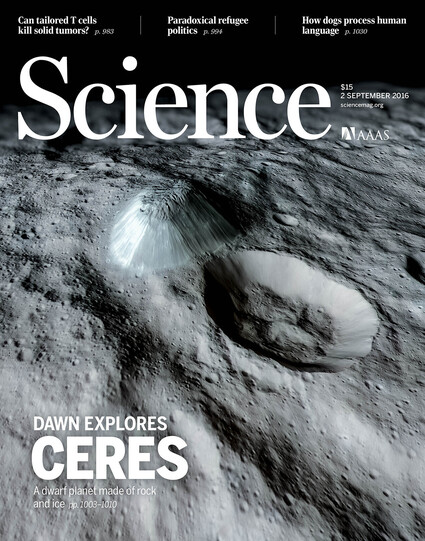
Dawn explores Ceres (2016) - Featuring Ahuna Mons, a 4-kilometer-high cryovolcano formed by an eruption of ice from beneath the surface and an unnamed 17-kilometer-diameter crater.

https://science.org/toc/science/353/6303

#universe #ceres #dwarfplanet #dawn #spacecraft #dawnspacecraft #nasa #astronomy #astrophysics #astrodon #space #science #sciencecovers #cover #covers #research #planets #planet #solarsystem #cryovolcanism #crater #craters

Contents | Science 353, 6303

Science