Great news!! A fast, butterfly (aka FFT-like), implementation of the Noiselet Transform [1] is now integrated into the LazyLinop toolbox [2] – “a python toolbox to ease and accelerate computations with (“matrix-free”) linear operators.” Thank you to Pascal Carrivain and Rémi Gribonval from the OCKHAM/INRIA team [3], in ENS Lyon, France (where I’m currently invited for a sabbatical year in 25-26) for this implementation. The idea came from common discussions we had together (I share my office with Pascal at ENS Lyon) about possible additional butterfly transformations to complete the (already long) list of operators integrated to LazyLinop. The whole Noiselet Tansform (and its inverse) is described here in the LazyLinop documentation, with a demonstration code in python. Enjoy!

---

[1] https://laurentjacques.gitlab.io/post/some-comments-on-noiselets/

[2] https://faustgrp.gitlabpages.inria.fr/lazylinop/index.html "Lazylinop is a python toolbox to ease and accelerate computations with (“matrix-free”) linear operators. It provides glue to combine linear operators as easily as NumPy arrays, PyTorch/CuPy compatibility, standard signal/image processing linear operators, as well as advanced tools to approximate large matrices by efficient butterfly operators."

[3] https://team.inria.fr/ockham/

#Noiselet #CompressiveSensing #Butterfly #fft #InverseProblem #Python #Numeric #PyTorch
Some comments on the Noiselet Transform (special "LazyLinopt update") | Laurent Jacques

Updates: (22/04/26) Great news!! A fast, butterfly (aka FFT-like), implementation of the Noiselet Transform (see below) is now integrated into the LazyLinop toolbox – “a python toolbox to ease and accelerate computations with (“matrix-free”) linear operators.

Laurent Jacques

Easy Ghost Imaging simulations (and some codes to do it at home)

A few weeks ago I gave a short seminar on how to do very simple Ghost Imaging simulations. So simple that you can run then in your latptop in a few seconds (or minutes), and you can use them as building blocks to develop larger projects. I created a Github repo with all the codes needed, and I will explain how to use them a little bit here. This is just a quick text covering some of the slides of the seminar, which were aimed at people who are already familiar with Ghost Imaging, but not so […]

https://fsolt.es/2025/04/easy-ghost-imaging-simulations-and-some-codes-to-do-it-at-home/

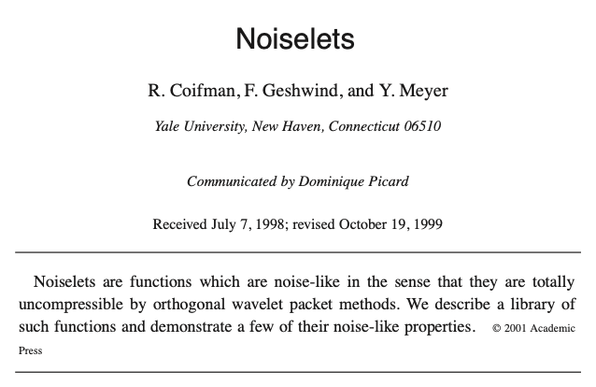
[New Python code: PyNoiselet] About 15 years ago, I wrote a simple set of matlab functions to compute the #Noiselet transform of Coifman et al (R. Coifman, F. Geshwind, and Y. Meyer, "Noiselets", *Applied and Computational Harmonic Analysis*, 10(1):27–44, 2001). The noiselet transform is used in #CompressiveSensing applications as well as in #Sparse signal coding as noiselets have minimally low coherence with wavelet bases (Haar and Daubechies), which is useful for sparse signal recovery.

Today, from a code request received yesterday by email, I decided to quickly rewrite this old code in Python (with the useful help of one LLM I admit).

Here is the result if you need an O(N log N) (butterfly like) algorithm to compute this transformation:

https://gitlab.com/laurentjacques/PyNoiselet

More information also in this old blog post : https://laurentjacques.gitlab.io/post/some-comments-on-noiselets/

Feel free to fork it and improve this non-optimized code.

Laurent Jacques / PyNoiselet · GitLab

GitLab.com

GitLab
"Phase Transitions in Phase-Only Compressed Sensing," by
Junren Chen, Lexiao Lai, Arian Maleki https://arxiv.org/abs/2501.11905 #PhaseOnly #CompressiveSensing
Phase Transitions in Phase-Only Compressed Sensing

The goal of phase-only compressed sensing is to recover a structured signal $\mathbf{x}$ from the phases $\mathbf{z} = {\rm sign}(\mathbfΦ\mathbf{x})$ under some complex-valued sensing matrix $\mathbfΦ$. Exact reconstruction of the signal's direction is possible: we can reformulate it as a linear compressed sensing problem and use basis pursuit (i.e., constrained norm minimization). For $\mathbfΦ$ with i.i.d. complex-valued Gaussian entries, this paper shows that the phase transition is approximately located at the statistical dimension of the descent cone of a signal-dependent norm. Leveraging this insight, we derive asymptotically precise formulas for the phase transition locations in phase-only sensing of both sparse signals and low-rank matrices. Our results prove that the minimum number of measurements required for exact recovery is smaller for phase-only measurements than for traditional linear compressed sensing. For instance, in recovering a 1-sparse signal with sufficiently large dimension, phase-only compressed sensing requires approximately 68% of the measurements needed for linear compressed sensing. This result disproves earlier conjecture suggesting that the two phase transitions coincide. Our proof hinges on the Gaussian min-max theorem and the key observation that, up to a signal-dependent orthogonal transformation, the sensing matrix in the reformulated problem behaves as a nearly Gaussian matrix.

arXiv.org

From @iscompsensing : "Recordings of #RADAR and #RemoteSensing session from #ISCS23 is now available on #youtube!
https://m.youtube.com/channel/UCUimNzje2TgXX1WvRtcZlGw
"

You can also subscribe to the YouTube channel @IS-Computational-Sensing

#CompressiveSensing #ComputationalSensing #Imaging #conference #video

International Symposium on Computational Sensing

Teile deine Videos mit Freunden, Verwandten oder der ganzen Welt

YouTube

From Julián Tachella @JulianTachella, posted on "Chi":

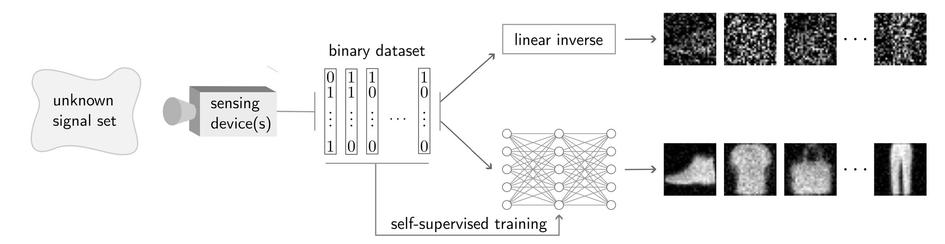
📰""Learning to reconstruct signals from binary measurements alone"📰

We present theory + a #selfsupervised approach for learning to reconstruct incomplete (!) and binary (!) measurements using the binary data itself. See the first figure and its alt-text.

https://arxiv.org/abs/2303.08691
with @lowrankjack
---

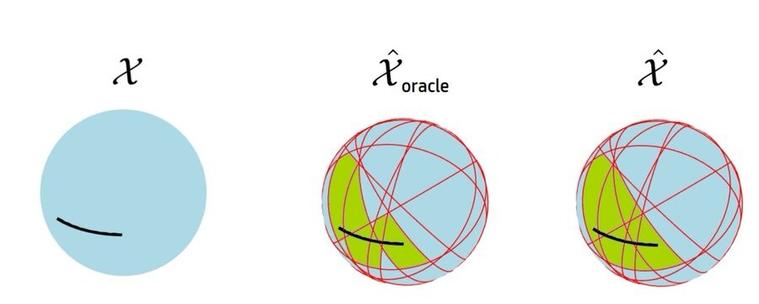
The theory characterizes

- the best approximation of a set of signals from incomplete binary observations
- its sample complexity
- complements existing theory for signal recovery from binary measurements

See the third figure and its alt-text.
---

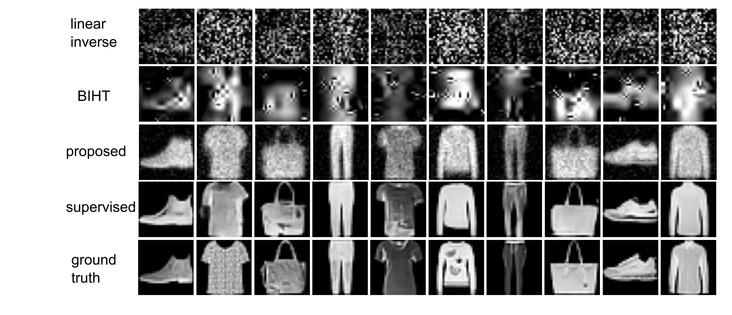
The proposed self-supervised algorithm obtains performances on par with supervised learning and outperforms standard reconstruction techniques (such as binary iterative hard thresholding)

See the second figure and its alt-text.

---

Code based on the deepinverse library is available at https://github.com/tachella/ssbm

Check out the paper for more details!

#SelfSupervisedLearning #CompressiveSensing #Quantization #InverseProblem #1bitcamera

Learning to Reconstruct Signals From Binary Measurements

Recent advances in unsupervised learning have highlighted the possibility of learning to reconstruct signals from noisy and incomplete linear measurements alone. These methods play a key role in medical and scientific imaging and sensing, where ground truth data is often scarce or difficult to obtain. However, in practice, measurements are not only noisy and incomplete but also quantized. Here we explore the extreme case of learning from binary observations and provide necessary and sufficient conditions on the number of measurements required for identifying a set of signals from incomplete binary data. Our results are complementary to existing bounds on signal recovery from binary measurements. Furthermore, we introduce a novel self-supervised learning approach, which we name SSBM, that only requires binary data for training. We demonstrate in a series of experiments with real datasets that SSBM performs on par with supervised learning and outperforms sparse reconstruction methods with a fixed wavelet basis by a large margin.

arXiv.org
Slides and abstract of my talk "Interferometric single-pixel imaging with a multicore fiber" made at ISCS23 (Luxembourg, June 12-14, 2023) now available at https://laurentjacques.gitlab.io/event/interferometric-single-pixel-imaging-with-a-multicore-fiber/ and https://laurentjacques.gitlab.io/publication/interferometric-single-pixel-imaging-with-a-multicore-fiber/ All this is based on the work of Olivier Leblanc. Long journal preprint version "Interferometric lensless imaging: rank-one projections of image frequencies with speckle illuminations" on https://arxiv.org /abs/2306.12698 in colaboration with S. Sivankutty, M. Hofer, H. Rigneault, #imaging #lensless #compressivesensing #computationalimaging #speckle #compressedsensing #InverseProblem (toot generated thanks to https://tootpick.org directly from my website)
Interferometric single-pixel imaging with a multicore fiber | Laurent Jacques

Abstract: Lensless illumination single-pixel imaging with a multicore fiber (MCF) is a computational imaging technique that enables potential endoscopic observations of biological samples at cellular scale. In this work, we show that this technique is tantamount to collecting multiple symmetric rank-one projections (SROP) of a Hermitian interferometric matrix – a matrix encoding the spectral content of the sample image.

Laurent Jacques

📣 Deadline Extension Alert 📣

Due to popular demand, we're excited to announce that the deadline for abstract submissions for http://ISCS2023.com has been extended by a week! You now have until 3/22/23 to submit your abstracts. Don't miss out on this opportunity!

#compressivesensing #computationalimaging #biomedical #electronmicroscopy #microscop #signalprocessing #deeplearning

ISCS 2023

The International Symposium on Computational Sensing (ISCS) brings together researchers from optical microscopy, electron microscopy, RADAR, astronomical imaging, biomedical imaging, remote sensing, and signal processing. With a particular focus on applications and demonstrators, the purpose of

It is our pleasure to announce the title of Prof. Ayush Bhandari's keynote talk, "Computational Sensing via Folding: Revisiting the Legacy of Shannon-Nyquist, Prony, Schoenberg, Pisarenko and Radon."

See #ISCS2023 website for the abstract of this talk.

Submit your papers before March 15, for platform, poster, or show-and-tell demo presentations.

* Conference website: https://www.iscs2023.com/

#microscopy #radar #remotesensing #astronomical #biomedical #signalprocessing #compressivesensing #electronmicroscopy #ComputationalSensing

ISCS 2023

The International Symposium on Computational Sensing (ISCS) brings together researchers from optical microscopy, electron microscopy, RADAR, astronomical imaging, biomedical imaging, remote sensing, and signal processing. With a particular focus on applications and demonstrators, the purpose of

It is our pleasure to announce the title of Prof. Yves Wiaux's keynote talk, "Optimisation and Deep Learning for Large-scale High-dynamic Range Computational Imaging in Radio Astronomy."

See #ISCS2023 website for the abstract of this talk.

Submit your papers before March 15, for platform, poster, or show-and-tell demo presentations.

* Conference website: https://www.iscs2023.com/

#microscopy #radar #remotesensing #astronomical #biomedical #signalprocessing #compressivesensing #electronmicroscopy #ComputationalSensing

ISCS 2023

The International Symposium on Computational Sensing (ISCS) brings together researchers from optical microscopy, electron microscopy, RADAR, astronomical imaging, biomedical imaging, remote sensing, and signal processing. With a particular focus on applications and demonstrators, the purpose of