 Lnk.Bio
Your 3D models deserve more than screenshots 👀
Now you can embed interactive Speckle models right into your LnkBio page.
🎯 Zoom, rotate, explore - all in your linkinbio
Check it out → https://lnk.bio/linkin/embed-your-speckle-3d-models-on-lnkbio

Your 3D models deserve more than screenshots 👀
Now you can embed interactive Speckle models right into your LnkBio page.
🎯 Zoom, rotate, explore - all in your linkinbio
Check it out → https://lnk.bio/linkin/embed-your-speckle-3d-models-on-lnkbio
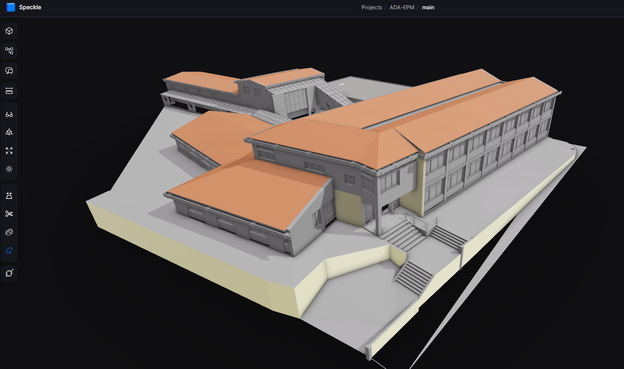
Project management web app 3D data base
Project management app that allows real-time 3D data base connection to Speckle and firebase #speckle #javascript #firebase ... source
https://quadexcel.com/wp/project-management-web-app-3d-data-base/
Primeiro post a compartilhar renderização de IA e competir por um ano de renderizações gratuitas + brindes Speckle. #Renderização #GendoAI #Speckle
prompt:
Snow, Christmas scene, modern exterior school, hyper realistic, soft glow lights from windows, interior christmas tree with lights

In Europe and interested in #FreeSoftware, #OpenSource, or #OpenBIM? In this year's #BILTEUR24 there will be a class from #ThatOpenCompany, 3 classes from #Speckle, and 1 double lab about the #BlenderBIM Add-on! https://bilteur2024.dekon.com.tr/schedule/


Abstract: Lensless illumination single-pixel imaging with a multicore fiber (MCF) is a computational imaging technique that enables potential endoscopic observations of biological samples at cellular scale. In this work, we show that this technique is tantamount to collecting multiple symmetric rank-one projections (SROP) of a Hermitian interferometric matrix – a matrix encoding the spectral content of the sample image.
Very happy of this 3-year work on "Interferometric #lensless #imaging: rank-one projections of image frequencies with #speckle illuminations" (https://arxiv.org/abs/2306.12698) carried out by Olivier Leblanc (ICTEAM, UCLouvain, Belgium), in collaboration with Mathias Hofer (Inst. Fresnel, France), Siddharth Sivankutty (U. Lille, France), and Hervé Rigneault (Inst. Fresnel, France).
In this work, we study how lensless imaging with a multicore fiber amounts to probing the spatial frequency content of an image (e.g., a biological sample for potential endoscopic applications).
In particular, by randomly programming the phase of the light emitted by each core (thanks to a spatial light modulator), the sensing model amounts to combining frequencies of the sample image, and this combination is explained by a rank-one projection model of a certain interferometric matrix.
Knowing this model improves our understanding of the model and eases the calibration compared to other speckle imaging approaches.

Lensless illumination single-pixel imaging with a multicore fiber (MCF) is a computational imaging technique that enables potential endoscopic observations of biological samples at cellular scale. In this work, we show that this technique is tantamount to collecting multiple symmetric rank-one projections (SROP) of an interferometric matrix--a matrix encoding the spectral content of the sample image. In this model, each SROP is induced by the complex sketching vector shaping the incident light wavefront with a spatial light modulator (SLM), while the projected interferometric matrix collects up to $O(Q^2)$ image frequencies for a $Q$-core MCF. While this scheme subsumes previous sensing modalities, such as raster scanning (RS) imaging with beamformed illumination, we demonstrate that collecting the measurements of $M$ random SLM configurations--and thus acquiring $M$ SROPs--allows us to estimate an image of interest if $M$ and $Q$ scale log-linearly with the image sparsity level This demonstration is achieved both theoretically, with a specific restricted isometry analysis of the sensing scheme, and with extensive Monte Carlo experiments. On a practical side, we perform a single calibration of the sensing system robust to certain deviations to the theoretical model and independent of the sketching vectors used during the imaging phase. Experimental results made on an actual MCF system demonstrate the effectiveness of this imaging procedure on a benchmark image.
 Python Job Support
 JMArts Designer
 Dion Moult
 Low Rank Jack
 Lauren Juice 🧃
 OSArch - Open Source in AEC