https://www.walknews.com/1188695/ CLACK、マイクロン財団の支援により、広島で高校生向けAI教育・キャリア教育プログラム「AI Bridge Hiroshima」を開始 | 認定NPO法人CLACKのプレスリリース #CLACK、マイクロン財団の支援により、広島で高校生向けAI教育・キャリア教育プログラム「AIBridgeHiroshima」を開始 #hiroshima #PRTIMES #サービス #サイト #ニュースリリース #プレスリリース #代行 #広島 #広島県 #方法 #配信

Yet another Agfa Clack? This time we’re going to try a pinhole conversion.

My experiments with pinhole photography have never been really satisfactory. Firstly there was the pinhole option on the Diana F+, and then I discovered digital pinhole photography and the worst lens in the world, the Thingyfy Pinhole Pro. Yes, I could have bought myself a dedicated pinhole camera, like the Ondu or similar, but I really wanted to make my own.

A pinhole photograph taken with th Diana F+ using Lomography Redscale film.

Actually, I’ve had a home-made wine box pinhole camera on the go since, I don’t know when, but I’m not sure that’s never going to be finished. Which brings me to the Agfa Clack. To date I have three Agfa Clacks. There’s my ‘original’ Clack, the one I bought first and used for the Frugal Film Project in 2023. The second was bought to flip the lens, but the film wind-on knob was broken and I’ve never used it, and the third I added to replace the second one and flip the lens, which worked beautifully.

Back in the woods with my favourite old tree and a flipped lens Agfa Clack.

But now I’ve added a fourth to my collection and one might wonder, what on earth for? Well this time I would like to convert the venerable Clack to a pinhole camera, quite a common thing to do, so far as I can tell. Of course this one was in the ‘Not Passed’ category of the Kamerastore website, and is described as having ‘a significant amount of dust inside the optics that will affect image quality, but it is otherwise functional.’ Well, a little bit of dust will be no obstacle, seeing as I intend to rip out its innards anyhow (carefully, of course) before reassembling it with a pinhole behind the shutter mechanism. 

The Clack is a simple 120 roll film box camera introduced by Agfa in 1954. It will produce eight 6x9cm images per roll of film and has a fixed shutter speed of 1/30s (plus bulb) and two aperture settings, for sunny or cloudy weather (approximately f16 and f11, respectively.) It also features a ‘close-up’ lens or a yellow filter depending on the model. The early models were made of metal and the later versions of moulded plastic.

Taking apart a Clack is the easiest camera conversion ever. First remove the silver ring by unscrewing the single screw underneath the lens turret. Then twist the cover and it should pop off, revealing the lens above the shutter and aperture mechanism. 

The lens is held in place with a couple of pins and a single screw. Undo this screw and lift off the lens. Below is the aperture and shutter fixed to a plastic plate with two screws. Undo these and prise off the plate. You won’t be able to lift it much, though, since the two wires that power the flash are soldered to contacts under the plate. These wires need to be cut to fully remove the plate. 

Underneath the plate is a hole which opens to the camera body. The pinhole needs to be fixed here. It is possible, apparently, to just place this centrally over the hole and screw the plate back in place, but my pinhole kept on moving and I ended up glueing it in place. Just make sure that the pinhole is centred in the hole. Once the pinhole is in place, the camera can be reassembled. 

And that’s it. Except that for me it wasn’t quite. Although the lens is normally removed, I read somewhere that replacing the lens can give a bit extra sharpness, so I thought I would give that a try. However, what I did was take the lens, remove it from the holder and then flip it. Hopefully, this will give a slightly sharper pinhole image with distortion around the edges: the Deakinizer effect.

The distance of the pinhole to the focal plane (the focal length) of the Clack is about 72mm, and the pinhole aperture was 0.3mm, so by dividing the the focal length by the diameter of the pinhole we get an f-number of f240. I’ll use this measurement to determine the exposure time depending on the speed (ISO) of the film that I’ll be using.

Hopefully I’ll be able to get the flipped lens pinhole Agfa Clack out before the current Shitty Camera Challenge ends in January, but I’ve got a fair few things to do before then. If you are on Mastodon, you can now follow this blog directly. Just go to Mastodon and follow the ‘Snapshot’ WordPress account at @keithdevereux.wordpress.com. All new posts will be automatically updated to your timeline.

#Agfa #AgfaClack #Blurry #Camera #Clack #Dreamy #LensFlip #LensReverse #Pinhole
lo-fi Nintendo music to crew and quaver to

https://youtube.com/watch?v=mNiZFojFPhU — Which team are you in??? #mechanicalkeyboard #soundtest #clack #thocky #creamy #shorts (0:14)

Which team are you in??? #mechanicalkeyboard #soundtest #clack #thocky #creamy #shorts

YouTube

i am having lewd thoughts about building a split keeb. Should I? Should i not. And switching to workman or colemak layout.

#sexonthekeebs
#clackety #clack
#keybroads

I have to use my mechanical keyboard now. #clack #clack #clack

My first year with the Frugal Film Project was a mixed bag. For a start it was really only ten months, we were away on holiday during August and apart from a few days in October when I took an Agfa Clack clone instead of the Clack that month was a washout. I also didn’t get out and about as much as I had intended and my outings weren’t as adventurous as I had hoped. I was also continually challenged with the Clack (or rather Clacks as they both had the same issue) by ‘fat’ rolls, where the film and backing paper did not wrap tightly around the take-up spool. 

Despite all of these challenges, it was an enjoyable year and I really got to love my Agfa Clacks by the end of the year I had two Clacks on the go: the conventional Agfa Clack and a second model that I cleaned up and flipped the single lens. This produced photographs with a lovely radial blur around the outside of the image. I also explored multiple exposures, trichromes, and even the Vortoscope, three mirrors clamped together in a triangle shape like an open-ended kaleidoscope. 

In Early December I took the flipped lens Agfa Clack with me to try some trichromes. Sadly,  by my own fault I completely underexposed the images, so right at the tail end of the month I tried again. I headed to Águas Boas and made trichromes of my favourite views, the bandstand in the park and a lonely tree that sits in a field raised above the road. I also grabbed shots of a Christmas decoration by the roadside and the window of a derelict house. The lab I use in Aveiro only has a mask for 6×7 sized frames, not 6×9, the format of the Agfa Clack. So I end up with some strangely frames trichromes from time to time. Yes, I can scan the images again with the DigitaLiza Max, but sometimes I really like how these oddly framed trichromes come out.

I already have my film/camera combination ready for next year’s Frugal Film Project, in fact by the time this post is published (or is it ‘dropped’ in the modern vernacular) I’m sure I will have already posted my first images. Looking forward to seeing you all in 2024.

If you are on Mastodon, you can now follow this blog directly. Just go to Mastodon and follow my WordPress account at @[email protected]. All new posts will be automatically updated to your timeline on Mastodon.

https://keithdevereux.wordpress.com/2024/02/03/the-frugalfilmproject-december-2023-the-final-entry-of-the-year/

#Agfa #AgfaClack #Camera #Clack #Experimental #Fomapan #FrugalFilmProject #Retro #Trichrome #TrichromeEverything #Vintage

/ˈsnæp.ʃɒt/

snapshot: an informal photograph

/ˈsnæp.ʃɒt/

Lo dico?
Lo dico... Il mio libro è fuori da qualche giorno. Raccoglie fondi e si chiama CLACK!
Vi piacciono i romanzi?
Vi piace il fantasy?

Fatemi domande!!! 😁

#fantasy #libri #leggere #CLACK #scrivere #

After giving the Agfa Billy-Clack No.51 a good clean it was time to put it through its paces for the first time in who knows how long. From the state of the camera, with its dirty body and hazy glass, it was clearly a long time since it had been used but it was now clean and the shutter was firing nicely.

The Agfa Billy-Clack  has a single shutter speed of about 1/30s and three aperture settings (f8.8, f11 and f16), which are set with a lever on the front of the camera. In the late 1930s, when this camera was most likely made, the speed of typical films would have been about ISO 30-50. Modern films have a generous latitude and I reckoned that a fil with a speed of about ISO 100 would be perfectly usable in the camera.

For my first test with this camera I chose to use Lomochrome Purple from Lomography, a colour shifting film that turns vegetation to shades of red, as the infrared stock, Kodak Aerochrome, used to do. Lomochrome Purple has an ISO rating of 100-400, so it has quite a large latitude, but I still wondered if that might be too sensitive for the Billy-Clack. I therefore decided that I would set the aperture of the Billy-Clack to its smallest aperture (f16, it was a sunny day) and also used an ND2 filter, which would further cut exposure down by a stop.

To minimise camera shake, I rested the camera on a tripod each time I took a photograph. Thus of the 16 exposures on the roll I actually had 8 duplicated photographs, one without the filter and one with the ND filter.

On the back of the Bill-Clack is a long swivelling cover, behind which are two red windows to space sixteen 6×4,5 exposures from a normal 120 film. I thought that it might be quite complicated using the two windows, but in fact it was quite easy to keep track of the exposures.

On completing the film around the Melia Ria Hotel in the centre of Aveiro it was time to take it to Forever Blue for processing. Upon fully winding on the film and opening the back I found the film was tightly wound around the take up spool.  No worries about getting ‘fat’ rolls here. Now there was a nervous week waiting for the film to be developed and scanned.

Just after lunch today the smartphone chimed and there was a WeTransfer email in my in box. With some nervousness I opened and extracted the directories to find sixteen beautifully exposed images. I was thrilled. A quick check showed that thee were no obvious light leaks, although on one duplicate set there was a large red blob that might have been light getting in somewhere.

I really liked how these images came out. With most of them there was little difference between the frames taken with the ND filter and those without. In the exposures without the ND filter the grass was a little darker and in the frames with the ND filter the images were perhaps a little bit warmer, but there certainly wasn’t much difference between them. With my next experiment I think I’ll just use a film without any filters. In fact, I quite fancy trying out the Billy-Clack with some Lomography Redscale.

If you are on Mastodon, you can now follow this blog directly. Just go to Mastodon and follow my WordPress account at @[email protected]. All new posts will be automatically updated to your timeline on Mastodon.

https://keithdevereux.wordpress.com/2023/11/29/first-outing-with-the-agfa-billy-clack-lomochrome-purple-in-aveiro-28-november-2023/

#Agfa #ArtDeco #BillyClack #Camera #Clack #Experimental #Film #Lomochrome #Lomography #Purple #Vintage

First outing with the Agfa Billy-Clack: Lomochrome Purple in Aveiro, 28 November 2023

After giving the Agfa Billy-Clack No.51 a good clean it was time to put it through its paces for the first time in who knows how long. From the state of the camera, with its dirty body and hazy gla…

/ˈsnæp.ʃɒt/

I’ve been good recently, really good, but then a long sought after camera appeared on the Kamerastore website. It was probably overpriced, and not in good condition according to the description, but I added a new Clack to my growing collection. This time an Agfa Billy-Clack.

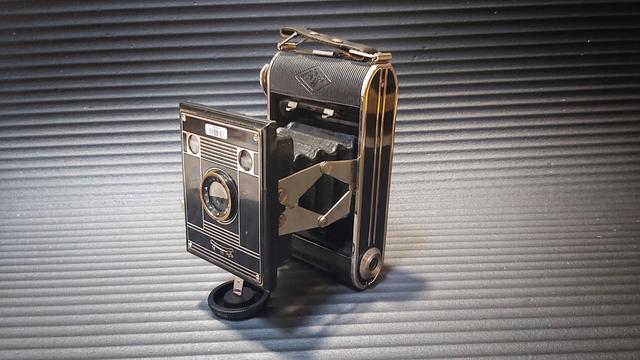
The Agfa Billy Clack is a strut-folding camera made by Agfa from about 1934 to 1940. There were two models; the Billy-Clack No. 51, which takes sixteen 6×4,5cm photos on a roll of 120 film, and the Billy-Clack No.74, which takes eight 6×9 cm pictures on a roll of 120 film. Both models were nearly identical, the body of the Billy-Clack No. 51 was slightly smaller, featuring a single shutter speed of about 1/30s (and ‘B’) and three aperture settings (f8.8, f11 and f16), which are set with a lever on the front of the camera.

The model on the Kamerastore website was the Billy-Clack No. 51 and was described as having, ‘rust on the body. Fungus, haze, and dust inside the lens. A bit loose and worn throughout’. I felt this was going to be a long-term project, but when the Agfa Billy-Clack arrived, it was lovely. This is the later version with the vertical lines on the front leatherette, which suggest that it dates from 1938-40.

The condition of the Billy-Clack was better than I thought, though it certainly needed a good clean. The leatherette and the front plate was dirty, the front lens was full of haze, and inside the film chamber and rear lens was full of haze and dust. The ‘brilliant’ viewfinders on the front plate for landscape and portrait image orientation were anything but, they were filled with dust and haze. On the top of the Billy-Clack is a sports finder, that opens up and allows the user to frame an image without using the mirrored viewfinders. However, on mine this was broken, so I’m going to keep it closed.

I gave the Agfa Billy-Clack a good clean of the outside with a gentle wipe and on the inside with a cotton bud soaked in methanol. The cleaned the film chamber and the rear lens quite nicely. I lot of dirt and grime came out of the metal film holders and the places where the film and take-up spool sits and I reckon they had not been cleaned in a long time. On the front of the Billy-Clack I couldn’t get into the ‘guts’ of the camera because there was a rusty screw firmly stuck in the plate. I was able to clean the front glass and the viewfinders though, which now look really ‘brilliant’. There was one minor hiccup, for a few minutes I lost a tiny screw from the front plate.

One thing I did discover while cleaning the Billy-Clack is that the take-up mechanism isn’t compatible with some modern plastic spools, at least with my camera. Sometimes the spools are just too big for the metal guides, which have a little circle of metal that protrudes out and catches the smooth top of the plastic spool, making it stick. Looking at older spools, there is a little indentation in the flat circular part that fits snugly into the frame and allows the spool to turn smoothly. Fortunately I have a few older metal and wooden spools, and some plastic ones that work, but I’m going to have to be very careful with making sure that I get them back from the lab when processing.

On the back of the Bill-Clack is a long swivelling cover, behind which are two red windows. The Billy-Clack No. 74 only has one window, because it is a regular 120 film camera, but because the Agfa Billy-Clack No. 51 is a 6×4,5 frame camera it uses two windows to align the frames properly on the negative.to get 16 exposures from a normal 120 film. The film is wound on until a number appears in the first window, and an image is taken. The film is then advanced until the same number appears in the second window, when another image can be taken. Then the film is wound on until the next number appears in the first window for the next image until all 16 images have been taken. Of course, with a 120 film the frame numbers don’t go to 16 but to 8, because the windows are in the same position to read numbers for a camera taking 6x9cm images.

Now that the Bill-Clack has been cleaned it looks much better. The viewfinders really are brilliant now and the front glass and rear lens are clear of dirt and haze. I’m hoping that the lens inside the camera has also been protected, but unfortunately because of the stuck screw I could not get to it. Typically, film available at the time would have had an ISO of around 30-50, and according to what I have learned with a modern 100 ISO film I can use an aperture f16 for sunny conditions, f11 for hazy days and f8.8 for cloudy conditions. My first test will load a roll of Lomochrome Purple that I had sitting around for a while and will see how that works. But that will be a post for another day.

If you are on Mastodon, you can now follow this blog directly. Just go to Mastodon and follow my WordPress account at @[email protected]. All new posts will be automatically updated to your timeline on Mastodon.

https://keithdevereux.wordpress.com/2023/11/20/the-agfa-billy-clack-an-art-deco-strut-folding-camera-20-november-2023/

#Agfa #ArtDeco #Believeinfilm #BillyClack #Camera #Clack #Experimental #Film #Filmisnotdead #Fomapan #FrugalFilmProject #Retro #Shootfilmbenice #Vintage

/ˈsnæp.ʃɒt/

snapshot: an informal photograph

/ˈsnæp.ʃɒt/