 Charring Auh
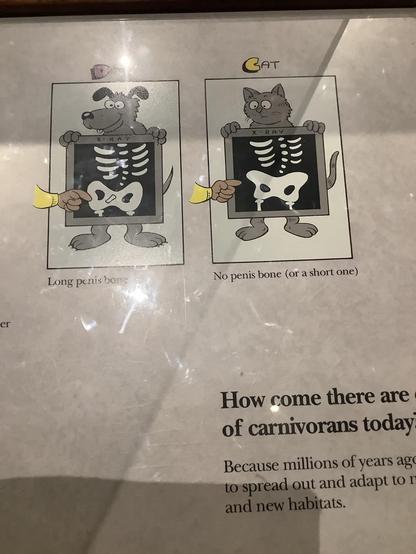
How come there are of #carnivorans today
Because millions of years ag to spread out and adapt to r
Because millions of years ag to spread out and adapt to r
Oligocene-Period Raccoon-Like Mammal Had Mollusk-Based Diet https://www.sci.news/paleontology/eoarctos-vorax-11988.html
An exquisitely preserved skeleton of #Eoarctos vorax from #NorthDakota (early #Oligocene) and systematics and phylogeny of North American early #arctoids https://www.tandfonline.com/doi/full/10.1080/02724634.2022.2145900
E. vorax belongs to #Subparictidae, a North American family of extinct bear-like #carnivorans within the infraorder Arctoidea. The animal also had cat-like claws that likely helped it climb up and down the trees of the ancient wetland.
Today, #Africa's iconic #predators are #carnivorans such as #hyenas, #lions, and wild #dogs. But before this group arrived, a different type of #predator roamed Africa: #hyaenodonts (despite their name, not close relatives of living carnivorans) This #hyaenodont, Pakakali (#Swahili for "fierce #cat") is from #Nsungwe, #Tanzania 🇹🇿, a #Miocene site that dates to just before the arrival of carnivorans from #Eurasia.
Image from Borths & Stevens 2017

Throughout the Paleogene, most terrestrial carnivore niches in Afro-Arabia were occupied by Hyaenodonta, an extinct lineage of placental mammals. By the end of the Miocene, terrestrial carnivore niches had shifted to members of Carnivora, a clade with Eurasian origins. The transition from a hyaenodont-carnivore fauna to a carnivoran-carnivore fauna coincides with other ecological changes in Afro-Arabia as tectonic conditions in the African Rift System altered climatic conditions and facilitated faunal exchange with Eurasia. Fossil bearing deposits in the Nsungwe Formation in southwestern Tanzania are precisely dated to ~25.2 Ma (late Oligocene), preserving a late Paleogene Afro-Arabian fauna on the brink of environmental transition, including the earliest fossil evidence of the split between Old World monkeys and apes. Here we describe a new hyaenodont from the Nsungwe Formation, Pakakali rukwaensis gen. et sp. nov., a bobcat-sized taxon known from a portion of the maxilla that preserves a deciduous third premolar and alveoli of dP4 and M1. The crown of dP3 bears an elongate parastyle and metastyle and a small, blade-like metacone. Based on alveolar morphology, the two more distal teeth successively increased in size and had relatively large protocones. Using a hyaenodont character-taxon matrix that includes deciduous dental characters, Bayesian phylogenetic methods resolve Pakakali within the clade Hyainailouroidea. A Bayesian biogeographic analysis of phylogenetic results resolve the Pakakali clade as Afro-Arabian in origin, demonstrating that this small carnivorous mammal was part of an endemic Afro-Arabian lineage that persisted into the Miocene. Notably, Pakakali is in the size range of carnivoran forms that arrived and began to diversify in the region by the early Miocene. The description of Pakakali is important for exploring hyaenodont ontogeny and potential influences of Afro-Arabian tectonic events upon mammalian evolution, providing a deep time perspective on the stability of terrestrial carnivore niches through time.
#NewPaper #Carnivorans #Ecology
Strampelli P, Campbell LA, Henschel P, Nicholson SK, Macdonald DW, Dickman AJ. 2022. Trends and biases in African large carnivore population assessments: identifying priorities and opportunities from a systematic review of two decades of research. PeerJ 10:e14354 https://doi.org/10.7717/peerj.14354

African large carnivores have undergone significant range and population declines over recent decades. Although conservation planning and the management of threatened species requires accurate assessments of population status and monitoring of trends, there is evidence that biodiversity monitoring may not be evenly distributed or occurring where most needed. Here, we provide the first systematic review of African large carnivore population assessments published over the last two decades (2000–2020), to investigate trends in research effort and identify knowledge gaps. We used generalised linear models (GLMs) and generalised linear mixed models (GLMMs) to identify taxonomic and geographical biases, and investigated biases associated with land use type and author nationality. Research effort was significantly biased towards lion (Panthera leo) and against striped hyaena (Hyaena hyaena), despite the latter being the species with the widest continental range. African wild dog (Lycaon pictus) also exhibited a negative bias in research attention, although this was partly explained by its relatively restricted distribution. The number of country assessments for a species was significantly positively associated with its geographic range in that country. Population assessments were biased towards southern and eastern Africa, particularly South Africa and Kenya. Northern, western, and central Africa were generally under-represented. Most studies were carried out in photographic tourism protected areas under government management, while non-protected and trophy hunting areas received less attention. Outside South Africa, almost half of studies (41%) did not include authors from the study country, suggesting that significant opportunities exist for capacity building in range states. Overall, large parts of Africa remain under-represented in the literature, and opportunities exist for further research on most species and in most countries. We develop recommendations for actions aimed at overcoming the identified biases and provide researchers, practitioners, and policymakers with priorities to help inform future research and monitoring agendas.
 Lukas VFN 🇪🇺
 John Orcutt
 Thomas Holtz
 Dr. Heather F. Smith