 Some Guy's Thoughts
From what I’ve seen, a lot of people who wear Meta Glasses seem to match the personality of what you’d think a Meta Glasses wearer would have.
 Zorz Studios
Waves are ‘Dumb’ #CameraGlasses aimed at creators: https://zorz.it/eKtcn
#JaronSchneider #ContentCreator #glasses #streaming #Symphonic #Waves #equipment #mobile #creators


 Unofficial PetaPixel Bot
Waves Are ‘Dumb’ Camera Glasses Aimed at Creators https://petapixel.com/2025/07/24/waves-are-dumb-camera-glasses-aimed-at-creators/ #contentcreator #cameraglasses #Equipment #streaming #symphonic #glasses #Mobile #waves #News

 Liz Whitmere
I’m suddenly captivated by #CameraGlasses not for social media use but for POV filmmaking. Are there any #SpyGlasses out there that don’t require a deal with the devil to run? I’d accept 1080p but have to believe there’s a higher quality resolution available given we live in the future.
 diyphotography (unofficial)
Rankin shoots world’s first magazine cover shot with FB smart glasses
#inspiration #cameraglasses #facebook #rankin #rayban #smartglasses #snapchat #snapchatspectacles

Rankin shoots world's first magazine cover shot with FB smart glasses - DIY Photography
Other than privacy concerns, it looks like Facebook’s and Ray-Ban’s camera glasses have also sparked creative ideas. Famous British photographer Rankin has recently shot the world’s first magazine cover using precisely this little gadget – both as a prop and as a camera. View this post on Instagram A post shared by rankin (@rankinarchive) Rankin […]
 petapixel (unofficial)
Brain Implant and Camera Glasses Restore Sight to Blind Woman
A team of researchers has found a way to restore sight to the blind by combining a brain implant with a pair of camera glasses.
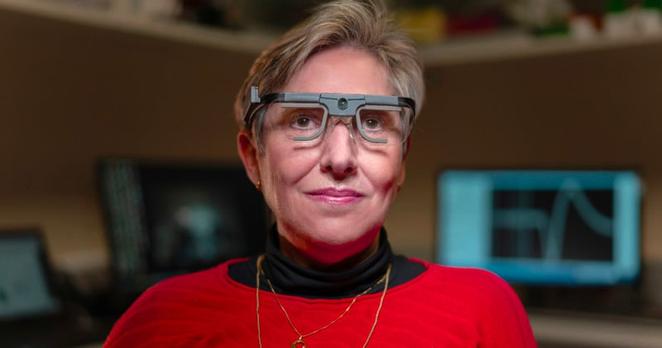
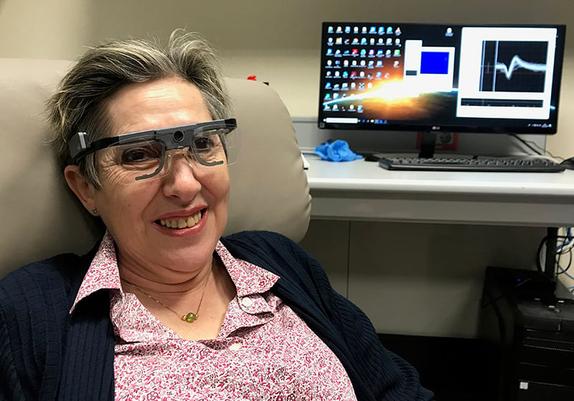
As summarized in an article from The University of Utah, a team of researchers from the John A. Moran Eye Center at the University of Utah and Spain’s Miguel Hernandez University successfully created a form of artificial vision for a blind 58-year old biology teacher named Berna Gomez.
When she was 42, Gomez developed toxic optical neuropathy, a severe disease that destroyed the optic nerves that connect her eyes to her brain. The illness left her blind.
To try and give her back her vision -- at least to some degree -- the team applied what they describe as a "visual prosthesis" that combines a 4×4-millimeter electrode with a hundred micro-needles and attached it to the visual cortex of Gomez's brain.
"We implanted an intracortical microelectrode array consisting of 96 electrodes in the visual cortex of a 57-year-old person with complete blindness for a six-month period. We measured thresholds and the characteristics of the visual percepts elicited by intracortical microstimulation," the team explains.
The implant, called the Moran | Cortivis prosthesis, is designed to bypass the eye and optic nerve and send signals directly to the center of visual perception in the brain, which was the focus of the researchers' attempts to restore Gomez's vision.
After the implant was inserted into her brain, Gomez spent six months with the researchers in a lab where she underwent daily tests that allowed her to practice with her new implant. Over the course of that time, she learned to recognize spots of light and edges of objects that were fed to her as a direct stimulation from the prosthesis.
According to the report that was published in The Journal of Clinical Investigation, the researchers found the process to be a rousing success. There were no complications with the implant process and they were able to consistently obtain high-quality recordings from the visually deprived neurons of her brain over time.
During the last part of the study, the researchers combined the implant with special glasses with a built-in camera that scanned objects in front of Gomez and then stimulated the electrodes in her brain through the prosthesis, which enhanced her ability to "see" simple images. Gomez was then able to learn to see contrasting boundaries of black and white stripes on cardboard.
<https://petapixel.com/assets/uploads/2021/11/151331-JCI-CMED-RV-3_sd_538313.mp4>
Based on the descriptions, what Gomez was experiencing was a completely new way of "seeing" that mimics how people with unimpaired eyesight perceive vision, but different since it has to bypass the normal optical pathways. This method requires training the brain to understand the signals that are being sent as sight over a period of time.
The results of their study have led the researchers to believe they have made major developments in the field.
"We observed a learning process that helped the subject to recognize complex patterns over time," the team reports and says that they believe that they have proven that this method has a high potential for restoring functional vision in the blind.
The full research report can be read in The Journal of Clinical Investigation.
_Image credits: Photos of Berna Gomez provided courtesy of the John A. Moran Eye Center at the University of Utah. _
#news #technology #cameraglasses #emergingtechnology #journal #moraneyecenter #science #scientificdiscovery #scientificjournal #smartglasses #universityofutah



Facebook’s camera glasses raise privacy concerns as you may not know when you’re being filmed
#news #cameraglasses #facebook #rayban #smartglasses #snapchat #snapchatspectacles

Facebook’s camera glasses raise privacy concerns as you may not know when you’re being filmed - DIY Photography
Earlier this month, Facebook debuted its first pair of “smart glasses” make in partnership with Ray-Ban. Of course, they have already raised privacy concerns because of the built-in cameras. As it turns out, the LED indicator telling you that the camera is on is way too small, making it easier to secretly film anyone. The […]
Why Not Wear a Camera on Your Face?
Think about it for a minute: if you’re willing to hold a camera to your eye, why not have a camera attached to it that can snap away, by voice instruction, instead of finger on the shutter?
That’s the premise of Facebook’s new $299 camera glasses that also play music and podcasts. And if you just got an icky feeling hearing that the Social Network wants access to your eyes and ears while you are out and about, know that Facebook has gone out of its way to have a partner do the marketing.
The glasses are officially called Ray-Ban Stories, and they’re being sold by the sunglass maker “in partnership” with Facebook on their website and other stores.
But that doesn’t change the bottom line. The glasses are made by Ray-Ban, but the software comes from the most notorious tracker of our personal and professional lives, Facebook.
Do you want to give Facebook more clues about where you shop and visit, who you hang out with and such? Sure, they say they don’t do that with these glasses, but this is Facebook. How much do you trust it?
So let’s take Facebook out of the equation and just talk about the concept of glasses that can double as a camera. Imagine that these smart glasses were made by Canon, Nikon or Sony, companies with solid reputations when it comes to our privacy.
I’m in. The idea makes sense to me.
If I can hold a camera to my eye and capture, the composition process would be more efficient with smart glasses. I love the idea of snapping something I would see right then and there, without having to pull the camera to my eye, or grabbing the smartphone from my pocket, opening the camera app and lining it up to shoot.
With camera glasses I could do all this by just positioning my head to frame the shot. I haven’t tried the Ray-Ban shades, but I’m assuming my head in place and glasses on my nose would be steadier than hand any day of the week. So potentially sharper photos.
And you could do some pretty cool POV videos by just turning the other cheek.
If I got pulled over by a cop and wanted to record the conversation, it would be less obtrusive to just let it roll from my glasses instead of shoving a smartphone at the officer.
Street photography? Wow.
You could take all sorts of photos of people without them noticing and getting mad at you. (Facebook does note that “the Capture LED light lets people know when you’re taking a photo or video so you won’t catch anyone near you off guard.”) How’s that gonna work on a bright sunny day? I’m guessing the light won’t be very visible.
As my mind reeled with all awful things one could do with these devices (a school soccer coach was arrested recently for installing a tiny camera in the girl’s bathroom), Facebook beat me to the punch by identifying them.
" Stop recording if anyone expresses that they would rather not be in a photo or video." Duh.
Don’t have the glasses on in private spaces like a doctor’s office, locker room, public bathroom, or place of worship. Obviously. But who wears sunglasses to church?
Let people see the LED light. If you chose to cover it up, as Facebook’s Mark Zuckerberg is said to do, by applying tape over his computer webcam, you are breaking the rules. “Tampering with this light is against our terms of service.”
Be good. “Don’t use your glasses to engage in harmful activities like harassment, infringing on privacy rights, or capturing sensitive information like pin codes.” Oh boy.
Now while it’s hard to believe that smart glasses technology in my lifetime will ever rival that of my Sony cameras, with manual controls for shutter speed and exposure, who knows? Apple and Android smartphones have gotten very close.
For now, the Facebook camera shoots low-resolution 5 megapixel photos and videos, about half the size of what I get on my iPhone 12 Pro (4032 x 2268 vs. Ray-Ban’s 2592 x 1944) and even lower 1184×1184 square videos.
And there’s a clunky method, explained by Facebook, that transfers the photos to a companion app. They then can be shared on Facebook, Instagram, What’s App and other places.
Google Glass and Snapchat Spectacles both tried to do the same thing, and were costly flops. Amazon’s Alexa audio glasses haven’t gone mainstream, and while I can’t tell you how popular the $250 Bose shades are, I can tell you this: AirPods sound a whole lot better than the tinny speakers in the sunglass frame.
The idea of a camera attached to your eye sounds smart, but let’s face it: most of us are rather dumb to the idea. I don’t see that changing soon.
But for me, I’m ready. Not for the creepy stuff, but the ease of capturing moments instantly when I’m out and about without having to grab the camera. Put a 12 megapixel, super sharp camera in my sunglasses that doesn’t have software from Facebook, and sign me up.
About the author: Jefferson Graham is a Los Angeles area writer/photographer and the host of the travel photography streaming TV series Photowalks. The opinions expressed in this article are solely those of the author. You can subscribe to Jeff’s newsletter here. This article was also published here.
#culture #editorial #equipment #cameraglasses #commentary #facebookglasses #glasses #jeffersongraham #rayban #raybanstories



Facebook teams up with Ray-Ban to make Snapchat wanna-be camera glasses
#news #cameraglasses #facebook #rayban #smartglasses #snapchat #snapchatspectacles
Facebook teams up with Ray-Ban to make Snapchat wanna-be camera glasses - DIY Photography
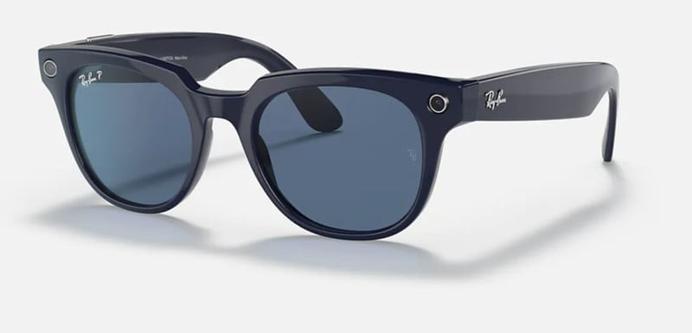
Facebook has teamed up with Ray-Ban to bring you Ray-Ban Stories, its first pair of “smart glasses.” They combine the recognizable Ray-Ban frames, Facebook technology, and a pair of cameras so you can now share absolutely every moment of your life on social media. Sounds familiar? Yeah, I thought of Snapchat Spectacles, too. Facebook’s no […]