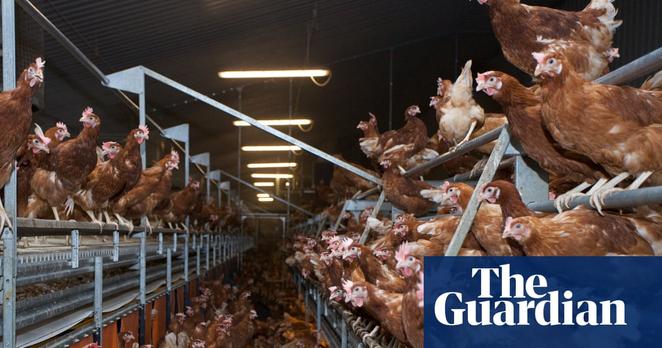
Remember the hog #CAFO whose biodigester ruptured in 2022 and released millions of gallons of waste, liquified dead hogs and castoff deli meats, some of which reached a wetland? It has a new owner, and the company already has 7 violations insideclimatenews.org/news/0402202...

A Troubled Hog Farm in Wayne C...
A Troubled Hog Farm in Wayne County, North Carolina, Is Hit With a New String of Violations - Inside Climate News

Equipped with both a biodigester to capture methane from hog waste and a system to spray what’s left of the feces and urine onto nearby farm fields, White Oaks Farm continues to pollute the surrounding environment.

Inside Climate News
The most efficient protein source: duckweed. Are you a #farmer? Grow your own? Turn a problem into a solution. Important documentary. #Environment #PigFarmers #CAFO #ManureLagoons #IncomeOpportunity www.youtube.com/watch?v=U_40...

The Fastest Growing Food on Ea...
The Fastest Growing Food on Earth: Why is the World’s Most Efficient Protein Labeled a Weed?

YouTube

"The Right’s ‘Natural’ Meat Obsession Is a Regressive Fantasy" by @sentientmedia

<💬>
Another component for Kennedy of what constitutes “natural” is taking on things like red food dye, seed oils and ultra-processed foods — while promoting tallow, raw milk and grass-fed beef.
</💬>

https://sentientmedia.org/mahas-natural-foods-obsession/

Vegans often are faced with fallacious arguments, and one of the most common is the Naturalistic fallacy.

https://en.wikipedia.org/wiki/Naturalistic_fallacy

However, this is often a bad faith disguise. The use of naturalistic fallacies in these contexts, such as the claim that consuming animals is "good" because it's natural, is a disguise for another more insidious fallacy: the traditionalist fallacy or "appeal to tradition".

https://simple.wikipedia.org/wiki/Appeal_to_tradition

The traditionalist fallacy is, in this context, the argument that "consuming animals is good because we've done it for thousands of years".

Traditionalism is heavily political, as the people are finding out again in places such as the US. It's sometimes known as "paleoconservatism", and it should be no surprise that the popularity of the "paleo diet" culturally connects to this.

Conservatives, ever since the rise of modernity (end of 'traditional' society, end of monarchism and feudalism) have been trying to reinvent the past through pseudointellectual and pseudoscientific efforts. This has been at the heart of incredible amounts of suffering and horror since then. I have some notes on that on my pinned thread: https://veganism.social/deck/@veganpizza69/110813538364525265

Bullshit & snake oil are not vegan.

#MAHA #meat #grassFed #animalIndustry #CAFO #intensivization #extensivization #sustainability #fascism #ecofascism #conservatism #traditionalism #paleoconservatism #paleo #paleodiet #traditions #tradwife #pseudoscience #scam #antivaccine #antivaxx #grifters #sustainability #snakeoil
The Right’s ‘Natural’ Meat Obsession Is a Regressive Fantasy

The rise of the carnivore diet, and the search for simplicity.

Sentient

The World Bank Must Stop Ploughing Funds into Factory Farming

"We found that 16 leading international banks together invested $3.33 billion in #AnimalAgriculture in 2023. Over two thirds (68 % or $2.27 bn) was channeled to factory farming – projects that support concentrated or intensive animal operations. Just 2 % ($77 million) went towards non-industrial animal farming projects, which invest in small-scale agriculture and more sustainable practices."

https://www.desmog.com/2024/11/15/world-bank-sustainable-agriculture-farming/
#CAFO

World Bank’s Green Farming Push Needs Action – Not Just Words

Alessandro Ramazzotti is a researcher at the International Accountability Project, an international advocacy organization Animal agriculture is one of the leading drivers of the climate crisis. According to a recent World Bank report, food and agriculture generate almost a third of global greenhouse gas emissions, of which meat and dairy account for nearly 60 percent.  […]

DeSmog
Proposed factory farm ban divides California county

By Shannon Kelleher When voters head to the polls on Tuesday to decide the next US president, residents of Sonoma County, California, will be asked to decide another contentious issue – they will be voting on a measure that would make their county the first in the nation to ban factory farms. Measure J would prohibit farm operations that meet the US Environmental Protection Agency (EPA)’s definition of a concentrated animal feeding operation (CAFO), requiring them to either close or downsize within three years. The measure would also prevent new CAFOs from coming into the county. Proponents say that CAFOs, where large numbers of animals are crowded together generating massive amounts of manure, are “major polluters” that pose a threat to wildlife and “vital watersheds” and present a “serious risk to public health” by providing a breeding ground for disease and creating other hazards. They cite one Sonoma County poultry operation with more than 500,000 birds as well as “documented criminal animal cruelty” at some CAFOs. The measure appears to have only a slim chance of passing, facing staunch opposition from powerful farming organizations as well as business groups and even sustainability groups. But backers of the measure say their effort contributes to a groundswell of support for action against CAFOs. In July, a state court in Michigan ruled that state regulators could take stronger actions to manage manure waste from CAFOs there, and in June 2023, Oregon passed a bill to tighten CAFO permitting to help mitigate water pollution. Calls for moratoriums on new CAFOs have been heard in recent years by legislatures in Iowa, Missouri, Minnesota, and Wisconsin. “There’s been a lot of attempts, but there’s nothing yet that has been an actual vote among the people on prohibiting factory farms,” said Cassie King, an organizer with the activist group Direct Action Everywhere and the Yes on J campaign. “I think there’s a latent desire across the country to stop factory farming. This measure would provide not only a blueprint but also the inspiration that’s needed to kick more action into gear.” Measure J is modeled on the Farm System Reform Act, said King, which was introduced in 2023 by US Sen. Cory Booker but has yet to move forward. The bill proposes phasing out CAFOs on a national level by 2041. Measure J supporters state that only 21 of the more than 700 animal farms in the county would be affected if it passes. But opponents, including the Sonoma County Farm Bureau, maintain the measure will have a number of negative ripple effects, including jeopardizing the existence of even small farming operations and reducing the availability of local meat, dairy and eggs.

The New Lede

It seems large herbivores may be important for some ecosystems (and, to be clear, #CAFO are not a desirable ecosystem, they are an abomination)

https://www.theguardian.com/environment/2024/sep/28/cows-help-farms-capture-more-carbon-in-soil-study-shows?CMP=Share_AndroidApp_Other

Cows help farms capture more carbon in soil, study shows

Research also reveals that a mixture of arable crops and cattle helps improve the biodiversity of the land

The Guardian
Leading Causes of Food Recalls Across US Revealed

Food recalls are issued when hazards, such as allergens or bacterial contamination, are detected.

Newsweek
How Tyson Captured All The Pork You Eat (And Made Billions)

YouTube

Producing protein
Fractionation of animal bodies, mass consumption of cheap protein, and the value of protein sourced from industrial hog operations

Katie MacDonald

#Protein #Meat #Hogs #CAFO #Substitutionism #Canada

#Read all you want! #OpenAccess
#Share generously! #KnowledgeSharing
#Grow your understanding of #Food
#Repeat

https://canadianfoodstudies.uwaterloo.ca/index.php/cfs/article/view/635

Producing protein: Fractionation of animal bodies, mass consumption of cheap protein, and the value of protein sourced from industrial hog operations | Canadian Food Studies / La Revue canadienne des études sur l'alimentation

Scholarly and community articles about food and food systems