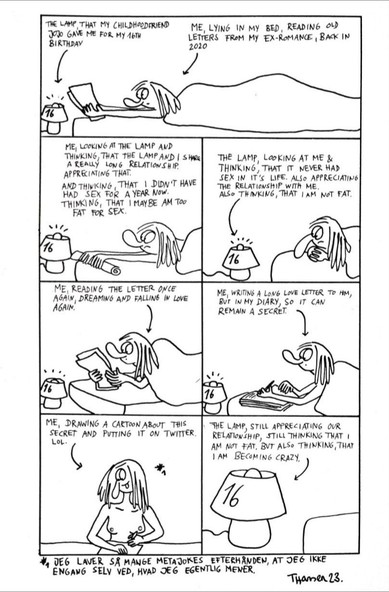
A whole day at home, being ill and talking to my lamp. Enjoy reading. #relationships #bodyissues #lamp #metajokes #sex

What better topic for a summer issue than a #poem about surviving extreme heat (as a body dysmoprhic)? We welcome back Everett Cruz with a crushing, artful take:
https://stanzacannon.com/issues/issue-six#cruz-take

#poetry #breakthesoundbarrier #poetrycommunity #bodyissues #mentalissues #literaryissues

Issue #6

Thanks to Kody Taylor for this picture of Pebbles.Looks like she’s having a … blast. “Hear, girl!” Did you know that summer is the Stanza Cannon EIC’s favorite time of…

Stanza Cannon
@chris_shinra Es steckt aber noch mehr dahinter. Obwohl ich das #eyecandy im #gym durchaus genieße, vermiede ich crowds dort, weil ich mich sonst aufgrund meiner #bodyissues dort mega unwohl und deplatziert fühle und vor den Urteilen anderer fürchte. 

I'm going through old photos to organise some of my digital shit and generally speaking, going through old memories is very hard for me. There's a lot of pain there.

Which is still true at this moment, however the particular period of time I'm scanning through at the moment is not only mixed with that vague feeling of dread deep in my stomach but also mixed with thoughts along the lines of, 'I was such a little hottie??? Wtf?' In particular there are photos where I am seen next to my best friend at the time, and I remember how much I struggled with the comparison between us. To be more specific, how I felt that she was breathtaking and I was not. Now I can see that we were both beautiful in our differences.

I have truly held so much disgust towards my body throughout different stages in my life and it makes me so sad to look back at that girl, that woman, and think she felt she was anything short of beautiful.

Looking back at past versions of myself and noticing the tenderness I feel towards her has truly been such an integral part of my journey with self-love. I even keep a photo of myself at around age 5 at my desk, the same one that was owned by my great grandmother, and remind myself that I am still that little girl that deserves love.

#SelfLove #Growth #PersonalDevelopment #InnerChildWork #BodyIssues

Facebook Publishes its Findings on Instagram’s Mental Health Effects

Facebook has faced heavy scrutiny since a report revealed that internal Facebook research showed that Instagram was toxic for teen girls. Facebook has published the full details of that report in an attempt to show it wasn't a complete picture of the study.

In the weeks following that report, Facebook announced plans to develop an "Instagram for Kids" had been paused, and United States Congress members called for an investigation into the company, claiming that it had "lied" about the effects of its platform on children.

Facebook published the slides that were used as the basis of the Wall Street Journal report as a way to reveal what it's research "really says" about the well-being of teens on Instagram. In it, Facebook alleges that contrary to the _Journal '_s characterization, Instagram's research shows that on 11 of 12 well-being issues, teenage girls who said they struggled with those difficult issues also said that Instagram made them better rather than worse.

"This research, like external research on these issues, found teens report having both positive and negative experiences with social media," the company writes. "We do internal research to find out how we can best improve the experience for teens, and our research has informed product changes as well as new resources."

Facebook has published the slides on its website after ir provided Congress with two full research decks that were the primary focus of the Wall Street Journal report. Facebook contends multiple times that the Journal "mischaracterized" the internal Instagram research and that the publication of these slides. The social media giant has published them along with annotations to each that give more context as this type of research is designed to inform its internal conversations and Facebook says that the documents were created for and used by people who "understood the limitations of the research."

It is simply not accurate that this research demonstrates Instagram is “toxic” for teen girls. The research actually demonstrated that many teens we heard from feel that using Instagram helps them when they are struggling with the kinds of hard moments and issues teenagers have always faced. In fact, in 11 of 12 areas on the slide referenced by the Journal — including serious areas like loneliness, anxiety, sadness and eating issues — more teenage girls who said they struggled with that issue also said that Instagram made those difficult times better rather than worse. Body image was the only area where teen girls who reported struggling with the issue said Instagram made it worse as compared to the other 11 areas. But here also, the majority of teenage girls who experienced body image issues still reported Instagram either made it better or had no impact. We go into more details below on how the research actually lines up with what The Wall Street Journal claimed.

As noted by The Verge, The Journal 's report focused on specific findings of the report as evidence of mental health issues that are caused by the popular social media app. Notably, it pointed to "32-percent of teen girls said that when they felt bad about their bodies, Instagram made them feel worse.”

Facebook disputes specific points of that interpretation. In one particular slide, Facebook says that the data is better interpreted as “teens who have lower life satisfaction more likely to say Instagram makes their mental health or the way they feel about themselves worse than teens who are satisfied with their lives.”

Congress is set to host a hearing on the effect of Facebook and Instagram on the mental health of children on Thursday, October 1, at 10:30 AM ET.

Below are the slides from the first deck, and the second deck can be read on Facebook's website.

Image credits: Header photo licensed via Depositphotos.

#culture #news #bodyissues #bullying #facebook #instagram #negativity #selfimage #socialnetworks #toxic #wallstreetjournal

Facebook Publishes its Findings on Instagram's Mental Health Effects

The report has also been shared with Congress.

Instagram’s Chief Compares Social Media Dangers to Car Accidents

In response to a Wall Street Journal story that revealed Facebook is aware that social media can harm teens, Instagram's head Adam Mosseri says the dangers of his app are akin to car accidents, a comparison that has drawn considerable ridicule.

After the Wall Street Journal published a story that leaked internal Facebook studies that showed that social media can be toxic to teens, Instagram quickly released a response. The social media company did not deny the findings but claimed the Journal 's article only focused on the negative.

“At Instagram, we look at the benefits and the risks of what we do. We’re proud that our app can give voice to those who have been marginalized, that it can help friends and families stay connected from all corners of the world, that it can prompt societal change; but we also know it can be a place where people have negative experiences, as the Journal called out,” Instagram wrote. “Our job is to make sure people feel good about the experience they have on Instagram, and achieving that is something we care a great deal about.”

In addition to the detailed response on the Instagram blog, Mosseri was interviewed on the Recode Media Podcast where he attempted to defend the negative effects of the platform by comparing social media to cars. As Mashable put it, his response uses a metaphor where it seems as though he is saying that just as with the existence of cars, on social media, some people are just going to get run over.

"We know that more people die than would otherwise because of car accidents, but by and large cars create way more value in the world than they destroy," Mosseri said. "And I think social media is similar."

Mosseri's sentiment was met with an onslaught of ridicule as many pointed out that cars, unlike social media, are heavily regulated, regularly inspected, and are illegal to operate for those under the age of 16.

We also regulate cars. Licenses from state governments. Speed limits. Seat belts. Etc. https://t.co/cgUTAygTND

-- Steve Kovach (@stevekovach) September 16, 2021

Yes, and cars have rigorous licensing, crash testing, emission standards, public infrastructure, regulatory agencies, and the average person can get a $ ticket for a variety of things while using them. https://t.co/IZZegvsDxp

-- John J. Howard, Ph.D. (@John_J_Howard) September 16, 2021

putting my former autos reporter hat on — Cars are ~heavily~ regulated, down to the color of the blinker, & regularly tested for safety problems. That industry also needed to be -shoved- into mandating seat belts & other safety features despite knowing they’d save lives. https://t.co/ym66kJ4dMk

-- Deepa Seetharaman (@dseetharaman) September 16, 2021

ah yes, cars, those innovations that never kill anyone, have no meaningful regulation, are in no way related to the greatest crisis facing our planet, and are freely accessible to children under 16 https://t.co/lf08YzzDWu

-- Julia Carrie Wong (@juliacarriew) September 16, 2021

folks, this isn’t a bad narrative/PR problem; it’s a fundamentally toxic business model that leadership wants to protect because it’s profitable https://t.co/F19lX6r1V7

-- Michael Selvidge - ‘tine wolf (@selviano) September 16, 2021

Others noted that the comparison, even taken at face value, is still not a good one. Cars arguably are a net negative as well, as their emissions have been tied to the pollution that causes global warming.

Thinking the only or even main harm of cars is the accidents, and not the systemic social and environmental transformations wrought by them, is exactly the kind of myopic thinking required to be a tech executive. Ironically the strange analogy still holds—just not how he intended https://t.co/t4EuBdFSDU

-- Jathan Sadowski (@jathansadowski) September 18, 2021

this is a terrible analogy by @mosseri in a time when

  • climate change is rampant
  • cities are struggling to bring back walkability
  • experts agree we should invest in other forms of transportation

but efforts have historically been slowed by the $$$$$ automotive industry https://t.co/WT4f8YCFrs

-- Kevin Chavez (@aykev) September 16, 2021

Regardless of Mosserri's spin, Instagram and Facebook are facing increasing pressure from lawmakers who focus on consumer protection. Last week, two leading members of the Senate Commerce Committee said they would launch an investigation into Facebook and take additional steps to see what other data the social media company might have but is not releasing.

“Big Tech has become the new Big Tobacco,” Representative Ken Buck (R-CO), a member of the House Judiciary Committee’s antitrust subcommittee said in a tweet. “Facebook is lying about how their product harms teens.”

#culture #news #adammosseri #bodyissues #bullying #facebook #instagram #negativity #selfimage #socialnetworks #toxic #wallstreetjournal

Instagram's Chief Compares Social Media Dangers to Car Accidents

Browsing Instagram is like driving a car?

Senators to Investigate Instagram: Congress Members Say Facebook Lied

Two leading members of the Senate Commerce Committee's panel over consumer protection have said they will launch an investigation into Facebook following the report that the company was aware its product was harmful to teens.

As reported by The Verge, Senators Richard Blumenthal (D-CT) and Marsha Blackburn (R-TN), Chair and Ranking Member of the Senate Commerce, Science, and Transportation Subcommittee on Consumer Protection, Product Safety, and Data Security, announced that their subcommittee would take additional steps to look into Facebook’s knowledge of its platforms’ negative impact on teenagers. The issue has come under scrutiny following a report from The Wall Street Journal.

"It is clear that Facebook is incapable of holding itself accountable," the two Senators' joint statement reads. "The Wall Street Journal’s reporting reveals Facebook’s leadership to be focused on a growth-at-all-costs mindset that valued profits over the health and lives of children and teens."

The two Senators added that they are currently in touch with a Facebook whistleblower and say that they will use every resource at their disposal to investigate what Facebook knew and when they knew it. The Senators say they will seek additional documents and further witness testimony, as they believe the report from The Wall Street Journal may only be the tip of the iceberg.

"When given the opportunity to come clean to us about their knowledge of Instagram’s impact on young users, Facebook provided evasive answers that were misleading and covered up clear evidence of significant harm," the Senators say.

“Big Tech has become the new Big Tobacco," Representative Ken Buck (R-CO), a member of the House Judiciary Committee's antitrust subcommittee said in a tweet. "Facebook is lying about how their product harms teens.”

Big Tech has become the new Big Tobacco.

Facebook is lying about how their product harms teens. https://t.co/85oo3B9oO0

-- Rep. Ken Buck (@RepKenBuck) September 14, 2021

Both Blumenthal and Blackburn called on Facebook CEO Mark Zuckerberg earlier this year to release its internal research on the potentially harmful effects of its platform on children, and Blackburn was one of two senators and two other congresswomen who sent a detailed four-page letter to Facebook's ceo that outlined major concerns over the development of an Instagram for Kids.

The development of Instagram for kids was revealed in a Buzzfeed report last March and was immediately hit with significant pushback. The congress members were joined by 44 State Attorneys General and 35 children's and consumer groups who called for the cancelation of the Instagram for Kids project.

In May, Blumenthal and Blackburn held a hearing on protecting kids online. With children’s screen time surging on popular apps like TikTok, Facebook Messenger, and Instagram, the two senators allege that kids are being exposed to safety and privacy issues including data collection, aggressive marketing, and sexual exploitation.

“Children and teens are uniquely vulnerable populations online, and these findings paint a clear and devastating picture of Instagram as an app that poses significant threats to young people’s wellbeing,” the senators say.

Image credits: Header photo licensed via Depositphotos.

#culture #news #bodyissues #bullying #congress #facebook #instagram #instagramforkids #negativity #selfimage #senators #socialnetworks #teens #toxic #wallstreetjournal

Senators to Investigate Instagram: Congress Members Say Facebook Lied

The senators are in contact with a Facebook whistleblower.

Internal Facebook Research Shows Instagram is Toxic for Teen Girls

According to internal research obtained by The Wall Street Journal , Facebook knows that Instagram can be toxic and harmful for teen girls. Instagram has responded that these findings, while true, only focus on the negative.

In a detailed report, The Wall Street Journal found that not only is Instagram harmful to young girls, its executives have struggled to find a way to reduce that harm while also keeping people on the platform. Instagram has tried multiple ways to reduce issues such as hiding "like" counts -- a feature that was rolled out but made optional.

The main issue with toxicity is linked to social pressure and bullying that young girls feel from using the social network, issues that are intrinsically tied to the popularity contest that is Instagram. Fixing the problems exacerbated by Instagram while also keeping it engaging seem to be goals that are at odds, and are perhaps unreconcilable.

The full report reads like a damning conclusion that has been theorized by outside groups but given more credence since now it is coming from inside the company. In response, Instagram published a statement that acknowledges the findings encompassed in the Wall Street Journal report, but says they are only part of the full picture.

"While the story focuses on a limited set of findings and casts them in a negative light, we stand by this research," Instagram's Head of Public Policy Karina Newton writes. "It demonstrates our commitment to understanding complex and difficult issues young people may struggle with, and informs all the work we do to help those experiencing these issues."

Instagram says that the core of the issue is not whether Instagram is good or bad for people, but whether social media in general is. The company says that its research on this is mixed and that it can be both.

"At Instagram, we look at the benefits and the risks of what we do. We’re proud that our app can give voice to those who have been marginalized, that it can help friends and families stay connected from all corners of the world, that it can prompt societal change; but we also know it can be a place where people have negative experiences, as the Journal called out," Newton continues. "Our job is to make sure people feel good about the experience they have on Instagram, and achieving that is something we care a great deal about."

The social media company defended itself by saying it invests in this kind of research and consults with leading experts and researchers to help it see beyond its own work. Unfortunately, both its research and those of third parties continue to present a see-saw of results. On the one hand, Instagram cites a Pew Internet study in the United States that shows 81% of teens said that social media makes them feel more connected to their friends, while 26% reported social media makes them feel worse about their lives. On the other, the Wall Street Journal 's publication of Instagram's research shows it can be incredibly harmful.

It should be noted that Newton does not cite Facebook's own internal research in its detailed response to the Wall Street Journal story, but rather links to a host of others.

"Many said Instagram makes things better or has no effect, but some, particularly those who were already feeling down, said Instagram may make things worse. In the research world, this isn’t surprising or unexpected," Newton argues. "Issues like negative social comparison and anxiety exist in the world, so they’re going to exist on social media too. That doesn’t change the fact that we take these findings seriously, and we set up a specific effort to respond to this research and change Instagram for the better."

Instagram says it has done extensive work around making Instagram a supportive place and is increasingly focused on addressing negative social comparisons and negative body image issues. It's not clear if Instagram's dedication or work has resulted with any solutions to this problem, however.

Many of the teens that were interviewed for the Wall Street Journal 's story said they didn't want Instagram to disappear, but that they were skeptical that Facebook has tried hard enough to make the platform less toxic. Based on Instagram's response, it might not be that they haven't tried, but that the company hasn't found a solution that keeps the app engaging while also making the situation better for those it harms.

Instagram's full response can be read on its website.

Image credits: All photos licensed via Depositphotos.

#culture #news #bodyissues #bullying #facebook #instagram #negativity #selfimage #socialnetworks #toxic #wallstreetjournal

Internal Facebook Research Shows Instagram is Toxic for Teen Girls

Fixing Instagram and also keeping it engaging seem to be goals that are at odds.