What pre-1985 science fiction are you reading? + Update No. XXVII
What pre-1985 science fiction are you reading or planning to read next month? Here’s the October installment of this column.
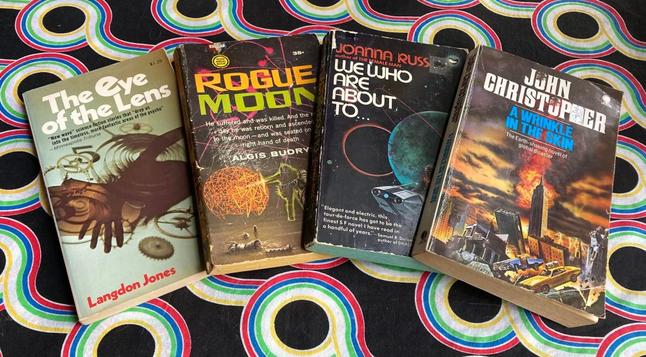
- A selection of read volumes from my shelves
If I’m feeling a bit unmotivated to write about science fiction, I always end up on Fanac or another online repository of fanzines/newspapers exploring all the old historical fannish debates. I especially enjoy their reports on various conventions and the community (from accepting to reactionary) that emerges. For example, the details I uncovered about a lost Philip José Farmer speech titled “SF and the Kinsey Report at the 11th World Science Fiction Convention (Philcon 2) in Philadelphia (September 1953) and Pat M. Kuras and Rob Schmieder’s article “When It Changed: Lesbians, Gay Men, and Science Fiction Fandom” (1980) on the first Worldcon panel with an openly LGBTQ topic: “The Closed Open Mind: Homophobia in Science Fiction Fantasy Stories” moderated by Jerry Jacks, one of the “early openly gay fans.” I recently edited a friend’s article for academic publication on the role of conventions in forming feminist and political activism. Conventions sound like fascinating places, at least from my historically-minded vantage point and lens.
However, as visitors to the site probably know, I’ve never attended a science fiction specific con (I’ve attended Gencon twice as its in my current hometown and tons of academic conferences earlier in my career). For fear of revealing too much of my psychological profile (muahaha), I enjoy the self-created illusion of being an outsider. The scholar who writes from the shadows. I often tell myself “I’m a historian, not a fan.” Of course, both can be true… I know cons cover a vast variety of topics beyond contemporary science fiction (which does not interest me in the slightest, alas). There are frequently panels on all the topics, authors, and themes I enjoy. And of course, all the friendships with fans with similar interests… As meeting authors? Not my thing, sorry. Well-meaning readers of my website often attempt to invite me to participate on panels on historical topics. Thank you! Maybe at one point I will. I really should.
I’d love to know why you, lovely readers, enjoy attending cons.
Also, before we get to the photograph above and the curated birthdays, let me know what pre-1985 SF you’re currently reading or planning to read!
The Photograph (with links to reviews and brief thoughts)
I suspect I’ve featured Langdon Jones’ wonderful collection The Eye of the Lens (1972) before. It’s an example of the exuberant (and successful) elements of the New Wave movement. “The Hall of the Machines” (1968) represents what I enjoy most lates 60s SF. Algis Budrys’ Rogue Moon (1960). A good one! I wish I managed to write a full-length review. Joanna Russ’ We Who Are About To…. (1976). Remains my favorite Russ novel.John Christopher’s A Wrinkle in the Skin (variant title: The Ragged Edge) (1965). I preferred this post-apocalyptic nightmare to The Death of Grass (1956). The scene with the tanker stranded in the dried-out English Channel, top notch… What am I writing about?
I recently restarted my series on translated SF short fiction—after a lull on my part–with Rachel S. Cordasco over at Speculative Fiction in Translation. We thoroughly enjoyed Izumi Suzuki’s “Terminal Boredom” (1984). Up next– a story from Germany!
Despite a slow writing month, I did manage to put together my first full-length review of Octavia E. Butler’s Clay’s Ark (1984). My favorite of her novels so far! There’s some solid early 80s SF out there.
What am I reading?
My reading of various forms of American leftist politics continues. Finished Mathew Hild’s Greenbackers, Knight of Labor, and Populist: Farmer-Labor Insurgency in the Late-Nineteenth-Century South (2007). There’s a larger incubatory SF-related writing project looming that will connect to late 19th century attempts to challenge Southern Democrats. Simultaneously, as I teach college-level American History courses I felt that that portion of my classes needed some work. Stay tuned!
Most of my reading has been related to the scholarship related to my unnamed writing project. However, I finally finished my Kim Stanley Robinson novel and should (I know, I promised the same thing a while back) have a review up soon(ish). A vampiric cloud of despair–generated by American politics, the challenges of my job, etc.–continues to consume my energy.
A Curated List of SF Birthdays from the Last Two Weeks [names link to The Internet Speculative Fiction Database for bibliographical info]
November 15th: William Hope Hodgson (1877-1918). I recently acquired a copy of The House on the Borderland (1908).
November 15th: J. G. Ballard (1930-2009). A favorite of mine.
November 16th: Candas Jane Dorsey (1952-). There’s a copy of Machine Sex and Other Stories (1988) judging me from the shelves.
- Diane and Leo Dillon’s cover for the 1971 1st edition
November 18th: Suzette Haden Elgin (1936-2015). I’ve reviewed At the Seventh Level (1972) and Furthest (1971).
November 18th: Margaret Atwood (1939-).
November 18th: Frederick Turner (1943).
November 18th: Alan Dean Foster (1946-).
November 18th: Graham Charnock (1946-). One of the British voices of the New Wave movement. I’ve only read “The Chinese Boxes” (1970).
- Mark Salwowski’s cover for the 1989 edition
November 18th: Michael Swanwick (1950-). I read my first Swanwick novel last year–In the Drift (1985).
November 19th: Wolfgang Jeschke (1936-2015). A Czech-born German SF author whom I really should read… I own his translated novel The Last Day of Creation (1981, trans. 1982).
November 20th: Molly Gloss (1944-). The Dazzle of the Day (1997) is supposed to be a really great take on the generation ship premise (outside of my date range, alas).
November 21st: Artist Vincent Di Fate (1945-).
- Ken Laidlaw’s cover for the 1977 edition
November 22nd: William Kotzwinkle (1938-). Doctor Rat (1976) still unsettles me.
November 23rd: Wilson Tucker (1914-2006). Huge fan of The Long Loud Silence (1952, rev. 1969) — one of the better nuclear-war themed 50s novels. I must get to more of his work in 2026…
November 24th: Editor T. O’Conor Sloane, Ph.D. (1851-1940). The editor of Amazing between 1929-1938.
November 24th: Spider Robinson (1948-).
November 25th: Amelia Reynolds Long (1904-1978). An earlier female SF pioneer, I’ve only read Long’s “Omega” (1932). Unfortunately, my dislike of 30s SF informs my comments — regardless, she’s a historically important figure.
November 25th: Poul Anderson (1926-2001). One of the authors of the first years of my website. I’ve covered eleven novels and twenty-six of his short stories. Most recently I featured “The Troublemakers” (1953) in my generation ship review series.
November 26th: Leonard Tushnet (1908-1973)
November 26th: Artist Victoria Poyser (1949-).
November 27th: L. Sprague de Camp (1907-2000).
November 27th: C. C. MacApp (1917-1971)
- Uncredited cover for the 1965 edition
November 27th: Dave Wallis (1917-1990). I thoroughly enjoyed his sole SF novel Only Lovers Left Alive (1964).
November 27th: Artist Josh Kirby (1928-2001). Perhaps best known for his Discworld covers, Kirby was a prolific contributor of art for a vast variety of authors.
November 28th: Richard R. Smith (1930-). A prolific contributor to the magazines in the 1950s, I’ve yet to read his work.
November 28th: Artist Walter Velez (1939-2018).
- MacGowan’s interior art for Gregory Benford’s “Nobody Lives Around There” in Vertex: The Magazine of Science Fiction (February 1974)
November 28th: Editor and author Donald J. Pfeil (1937-1989). Best known for editing Vertex (1973-1975).
November 29th: C. S. Lewis (1898-1963).
November 29th: Madeleine L’Engle (1918-2007). If you haven’t read about the L’Engle great cover mystery, you should!
November 29th: Kevin O’Donnell, Jr. (1950-2012).
November 29th: Artist Doug Beekman (1952-).
For book reviews consult the INDEX
For cover art posts consult the INDEX
For TV and film reviews consult the INDEX
#1950s #1960s #1970s #algisBudrys #avantGarde #bookReview #bookReviews #books #fiction #joannaRuss #johnChristopher #langdonJones #paperbacks #reading #sciFi #scienceFiction #writing
 Vincent Waciuk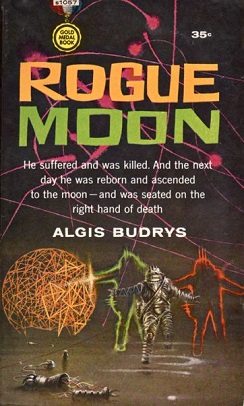

 lokatzi
 Pablo
Pablo 
 Science Fiction and Other Suspect Ruminations
 Christopher Stewart
 d4doome