
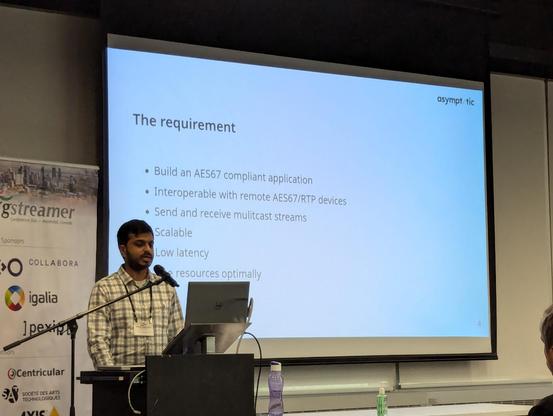
Here's Taruntej Kanakamalla, walking us through his experience building a real-time network audio application in Windows.

#linux #multimedia #windows #realtime #audio #aes67 #Dante #gstconf2024
Anyone have any experience with #aes67?

I'm working in a theatre to consolidate a bunch of ad-hoc networks into a nice VLAN segregated network. I'm running an #openwrt router with a #cisco 2900-x series switch.

I have a #barco #sp4k projector and #dolby #cp950 audio processor, which uses 8 channels of aes67.

Currently we have a direct link over cat6 between the projector and the processor.

I would like to put the AES on the same trunk line as the rest of the network.

The network setting on the Dolby AES67 has 2 IPs:

1) static source IP: 192.168.1.151
2) destination broadcast IP: 239.81.83.67

The Barco doesn't seem to have any configuration for audio network.

My thinking is I should be able to change the source IP to something on the relevant VLAN: 10.10.11.151 (VLAN 11).

But what about the multicast? It seems common to be on a 239.0.0.0. Do I need another VLAN to cover that network?

@pkw @screwtape @fishfinger Thanks for the pointer. All the doc and references are a bit thin on the sample clock/synchronization side - pretty sure if they'd implemented a standard like #AES67, or used a super accurate sample clock timing like with PTP, then that would've been mentioned. Having AES67 available out-of-the box would be an absolute killer for studio and live audio stuff - especially now that there's some serious DAW offerings out there for #FOSS OS and #linuxaudio in particular.
@pkw @screwtape @fishfinger that’s interesting! I’m trying to figure out a good platform for building #aes67 - based networked #audio gadgets - thus far mainly looked at alsa-based #linuxaudio stuff, like (GPLed) Ravenna drivers, etc. Will have a closer look.
Has anyone had luck playing with the #aes67 on #pipewire yet? Would very much like to pick your brain if it is so. #linuxaudio
I've spent half the day on a deep dive into building portable monitor #mixing rigs for touring bands. My brain hurts, now. It's 2023, and the whole #proaudio industry is still stuck on proprietary #audionetworking protocols with virtually zero #interoperability. Things are moving toward #AES67 as a standard, but it's unclear whether this solves much.
Also Audinate has indicated they are not interested in porting their stuff to Linux. #Ableton as well. I’ve used #bitwig on #Linux in a theatre performance and it works just great! Now if I could only directly connect to existing #Dante / #AES67 systems without extra hardware, like the USB dongle.
Pretty high on my #LinuxAudio wishlist would be #aes67 support for #jack and/or #pipewire. That would open up (most) #dante devices in compatibility mode, and a whole new world of professional #audio. Most pieces of the puzzle are there already, but require a lot of tinkering to get working. The discovery / routing side of Dante is not that hard but it is encumbered by patents, afaik.