“Underbussing” in Heather Cox Richardson’s “Letter from an American” on 1 December 2025

In her Letter from an American for yesterday, 1 December 2025, Heather Cox Richardson writes about Secretary of Defense Pete Hegseth's alleged order on 2 September about the survivors of the first bombing of a boat off the Venezuelan coast: "Kill them all." As White House press secretary Karoline Leavitt

111 Words
Nice agentive -er derivation from an adjective noun phrase in Nabokov's Lolita: "In a street called Thayer Street, in the residential green, fawn, and golden of a mellow academic townlet, one was bound to have a few amiable fine-dayers yelping at you."
#English #wordFormation
New paper on #English #wordFormation with -ity and -ness out.
What is it about? In a nutshell: What determines the choice of ity/ness
for a given adjective? And do the two affixes contribute the same
meaning? (1/9)
#morphology

diese maligne Geschwulst des Seins
lauter Sehensunwürdigkeiten

Terézia Mora, Das Ungeheuer

#German #wordFormation

Nice example for effective affix use: "a disproportionate amount of disapproval". Note the slight cline in #semanticTransparency from the first "dis" to the second.
Source: Jassy Mackenzie, Stolen Lives
#English #wordFormation
One of my favorite #English #wordFormation facts: "atone" is not a #borrowing from Latin or French, but a #MiddleEnglish conversion from "at one", according to the #OED helped by the prior existence of the verb "one" and the usage of "onement". "atone" then took the place of the verb "one".
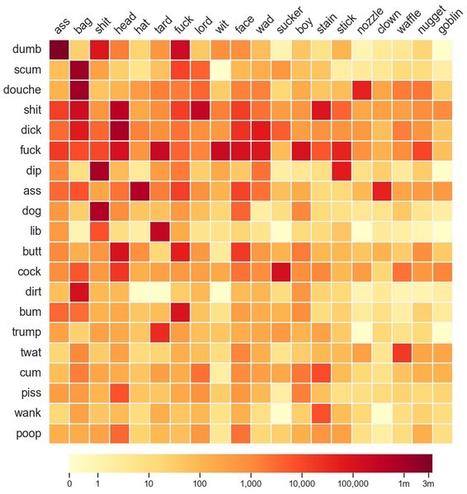
Language Log » Compound pejoratives

There's "hairpiece" and there's "earpiece", but while in close proximity physically, they don't have much else in common.
#Composition #WordFormation
Getting ready to leave for #iclc16 in Düsseldorf, here a small teaser for my talk on Tuesday 14:45 on the #affix rivalry between -ity and -ness in #English:
Why to some adjectives take -ity (insular -> insularity), while others take -ness (red -> redness)? Many factors have been considered, I use #distributionalSemantics to explore the role of the adjective's meaning. Mapping the vectors on a two dimensional space with t-SNE, a dimensionality reduction technique, the resulting visualization shows that adjective meaning might indeed be a highly relevant factor. For example, even for adjectives with the same ending -ive, the bases of those taking -ity (e.g. narrativity) and those taking -ness (distinctiveness) fall into two clear clusters.
Looking forward to seeing some of you there :)
#wordformation
I guess if you write a book on #English #wordformation, you might as well use as many fancy derivatives yourself as you want: Marchand (1969:259) states that many -ate adaptions are "not clearly etymologizable."