“I want to see people freaking out!”
Rock’n’roll spirit combined with social consciousness – that’s how you could describe Sanhedrin’s bassist and lead singer Erica Stoltz. A conversation about community organising, surviving in an age of misinformation, family – and the New York-based rock trio’s new offering: a “Heat Lightning” in every sense of the word.
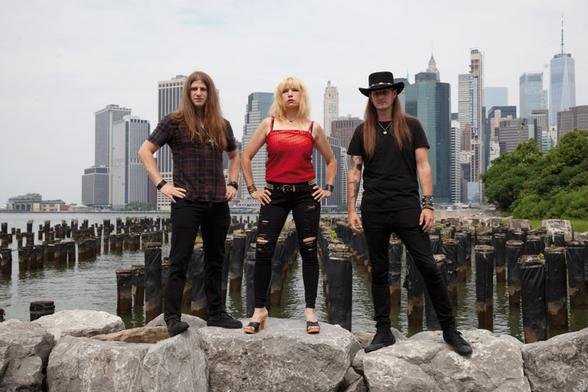
«An album that sounds a bit more aggressive this time»: New York City Rock-/Metal-Trio «Sanhedrin» released their LP «Heat Lightning» on March 14. (photo: Suzanne E. Abramson)
woxx: You are going on tour in Europe in May. Unfortunately you will not play in Luxembourg. Have you ever had a show here?
Erica Stoltz: No, I never played there, but culturally I am Luxembourgeois.
Ah, really? I thought your father was from France.
Yes, but his family, generations ago, was partly from Luxembourg. My father’s mother’s side is from Flanders. And my grandfather’s side is from Luxembourg.
But he was raised in France?
He was raised in Nanterre, which is outside Paris. That’s where the university is, where they had the riots in ’68. My family had been displaced by World War II. They built some housing after the war to bring people back, and the place they lived was like an HLM (“habitation à loyer modéré”, social housing; ed.). He emigrated to the United States in 1963, when he was 17. He didn’t want to go into active combat with the French army in Algeria. So he went to the US and joined the army there, which was quite a trip, because he didn’t speak any English at the time. I think he wanted to get away from his family. He was stationed in Germany, he learned how to speak English, how to drive, how to handle early computer technology, and things like that. I wonder if today it would even be possible to join the army without speaking English.
And he was able to avoid active combat?
Yeah, it was right before Vietnam. He did his four years and he got lucky.
Do you still have any connection to France?
I still do have family in France that I’m very close with, and I try to visit them as often as possible. Since Sanhedrin has been active, most of the travelling I’ve done has been with the band. So I haven’t been to France that much, but I was able to go last summer.
Your new album “Heat Lightning” has already received some fantastic reviews. Can you enjoy this success now?
That’s a good question. I’m actually allowing myself to enjoy it very much. When “Lights On” (the previous album; ed.) came out, I was ending a 16-year marriage pretty much at the same time. So I was very distracted at the time, and I couldn’t really enjoy the fruits of my labour. This time it’s different: We worked really hard on this record, and we made sure it was produced differently. The people that were involved, Matt Brown and Jerry Farley, did such a careful job. They handled it so lovingly that I am just so proud of how the album turned out.
So you’re not the kind of person who tends to be consumed by self-doubt right after you’ve achieved something?
There was a time in my life when I was like that. The more accolades I got, the worse I felt about myself. But I was able to sift through it and come out on the other side.
Do you have any advice on how to overcome this negative attitude towards one’s own work?
Well, I have a friend who’s a harpist. One day she was really nervous because she had an audition. And I remember telling her: “Look, don’t play for anybody but yourself and your muse. Whatever you do, just remember that that’s at the core of your effort.”
Is this also a way of describing the philosophy of Sanhedrin? The three of you have been together since the beginning, without any line-up changes.
Absolutely, and we’ve been lucky. Initially we decided to stay a three-piece because, logistically, it’s a lot easier to work that way. But also, sonically, we were able to create something that we felt really good about presenting as a band. When we write songs we write them more or less for ourselves. We don’t really think about the reaction of an audience.
On the other hand, you once said that it was difficult during the pandemic, because you couldn’t test the songs from your previous album in front of a live audience.
Yeah, I typically like to be able to play songs to an audience first, because it helps to identify the parts of a song that might not be working. I’d like to adjust them, but that’s mainly from the perspective of the vocal delivery. And also the physicality of playing in front of an audience and delivering a performance as opposed to composing.
Do you really think it made a big difference this time around that you were able to play the songs in front of an audience before recording “Heat Lightning”?
No, honestly no! (laughs) I think we got really good at writing Sanhedrin songs.
I already had the chance to listen to the new album, and I think it is at least as good as the last one, which was fantastic. From my perspective, you didn’t change an awful lot – maybe you’ve trimmed the fat a bit. I wouldn’t say the album as a whole is tighter, but the songs have a bit more punch.
I think so, definitely, yeah. That was potentially intentional. I remember saying to Jeremy (Sosville; guitar; ed.) that I wanted to make an album that sounded a bit more aggressive this time. And I think that that’s how we interpreted that.
In an interview Jeremy said that you take a lot of inspiration from bands from the ’70s and ’80s, especially when it comes to their willingness to mix styles and experiment in their compositions. He mentioned bands like Thin Lizzy or Ufo and described their albums as colourful journeys, adding that he would love to see Sanhedrin to get there one day. Would you agree with him on this mission statement?
Yeah, I think a colourful journey sounds like a lot of fun (laughs). I’ve been in a lot of bands and I’ve recorded a lot of records and they weren’t all really in the metal scene. One thing I’ve learnt is that you don’t easily find writing partners that are as effective as the Sanhedrin writing and composition universe. It’s a unique thing.
You never experienced this before?
I did! I’ve had the pleasure of having some really great collaborations, and I’ve also, gratefully, had the presence of mind to realize: wow, this is pretty cool! So I have had fruitful collaborations before Sanhedrin, but that enabled me to realize what I have with Sanhedrin.
In an earlier interview you said that if you could go back in time you’d like to hang out with the MC5 and the Stooges in Ann Arbor in the early 70s. It’s been a while since you said that, but what made that thought so appealing to you?
I still feel that way. The MC5 are my favourite band ever. I’ve been into them for a long time and I find their brand of upstart very appealing.
Are they a musical influence on Sanhedrin?
They’re definitely a musical influence on me, all the time. I really love the vocal harmonies and the urgent sound.
Which also had to do with their political attitude, right? The sense of urgency that they had politically was translated into music.
I don’t know if that part is necessarily what Sanhedrin has adopted, because the three of us… I mean, it’s not like we’re in different places politically, we’re pretty much on the same page, but we have decided together as artists that the politics will come out at some point, but they don’t need to be at the forefront of the idea of the band.
So you don’t think that music as an act of rebellion is necessarily an important part of…
Of Sanhedrin? I think that it is inherent. I don’t think you can separate that. It’s an act of rebellion, sure. Absolutely. Especially in this day and age in America – and it’s probably the same in Europe – when a bunch of kids who don’t have a lot of money want to start a band and come together, then it’s only sheer will that makes it happen. And that is an act of rebellion.
«Being able to discuss and listen to other people’s ideas and have a discourse about them is something that is like a dying art»: Erica Stoltz on the importance of critical thinking. (photo: Suzanne E. Abramson)
How important is the aspect of processing rather unpleasant aspects of life in your music, be it politically or personally?
Well, I think that is my modus operandi lyrically – whether it is obvious or not. “Lights On” probably had more obvious processing moments (laughs). That album was written when we were witnessing a lot of brutality in terms of the treatment of Black and Brown people in America, and there was an awakening during the pandemic about that. A discussion began, so I was reacting to that. As time went on, I found that the thing that really gets me right now, is Christo-fascism.
The conservative backlash and the return of religion as a political force…
Exactly, yeah, all of that. I want to burn that to the ground.
Do you think that this played a big role in the re-election of Trump in the US?
Oh yeah. These Christian fundamentalists propped him up. There’s this whole convoluted philosophy in America, that if you get rich, it’s because God loves you. So there’s that in the different Christian philosophical camps. There’s a lot of bullshit. A lot of stuff that’s designed to justify bad behaviour.
Your mother was a social activist and a community organiser in Brooklyn. Did she influence you a lot?
Oh, yeah. I actually had the opportunity to make a little documentary about her work. So I definitely took after her. I’ve had a lot of enjoyment doing things like creating an after-school programme, crowdfunding it and then implementing it in different community centres and different spaces in Brooklyn. I’m a sound engineer by trade, I’m a union stagehand, you know. One of the things I really like to do is teach and pass on that practice, because in New York, music is a big sub-economy, and there’s a lot of work here that does that. Now I’m a professor in the Entertainment Technology Department at the City University of New York (CUNY). I’ve been there for ten years and I see my students becoming my colleagues.
So you have a busy schedule.
Yeah, it’s not cheap to live here. But that’s not why I teach. I teach because I really enjoy it.
You were involved in community organising yourself.
Yeah, it’s a long story. My mum died suddenly in 2015 and I took over her non-profit. It was called the South Brooklyn Local Development Corporation. It was community development, but not real estate. It was really about job creation, helping small businesses, doing after-school programmes for the local schools. She put a kitchen in one of the schools and created a culinary arts program. I did that from 2015 to 2019. When Sanhedrin started touring, I decided to stop doing that because part of the work was producing these really big street fairs and I couldn’t put in the time any more. And also the neighbourhood had become really bourgeois: The small businesses were not as community minded as they were when my mum started.
Enabling people to think critically is among the most important tasks for you. Why is that so?
Because I think that miseducation is the reason why we’re in the mess we’re in. Critical thinking is part of being educated. That doesn’t actually require formal education. Being able to discuss and listen to other people’s ideas and have a discourse about them is something that is like a dying art. I think it is really important to keep those lines of communication open and also to be able to question everything you see.
Which is probably even more important at a time when politicians are really trying to bend facts and reality to their own ends.
Absolutely. Right now in the American media climate, the only way I’ve found to fully grasp what’s happening is to look at those media that examine both sides, the intentions, the stories and the narratives of both sides, because there’s one side, there’s the other side, and there’s the truth.
That’s what journalism is supposed to do, really not just see one side, but compare both sides‘ arguments.
Absolutely. But in order to do that, it really helps to be able to think critically through everything you’re hearing. I think in America we’ve downgraded public education over the last couple of generations to the point where the life of the mind is not important, it’s not a priority.
What are the aspects of Trump’s politics that you are most afraid of so far, looking at what has happened in the last few weeks?
I have to be honest with you, I’m not afraid. I’m not scared because this has happened to so many other people in other countries. There’s nothing special about America that says it can’t happen here. But I’m also in a really lucky position because I could just high-tail it to France. I’m a dual citizen.
But you’re not actually thinking about leaving the States right now?
No. But I feel like if the press starts getting arrested, then I will probably get a little afraid.
The album title “Heat Lightning” refers to climate change and its effects. When I read the lyrics of the title track, I immediately thought of the LA wildfires. Do you think that the fact that the effects of climate change are becoming more visible in Western industrialised countries can raise awareness of the problem?
I don’t think America will really be hit by climate change until it hits our pocketbooks. The LA fires could hit our pocketbooks, because the insurance industry cannot support what has been lost. But I wrote that song two years prior to that. There were fires in Quebec, coming south, and the sky was red all day, fires that were thousands of miles away.
What about the lyrics of “Blind Wolf”? I’ve read that it’s a song inspired by the band’s shared fascination with religious cults. What is this fascination about?
Well, when you have to write a press release, everybody just latches onto something for interpretation. So that was a pretty powerful phrase or whatever. It was an eye-catcher. But for me the song is more about a couple of things. Full disclosure: sometimes when I write lyrics they’re not necessarily about anything, but then they become about something. So that happens and that happened here.
So you just follow an idea or a fantasy…
Exactly. In the end, when the song was finished, I realised that the one thing that all the mixed words had in common was that you lose your animal instincts when you adopt someone else’s belief system.
Founded in 2015, the New York-based rock band Sanhedrin has just released its fourth album “Heat Lightning” on Metal Blade Records. Stylistically, Erica Stoltz (vocals/bass), Jeremy Sosville (guitar/backing vocals) and Nathan Honor (drums) combine hard rock with melodic, sometimes doomy metal elements. While it’s great fun to listen to their records, the band is clearly designed to unleash its full potential on stage. They will be touring Europe in May and June 2025. (Foto: Marc Braner)
So it’s not a return to the animal instinct, but you lose it? One could also imagine that some cults try to exploit some animal instincts, like fear or aggressiveness and so on.
Interesting. I feel like fear has been manufactured globally since 9/11, to an extent that I… I don’t know. I just feel like, especially over here, we have just been sort of… You’re literally taught or expected to be afraid of the weather or whatever it is.
Fear plays a big role in politics, I would agree with you there. From my point of view it plays a big role in paralysing people because you can’t think rationally any more. I think you have to stop fear by analysing things and getting to the bottom of them, and then you can act against it and change it for the better.
Indeed. I live in an apartment in an old building, built in the 1940s. It has a German social housing feel to it. It used to be workers’ housing, but totally decent, totally functional, nice even, with green space in the middle and all that shit. But I’m really starting to focus on getting to know my neighbours here, because I feel like they’re going to be my best allies in whatever life has to offer. That’s the way for me to alleviate fear, to align myself with the people around me. I’m a little bit older than most metalheads, like 54, and I grew up in the ‘70s. So … it was a bit of a rosy window, post-civil rights era, pre-backlash, pre-Reagan, all of that. In that upbringing, my neighbours were my friends. So I really thought that’s where I felt comfortable, knowing who was around me and who I could relate to. And not all the kids I grew up with had the same background as me.
And yet you got along because you found out what you had in common on a social level.
Yeah, that’s how I want to live my life, even if it’s not necessarily the norm. But I think it still is, I think people still want to know their neighbours, wherever they are in the world.
Do you think that things like your mother did, working on a community level, could become even more important because the big media only emphasize cultural differences and not things like the common interests of, say, the working class?
In terms of the working class and class consciousness and delineations and all that, in America right now, there kind of is no middle class. You’re either rich or you aspire to be rich, or you live in relatively precarious situations. I say relatively because there’s still a “7-Eleven” that’s open 24 hours every day on the corner of my street. Convenience is still available, but most of us are one health crisis away from financial ruin. One more pandemic, or, God forbid, you get cancer, or you have to take a week off work, or you get long covid – whatever it is, most of us are one crisis away from being fucked.
Because people don’t have the savings and the social system is not good enough to cover the costs.
Yeah, exactly. And that makes people more dependent on each other.
How much do you think you were influenced by the fact that your father was from Europe and from France?
I think having the opportunity to go over there all the time as a child and being bilingual is something that really helps you blossom. I was a traveller, a backpacker. One of my most formative experiences was not in France. When I was 19, I backpacked from Aalborg, Denmark, basically through Germany to Greece. My travelling partner and I had been given a ride by these German people. And then we arrived in Berlin on the 8th of November 1989. And we thought, “Damn, there’s a lot of people here. What the hell is going on?” So we call our friends and they’re like, “Dude, this is the biggest party ever!” (the Berlin Wall fell on 9 November 1989; ed.). So we were there on the 10th of November 1989. Before everything really opened, I got to go to East Berlin. I bought batteries in a store where there was a bread line. And as a 19-year-old American kid, I was like, oh, hell …
Although I imagine you’ve seen your share of poverty in New York.
Yeah, I mean, crack really fucked up New York City. Crack and cocaine, it was really fucked up in the ‘80s, for sure. But this was different. This was institutional. Somehow, for me, watching people come out of East Berlin into West Berlin for the first time and just seeing the looks on their faces, I don’t even know. I wrote an essay about it at one point because I thought, I have to get this out of my head. But it was definitely a formative experience for me and it made me realise that nobody is immune to this shit. And it can happen, it can happen anywhere, and we’re all subject to the forces of human nature in that way. We’re all capable of great good and great evil.
Back to music. I imagine you really put a lot of energy into presenting a live show that’s really tight and intense, and that people don’t just tap along to, but really freak out, if possible. Is this what you are about?
Yes (laughs). What you just said is all… Yeah, I want to see people freaking out.
In an interview you mentioned that you’d like to go on tour with “Molasses” from the Netherlands. Unfortunately they just split up. What was it that made them so special to you?
Did I say that? – Oh, because I was a really big “The Devil’s Blood” fan, and I love Farida’s vocals (Farida Lemouchi, singer of “The Devil’s Blood” and “Molasses”; ed.), and I found the “Molasses” album very soothing. So those are the reasons.
What did you like particularly about “The Devil’s Blood”?
My favourite band is the MC5, as I said. I really enjoy the part of their career where they were a garage band. I like simple, ignorant garage music. When you pair that with powerful guitars, that’s something – you don’t hear that very often. That was what I heard with “The Devils Blood”.
They became quite a cult band as well.
Yeah, sure. I mean, I never saw them, but I could imagine because the aesthetic is pretty consistent. They have a pop sensibility. That means that somewhere in the songwriting there is a verse chorus. There are some real kernels of what I consider – whether it’s a reggae song, a country song, whatever it is – good songwriting. For me, because I’m influenced a lot by blues, garage, the Ramones, soul, girl groups, that kind of shit, that’s what pop sensibility means to me. They are not dismantling that structure.
How would you describe your own journey from your previous bands like „Lost Goats“ and all the other bands you played in to what you are doing now with Sanhedrin?
Well, I think for me it’s always been about finding those sweet collaborative relationships. The musical genre is not as important as the collaborative relationship. So when Nathan (Honor, drums; ed.) and Jeremy proposed the band, I thought to myself: “Wow, I have never played in a traditional metal band. Let me try this!” At first my bass playing wasn’t up to snuff because I couldn’t play with a pick and my fingers weren’t fast enough. It took practice, but I got it.
You’ll be playing a good dozen shows in Europe in May. What’s the best thing about playing live?
Looking out at the crowd and going: there’s a bunch of different souls in this room – let’s all get together and have some fucking fun.
 News Beep
 woxx
woxx
 Gravitas