 The Optimist Daily: Making Solutions the News [Unofficial]
Podcast Transcript March 20, 2026— From psilocybin to ocean robots: 10 solutions you’ll actually want to hear about

Podcast Transcript March 20, 2026— From psilocybin to ocean robots: 10 solutions you’ll actually want to hear about
"During the water cremation process, the body is placed inside, and over three to four hours is dissolved in a solution of 95% water 5% alkaline solution (potassium hydroxide). The body then becomes a sterile liquid that contains no DNA, that can be treated like wastewater.
It’s a method that has been found to be 90% less harmful to the environment than flame cremation."
#Aotearoa #ComingSoon #WaterCremation #WaterBurial #BodyDisposal
This is how I want to go when I go!
---
‘Boil in the bag’ environmentally friendly funerals arrive in the UK | Death and dying | The Guardian
@NoctisEqui ok, I have all kinds of info for you! Hope you don't need it soon.
Cremated remains ARE in fact bones rather than ashes. The ash content (from the cardboard box or casket) is pretty minimal. Most of that burns away to nothing and is released into the atmosphere.
After the cremation has finished, the bones are brittle and crumbly but often somewhat intact. After a cooling period, they're poured into an industrial blender called a cremulator. The bone fragments are pulverized into a sand-like consistency, which allows them to a) fit into the urn and b) be scattered per family wishes without freaking anyone out (no one wants to find bone chunks out in the wild).
I'm not sure if it's legal where you live, but also check into alkaline hydrolysis. It's basically water cremation instead of flames. It's much more eco friendly. I have a blog post explaining the whole thing. It's a really fascinating process, and I hope it catches on everywhere.
https://www.louisepachella.com/blog/funeralfacts/alkalinehydrolysis
#FuneralFactFriday: Cremated remains aren't "ashes" (plus, how much do you get?)
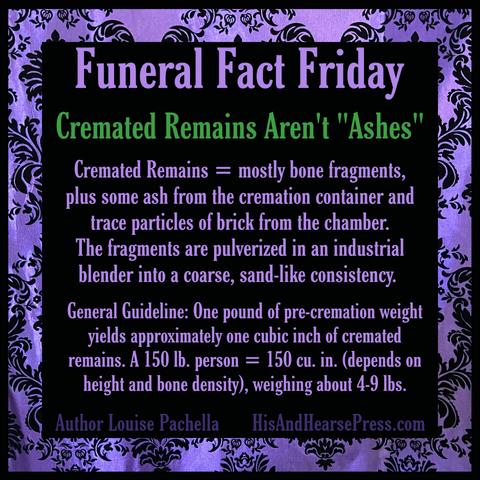
Cremated Remains = mostly bone fragments, plus some ash from the cremation container and trace particles of brick from the chamber. The fragments are pulverized in an industrial blender (called a cremulator) into a coarse, sand-like consistency. Surgical implants, like hip replacements, are pulled out of the fragments before processing and are usually collected for recycling.
General Guideline: One pound of pre-cremation weight yields approximately one cubic inch of cremated remains. A 150 lb. person = 150 cu. in., now weighing about 4-9 lbs. This varies slightly based on height, bone density, and whether the person was cremated in a cardboard container or a solid wood casket.
This information is critically important if you're shopping for an urn online! If you order one that's too small, the crematory must attach the excess in a cardboard or plastic urn and include it with the chosen urn. An average urn should hold about 200 cubic inches. Watch out for "keepsake" urns which are designed to only hold a token amount (usually 3-20 cu. in.).
Bonus fun fact: the alkaline hydrolysis method (AKA water cremation) yields approximately 20-30% more cremated remains than flame cremation! The process is gentler, so more of the delicate bone matrix is preserved. It's not lost to the air currents.
#HisAndHearsePress #Cremation #CrematedRemains #Cremains #Ashes #Urn #Crematory #Funeral #Death #FunFacts #WaterCremation #Aquamation #Resomation #AlkalineHydrolysis
 CBC Manitoba
 Marsden
 Nick Dunkenstein

 Chris AD
 BC Info Bot
 His & Hearse Press