 Carmelite Quotes
Quote of the day, 8 June: St. Elizabeth of the Trinity
... That daywhen Jesus came to dwell in me,
when God took possession of my heart,
so truly and completely that from that hour,
from that mysterious colloquy,
that divine, delightful exchange,
I desired only to give my life,
only to return some small part
of his great love,
which rested in my poor heart
and flooded it with all his favors.
— Saint Elizabeth of the Trinity, Poem 47
On Monday, 8 June 1891, Elizabeth once again put on her white First Communion dress. In the church of Notre-Dame, she received the sacrament of confirmation from the hands of Bishop Lecot, bishop of Dijon. What did her catechism say about confirmation? “Confirmation is the sacrament that confers the Holy Spirit upon us with the abundance of his gifts and makes us perfect Christians.” And “how does confirmation make us perfect Christians? Answer: Confirmation makes us perfect Christians by increasing in us the grace of baptism and by giving us the strength to profess our faith, even at the peril of our life.”
These fruits of the Holy Spirit quickly matured in her. “Our confirmation took place at Notre-Dame,” Marie-Louise Hallo recounts. “From that moment Elizabeth’s piety increased even more; she received Communion often and shed abundant tears afterward” (Biographical Account). “Often” means that, according to the norms of the time, as a general rule she received Communion once a week. Marie-Louise states this explicitly for the period “from the age of twelve”: “Her mother did not want her to receive Communion frequently and, in fact, she received Communion once a week,” even though “at the age of twelve we went to Mass three times a week” (Poinsenet Dossier). Louise Recoing, who became acquainted with Elizabeth not long before Elizabeth turned twelve, says more or less the same thing: “At that time [she] must have received Communion once or twice a week.”
Sometimes, in their games, the little girls were already expressing their dream of religious life. Marie-Louise recounts: “We played at being nuns before 1893, after our First Communion. We would go to confession behind the curtains. We put on our mothers’ skirts, especially the skirts with trains. Madame Catez was still in mourning for her husband. We imitated the Sisters of the Good Shepherd. At home we had a fairly large apartment, and what was especially enjoyable was that there was an empty attic where we played.” It is not said whether the mutual confessors remained serious the whole time.
Saint Elizabeth of the Trinity
Rien Moins Que Dieu, ch. 3
de Meester, C 2017, Rien moins que Dieu: sainte Elisabeth de la Trinité, Presses de la Renaissance, Paris.
Elizabeth of the Trinity, S 1984, Je te cherche dès l’aurore : évocation d’un visage et d’un coeur, produced by C. de Meester and the Carmel of Dijon, Carmel de Dijon, Flavignerot.
Translation from the French text is the blogger’s own work product and may not be reproduced without permission.
Featured image: Detailed portrait of St. Elizabeth of the Trinity, taken on 8 June 1891 after her Confirmation. Although photographed on the day of her Confirmation, the portrait also commemorates her First Holy Communion, received earlier on 19 April 1891. The setting is the garden of the Catez family home in Dijon. Image credit: Discalced Carmelites (used by permission).
#confirmation #HolyCommunion #poetry #StElizabethOfTheTrinity #vocations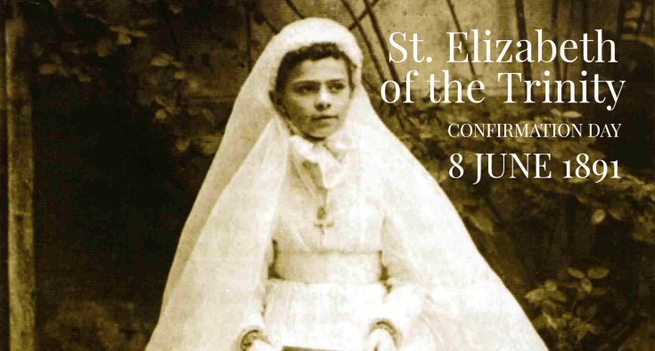
 Edgecontrol🍉🛹
 Bienvenue sur Riposte Catholique - La réinformation catholique au quotidien
 Frau Hangover