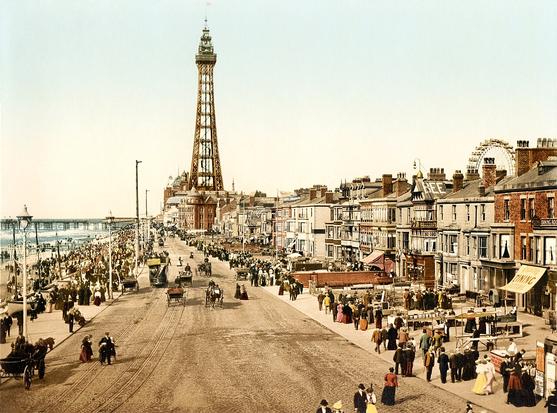
@david_chisnall @eclectech Maybe starting from Wakes Week, many of the English have been blurred about the distinction between having a holiday from work and going away elsewhere during said holiday.
It's in the verbs.
#verbs
https://en.wikipedia.org/wiki/Wakes_week?wprov=sfla1
Wakes week - Wikipedia

The strange absence of ‘ambiguate’

If I asked you to name or invent a word that means ‘make ambiguous’, what would it be – ambiguify? ambiguate? I’ve felt an occasional need for such a term, to say that a word or piece of syntax ambiguates the meaning in text or speech.

I mean, sure, I can say ‘makes the sense ambiguous’. But there’s no reason not to have a one-word verb. After all, we have its antonym, disambiguate: to make something unambiguous. More on that later.

Take this use of since: Since I’ve been injured, I haven’t gone running. Does it mean ‘because’ or ‘since the time that’? Is its meaning causal or temporal? Without further information, there’s no way to be sure. The choice of conjunction ambiguates the sense.

The same issue arises with other common words, like as and while. She made the sauce, while he chopped the vegetables. Does while have a temporal sense, indicating concurrent activities, or a contrastive or additive sense, like whereas or and? The comma and other factors might guide our interpretation, but ultimately we can’t be certain.

Usages like this are ambiguating. As a copy-editor I come across them fairly often, and I’ve begun using ambiguate judiciously in referring to them. Disambiguate is also useful, being more specific than synonyms like clarify and resolve. Disambiguate is a relatively new and specialized term, but it’s established enough to appear in major dictionaries:

to make (an ambiguous expression) unambiguous [Collins]

remove uncertainty of meaning from (an ambiguous sentence, phrase, or other linguistic unit) [Oxford]

to establish a single grammatical or semantic interpretation for [American Heritage]

to establish a single semantic or grammatical interpretation for [Merriam-Webster]

to make a sentence or phrase perfectly clear by removing all uncertainty [Vocabulary.com]

to make clear the meaning of a word, phrase, etc. that has more than one meaning [Macmillan]

(Note the tantalisingly near-identical definitions from AHD and M-W.) The OED has citations for disambiguate from 1960, generally in linguistic and philosophical contexts, and the word’s usage has risen steadily since then:

The noun disambiguation has been in use since at least 1827; it has become more familiar this century from its common appearance at the top of Wikipedia pages:

*

As it turns out, ambiguate exists in the lexicon, but only barely – not enough for lexicographers to include it. Dictionary aggregator OneLook shows it only in the crowd-sourced Wiktionary, whose entry defines it as ‘to make more ambiguous’ (which implies, oddly, that the thing was already ambiguous).

A sense of the two verbs’ relative frequency may be seen in this corpus comparison:

Corpus nameCorpus size (words)Time perioddisambiguateambiguateCOHA475 million1820–201900COCA1 billion1990–2019570GloWbE1.9 billion2012–20131170iWeb14 billion20178110

Ambiguate is not even in the OED, that great historical cabinet whose vast shelves swell with obscure Latinate vocabulary. Instead of the verb you’d expect – even if labelled archaic or obsolete ­– nestled in among ambigual, ambigue (n.), ambigue (adj.), ambiguity, ambiguous, ambiguously, and ambiguousness, there is a lacuna where ambiguate might go.

Its rival, ambiguify, appears in none of the corpora above but shows up a couple of times in Google Books (e.g., ‘Her words seemed to ambiguify their meanings’ —Norman Spinrad, The Void Captain’s Tale). Its chances of happening, fetch-style, are even smaller than those of ambiguate, yet it has its champions.

I’m not the first to point out the utility or validity of ambiguate, and a search on Twitter Bluesky shows it in casual use. But even here its appearances are sporadic, and in printed or edited texts it remains marginal.

My recommendation is that if you ever need to use the word, do. Its meaning should be transparent enough in context, and with more usage it will gain in familiarity and acceptability. Whether it will gain enough to ever show up in major dictionaries, or even in language corpora, is an open question.

Updates:

Languagehat joins me in ‘urging the use of this occasionally useful word’.

Peter Gilliver at the OED tells me they have evidence for ambiguate back to 1969. Watch this space.

In episode 211 of the Weird Studies podcast, about 11 minutes in, J.F. Martel says of Stanley Kubrick’s The Shining that is “just ambiguates everything”. Great to hear it in the wild!

*

[You’ll find more neologisms in the Sentence first archives.]

#ambiguate #corpus #dictionaries #disambiguate #editing #language #lexicography #linguistics #neologisms #semantics #usage #verbs #Wikipedia #words

Stan Carey editing and proofreading | Tidy, tighten, or transform your text

7 Things Writers Should Know About Verbs

Pulitzer Prize-winning critic Sarah L. Kaufman shares seven things that all writers should know about verbs.

Writer's Digest

[Перевод] Read-only-права в Kubernetes, позволяющие выполнить любой код: разбор критической уязвимости в популярных Helm-чартах

Казалось бы, права на чтение — что с них взять? Оказывается, в Kubernetes разрешение nodes/proxy GET позволяет выполнять любой код в любых подах кластера. Уязвимость уже нашли в популярных Helm-чартах, включая Prometheus, Datadog и Grafana. И да, команда Kubernetes решила это не исправлять. Узнать, как проверить свой кластер

https://habr.com/ru/companies/flant/articles/1001778/

#kubernetes #nodesproxy_GET #API_Server_Proxy #Kubelet_API #verbs #глаголы #HTTP_GET #WebSockets #KEP2862

Read-only-права в Kubernetes, позволяющие выполнить любой код: разбор критической уязвимости в популярных Helm-чартах

Обход авторизации в Kubernetes RBAC позволяет выполнять код в любом поде кластера с правами nodes/proxy GET . Введение В статье рассматривается баг, который позволяет выполнять произвольный код в...

Хабр

New blog post. The message: Use strong verbs. Make your voice heard.

https://field15.com/shape-strengthen-shine

Do you think the title, subtitle combo works well w/ this layout?

#writing #nonfiction #publishing #revision #verbs

Shape, Strengthen, Shine - field15

Weak verbs drain energy from your nonfiction. Strong verbs bring it to life. Margaret Eldridge shares a multi-pass editing technique to replace passive, abstract verb phrases with active, observable verbs that engage readers. Transform "is affected by" into "shapes" and watch your writing come alive.

field15

You might could dig these multiple modals

A passage from Walter Mosley’s Devil in a Blue Dress:

Joppy stopped wiping [the bar] for a moment and looked me in the eye.
“Don’t get me wrong, Ease. DeWitt is a tough man, and he runs in bad company. But you still might could get that mortgage payment an’ you might even learn sumpin’ from’im.”

That ‘might could get’ was a serendipitous phrase to encounter. Over the preceding days I’d come across several treatments of what are known as double modals or multiple modals, and had been considering a blog post about them. Hint taken.

Brad Dourif in ‘Deadwood’

First, a technical note on modals. These are a small and grammatically unusual family of verbs. They’re a subset of the auxiliary (helper) verbs and so are sometimes called modal auxiliaries. They qualify other verbs in a verb phrase, influencing the overall meaning: I can go, you may be, she must try. Geoffrey Pullum says there are 8–12 of them in English:

can, may, shall, will, dare, must, need, ought

He and Rodney Huddleston mention could, might, should and would as the preterite forms (past tense marked by inflection) of the first four. Grammarians differ slightly in naming the family members; this depends on the category boundaries, and needn’t concern us here.

Modals are used to indicate modality, or ‘mood’ – not in the sense of atmosphere, but to express possibility, permission, obligation, necessity, deduction, prediction and such things. Heather Marie Kosur writes that modality ‘allows language users to express what is, what would be, what may be, and what should be’.

Modern grammar generally divides modality into two or three branches: epistemic (probability, deduction, necessity) and deontic (duty, obligation, permission), and sometimes also dynamic (factual). See this glossary, or Kosur’s essay for a more detailed treatment.

Unlike lexical verbs, modals have no to-infinitives, no –s forms for subject agreement, and no tenses formed with be or have. So you don’t see oughting, mights or musted, etc. At least, not normally (James Joyce, Finnegans Wake: ‘when cherries next come back to Ealing as come they must, as they musted in their past’).

*

And so to double or multiple modals: might could, may would and the like.

Megan Risdal, in a recent post at For the Love of Linguistics, used a map of ‘might could’ usage to gauge its geographic distribution in the U.S. She also studied the reactions double modals inspire, and shared her thoughtful observations.

As I wrote in a comment there, double modals are not in my idiolect, but I find them charming. They’re also interesting grammatically, semantically, and sociolinguistically. They may be used with subtlety by those to whom they come naturally: to modify the degree of likelihood or speculation expressed, for example.

Multiple modals also popped up in an article on the influence of Scotch-Irish [PDF] on East Tennessee grammar, which John Cowan shared in a comment to my recent post on Hiberno-English till. The article’s author, Michael Montgomery, is one of the people behind MultiMo: The Database of Multiple Modals, which launched last week.

MultiMo offers, among other things, a multi-page table of reported examples, including some rare and delightful triple modals:

I might could should write home.

It’s a long way and he might will can’t come, but I’m gonna ask.

Aren’t they amazing? What is grammatical in standard English is often erroneously equated with what is grammatical, period. But grammaticality differs with dialect, and standard English is just one dialect (or a set of them) — privileged socially but not linguistically.

If you’re still with me, and you might would be hungry for more, Language Log has analysed double modals on several occasions; for starters see this post by Ben Zimmer and the pages it links to.

I’ll conclude as I began, with Devil in a Blue Dress:

I always tried to speak proper English in my life, the kind of English they taught in school, but I found over the years that I could only truly express myself in the natural, “uneducated” dialect of my upbringing.

Update: More discussion of double modals at Language Hat, who says:

They are a peripheral part of my dialect thanks to my Ozark ancestors, and while I don’t use them on a daily basis, I delight in tossing them into the mix once in a while; they give me that warm down-home feeling.

#crimeFiction #dialects #grammar #language #linguistics #modalVerbs #modality #modals #multipleModals #semantics #syntax #usage #verbs #WalterMosley #words

#writerscoffeeclub Oct 21: What is your take on the adverb debate?

I am guilty of adverbial use. And I will continue to be guilty of using adverbs. Especially in dialog. People speak normally with adverbs because often they are trying to be heard. Yes, yes, I've been told and yes the CSW says don't do it. Yes, there are other "maybe" better choice #verbs but once you've used them, what are you supposed to do? Reuse them a thousand time? No, use adverbs.
Writing is a balance of style and technique.

#writing #sciencefiction #grammar #chicago_standard_of_writing #grammarians_need_not_apply

to Agatha Christie (v.tr.)

The conversion of nouns to verbs (to impact, to medal, to leverage, to architect) is a continual object of criticism and word rage. But language has been verbing for as long as it has languaged. In…

Sentence first

to Agatha Christie (v.tr.)

The conversion of nouns to verbs (to impact, to medal, to leverage, to architect) is a continual object of criticism and word rage. But language has been verbing for as long as it has languaged. In fact, there’s nothing that can’t be verbed if you put your mind to it.

‘What about someone’s name?’ you might ask. ‘What about Agatha Christie?’

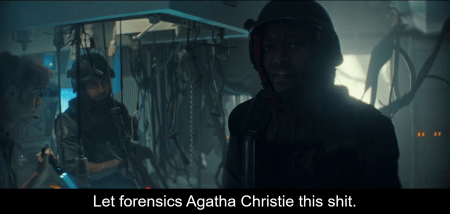
I’m glad you picked that example. Because the new FX series Alien: Earth offers this great line in its second episode, ‘Mr. October’ (a mild swear word follows):

Context, with a tiny spoiler in the first line:

In the year 2120, a military search-and-rescue team are investigating a spaceship that has crashed to Earth. When a grisly but intriguing discovery threatens to detain them unduly, Siberian (played by Diêm Camille) makes the call to keep moving:

Okay, come on. We’re search and rescue. Let forensics Agatha Christie this shit.

To Agatha Christie something, then, is to figure it out; to investigate and solve a puzzling problem in the manner of Miss Marple or Hercule Poirot, Christie’s fictional detectives.

I like this verbing because it reads like improvised slang. There’s no suggestion that the phrase has currency as a verbal eponym, whether broadly in-world or more specifically in Siberian’s own usage or that of one of her speech communities. Rather, it’s an impromptu linguistic innovation that’s both playful and bookish.

It also celebrates Christie’s enduring popularity as a mystery author. What other name could fit in this semantic slot? Only a fictional one, I think: Sherlock Holmes, Philip Marlowe, or Sam Spade – but not Arthur Conan Doyle, Raymond Chandler, or Dashiell Hammett.

Other contenders include Jessica Fletcher, Perry Mason, Columbo, Jules Maigret, Nancy Drew, Inspector Morse, and Special Agent Dale Cooper. But it’s more of a stretch to imagine them being so culturally salient in a century’s time.

Alien: Earth was created by Noah Hawley, who also has the writing credit on the episode. He’s probably not even the first person to verb Agatha Christie, but for once I didn’t bother trying to Agatha Christie it.

Updates:

A couple of nice examples from Bluesky: @iucounu tells me his wife uses Poirot as a verb: ‘”Don’t worry, I’ll Poirot that,” she says, when she’s going to ferret out some bit of gossip’.

And Jesse Sheidlower sent me this verbing of Agatha Christie in Ryan Rayston’s novel The Quiet Sound of Disappearing (2011):

*

Further reading:

In my A–Z of English usage myths, I wrote that peevers hate verbing, but only when they think it’s new – they constantly use verbings that were established earlier. Who remembers all the yelling and wailing over contact (v.)? Who would believe there even was such a controversy?

See also: ‘Verb all the things’; ‘Verbing weirds language – but in a good way’; and ‘Verbing and nouning are fine and here’s a quiz‘. And a few other posts about detective fiction.

#AgathaChristie #AlienEarth #conversion #detective #detectiveFiction #eponyms #humour #language #languageChange #NoahHawley #pragmatics #screenwriting #semantics #slang #TV #verbing #verbs #writing

⚡️ Hebrew verbs are like superheroes — they change costumes (conjugations) but keep their secret identity (the root)! 🦸‍♀️

Learn the patterns, and suddenly you can understand hundreds of words.

Ready to unlock your Hebrew superpowers? 💪✨

#Verbs #Nikud #Hebrew #SuperPowers #Language