Taoist Canon

This is also known as Daozang. It’s the largest canon of Taoist writings. It’s 1 of the most massive & complex religious compilations in human history. It has roughly 1,500 texts. It was first embodied by the Daodejing, Zhuangzi, & Liezi.

The canon was assembled by monds circa 400 CE in an attempt to bring together these disparate yet consonant teachings. This anthology consisted of 3 divisions (grottoes) based on what was seen at that time in Southern China as Taoism’s primary focus: meditation, ritual, & exorcism. These grottoes were ranked by skill level (exorcism is the lowest, meditation the highest) & used for the initiation of Taoist masters.

In addition to the 3 Grottoes, there were the “Four Supplements” that were added to the canon circa 500 CE. 3 were primarily sourced from the older core texts, with the other from a separate, established philosophical tradition known as Tianshi Dao.

Originally the Three Caverns & Four Supplements represented 3 distinct lineages of Daoism that emerged in Southern China.

The Three Caverns:

The Cavern of Authenticity (Dongzhen):

Contains texts of the Shangqing (Supreme Purity) tradition. This was considered the highest level of initiation, focusing on internal visualization, meditation, & “celestial travel.” (Think astral projection.)

The Cavern of Mystery (Dongxuan):

Contains texts of the Lingbao (Sacred Treasure) tradition. This tradition focused on communal rituals, liturgy, & the salvation of the dead.

The Cavern of Divinity (Dongshen):

Contains texts of the Sanhuang (Three Sovereigns) tradition. This was the lowest level, focusing on practical exorcisms, talismans, & warding off spirits.

Each of the 3 Grottoes contains the following 12 chapters:

  • Main texts (Benwen)
  • Talismans (Yujue)
  • Diagrams & illustrations (Lingtu)
  • Histories & genealogies (Pulu)
  • Precepts (Jielu)
  • Ceremonies (Weiyi)
  • Rituals (Fangfa)
  • Practices (Zhongshu)
  • Biographies (Jizhuan)
  • Hymns (Zansong)
  • Memorials (Biaozou)

The Four Supplements:

As newer movements & the original “classical” texts needed to be integrated, 4 supplementary sections were added.

Great Mystery (Taixuan):

Centered on the Daodejing.

Great Peace (Taiping):

Based on the Taiping Jing (Scripture of Great Peace).

Great Purity (Taiqing):

Focused on Waidan (External Alchemy), such as the creation of elixirs.

Orthodox One (Zhengyi):

Dedicated to the Celestial Masters, the oldest organized Daoist movement.

As with most religious texts, the history of the Daozang is a story of imperial patronage & periodic destruction.

The 1st Catalog (471 CE): The scholar Lu Xiujing compiled the 1st comprehensive catalog of Daoist scriptures. He was the 1st to formalize the “Three Caverns” structure, effectively creating a unified Daoist identity to compete with the rising influence of Buddhism.

The Tang “Golden Age” (748 CE): Emperor Xuanzong (who claimed to be a descendant of Laozi) ordered the 1st official “Canon of the Kaiyuan Era.” Copies were distributed to state-sponsored abbeys across China.

The Song & the 1st Painting (1111-1118 CE): Under Emperor Huizong (a “Daoist Emperor”), the canon was 1st carved into woodblocks for painting. This allowed for wider distribution but also made it a target during wars.

The Mongol Destruction: During the Yuan Dynasty, the Mongol rulers favored Buddhism. After a series of debates between Daoists & Buddhists, the Mongols ordered the burning of the Daoist Canon in 1281. Only the Daodejing was officially spared.

The Ming Canon (1445 CE): The version we use today is the Zhengtong Daozang, compiled during the Ming Dynasty. It survived because it was safely housed in the White Cloud Temple (Baiyun Guan) in Beijing. While other copies were destroyed during the 1900 Boxer Rebellion & subsequent wars.

The Daozang is essentially an “encyclopedia of Chinese culture.” Because Daoism was so deeply integrated into every level of society, the canon records nowhere else:

  • Science: It contains the world’s oldest descriptions of chemical reactions & metallurgical techniques (from alchemy).
  • Medicine: Many texts describe the “inner landscape” of the body, which forms the basis for Traditional Chinese Medicine (TDM) & Qigong.
  • Sociology: It documents the life of the common people (their fears of demons, their village rituals, & their hopes for immortality), which were often ignored by official Confucian court histories.

If you’re interested in looking at the texts yourself, the Zhonghua Daozang (2003) is a modern, punctuated edition that’s MUCH easier to read than the original Ming woodblock prints. Many of these are now being digitized by projects at the Chinese University of Hong Kong & several American research libraries.

Make a one-time donation

Your contribution is appreciated.

Donate

Make a monthly donation

Your contribution is appreciated.

Donate monthly

Make a yearly donation

Your contribution is appreciated.

Donate yearly

#1111CE #1118CE #1281 #1445CE #1900 #471CE #748CE #Abbeys #alchemy #BaiyunGuan #Beijing #Benwen #Biaozou #BoxerRebellion #Buddhism #CanonOfTheKaiyuanEra #CavernOfAuthenticity #CavernOfDivinity #CavernOfMystery #CelestialMasters #ChineseUniversityOfHongKong #Circa400CE #Circa500CE #Confucian #Daodejing #Daoism #DaoistMovement #Daozang #Dongshen #Dongxuan #Dongzhen #Elixirs #EmperorHuizong #EmperorXuanzong #Exorcism #ExternalAlchemy #Fangfa #FourSupplements #GreatMystery #GreatPeace #GreatPurity #Grottoes #Jielu #Jizhuan #Laozi #Liezi #Lingbao #LingbaoTradition #LuXiujing #Meditation #MingDynasty #Mongols #OrthodoxOne #Pulu #Qigong #Ritual #SacredTreasure #Sanhuang #SanhuangTradition #ScriptureOfGreatPeace #Shangqing #ShangqingTradition #Shenfu #SouthernChina #SupremePurity #Taiping #TaipingJing #Taiqing #Taixuan #Talismans #Taoism #Taoist #TaoistMasters #TCM #ThreeCaverns #ThreeGrottoes #ThreeSovereigns #TianshiDao #UnitedStatesOfAmerica #Waidan #WhiteCloudTemple #YuanDynasty #Yujue #Zansong #ZhengtongDaozang #Zhengyi #Zhongshu #Zhuangzi
Three Pure Ones

These entities are also known as: Three Pellucid Ones, Three Pristine Ones, Three Divine Teachers, Three Clarities, or Three Purities.

They’re the 3 highest gods in the Taoist pantheon. They’re considered as pure manifestations of the Tao & the origin of all sentient beings. Along with the “Lord’s of the Three Principles,” or qi. Also they were gods associated with the sky, the earth, & the underworld.

They were thought to be able to control, & have power over time in different ways. Sometimes they were literally seen as past, present, & future.

From the Tao Te Ching, it was held that “the Tao produced One; One produced Two; Two produced Three; Three produced All things.” It’s generally agreed that Tao produced One means Wuji produced Taiji. One produced Two means Taiji produced Yin & Yang (or Liangyi). Many believe Yin & Yang, with the presence of Chi, or life force.

In religious Taoism, how Tao produces One, Two, & Three is explained. In Tao produces One – Wuji produces Taiji, which represents the Great Tao. This is embodied by Hundun (pinyin: Hundun Wiyi Yuanshi Tianwang, “Heavenly King of the Never-ending Primordial Beginning”) at a time of pre-Creation.

Manifesting into the 1st of the Taoist Trinity, Yuanshi Tianzun. Yuanshi Tianzun oversees the earliest phase of Creation of the Universe. And is henceforth called Daobao (“Treasure of the Tao”).

In One produces Two – Taiji produces Yin Yang. Yuanshi Tianzun manifests into Lingbao Tianzun who separated the Yang from the Yin, the clear from the murky, & classified the elements into their rightful groups. He’s known as Jingbao (“Treasure of the Law/Scripture”).

In the final phase of Creation, Daode Tianzun is manifested from Lingbao Tianzun to bring civilization & preach the Law to all living beings. He’s known as Shibao (“Treasure of the Master”).

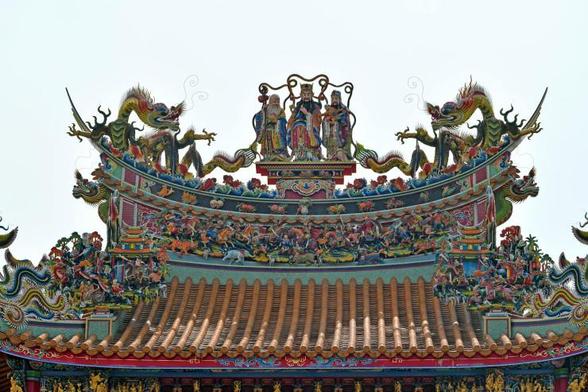
The Three Pure Ones represent both a primordial deity & a heaven. They’re often depicted seated on thrones, each holding a distinct symbol.

Yuanshi Tianzun, the first & highest of the Three Pure Ones, rules the first Heaven, Yu-Qing, which is found in the Jade Mountain. The entrance to this heaven is called the Golden Door. He represents the beginning of all existence & is associated with the formless & primordial chaos that existed before the universe. He’s believed to have created Heaven & Earth. His symbol is a pearl or a globe. This represents the cosmic egg from which the universe emerged. He’s known as the Jade Pure One. Known as the Celestial Worthy of Primordial Beginning.

Lingbao Tianzun rules over the Heaven of Shang-Qing. He represents the beginning of time & the revelation of the Dao’s teachings to the world. He is associated with the transition from primordial chaos to a structure universe & is said to be the keeper of the sacred scriptures & the master of rituals. His symbol is a ruyi scepter, signifying cosmic power & authority. He’s also known as the Supreme Pure Ones. Also known as the Celestial Worthy of Numinous Treasure.

Daode Tianzun rules over the Heaven of Tai-Qing. He’s the 3rd & most widely known of the 3. He’s believed to be the deified form of Laozi, the reputed author of the Daode Jing. He’s associated with the communication of the Dao’s teachings to humanity & is the master of compassion & ethics. His symbol is a fan, which he used to spread the teachings of the Tao/Dao, or a deer, a symbol of longevity & wisdom. He’s also known as the Great Pure One & the Celestial Worthy of the Way & its Virtue.

Schools of Taoist thought developed around each of these deities. Taoist Alchemy was a large part of these schools. Each of the Three Pure Ones represented 1 of 3 essential fields of the body: jing, qi, & shen. The congregation of all Three Pure Ones resulted in the return of Tao.

The 1st Pure One in universal/heavenly chi. The Second Pure One is human-plane chi. The Third Pure One is earth chi. Heavenly chi includes the chi, or energy, of all the planets, stars, & constellations. As well as the energy of God (the force of creation & universal love).

Human chi is the energy that exists on the surface of our planet & sustains human life. The earth force includes all of the forces inside the planet, as well as the 5 elemental forces.

Since the Three Pure Ones are manifestations of Primordial Energy, they are formless. However, to illustrate their role in Creation, they’re often pictured as elderly deities, robed in three basic colors, from which all colors originated: red, blue, & yellow (or green).

Each of them holds onto a divine object associated with their tasks. Yuanshi Tianzun is usually depicted holding the Pearl of Creation, signifying his role in recreating the Universe.

The Ruyi held by Lingbao Tianzun represents authority: the 2nd phase of Creation where the Yang was separated from the Yin & the Law of Things was ordered in place.

Lingbao Tianzun then took his seat on the left of Yuanshi Tianzun. Later, when all was complete, Daode Tianzun took his place on the right, with the fan symbolizing the completion of Creation. The act of fanning represents the spreading of Tao to all Mankind.

Some believe depictions & thought of the Three Pure Ones from the Tang Dynasty & were influenced by the Church of the East conception about the Trinity. Because of the heavy Christian – Taoist contact & mutual influence of the time.

Others believe that another Taoist trinity of gods evolved into the Pure Ones. Beliefs in the Jade Emperor were taken from other Chinese religious traditions. He was seen as their assistant who managed all of creation.

One-Time Monthly Yearly

Make a one-time donation

Make a monthly donation

Make a yearly donation

Choose an amount

$1.00 $5.00 $10.00 $1.00 $5.00 $10.00 $5.00 $10.00 $15.00

Or enter a custom amount

$

Your contribution is appreciated.

Your contribution is appreciated.

Your contribution is appreciated.

DonateDonate monthlyDonate yearly

#Chi #Christian #Dao #Daobao #DaodeJIng #DaodeTiansun #DaodeTianzun #Globe #GoldenDoor #GreatPureOne #GreatTao #Heaven #Hundun #HundunWijiYuanshiTianwang #JadeEmperor #JadeMountain #JadePureOne #Jing #Jingbao #Laozi #Liangyi #LifeForce #LingbaoTianzun #Pearl #PearlOfCreation #Pinyin #PreCreation #PrimordialDeity #PrimordialEnergy #Qi #RuyiScepter #ShangQing #Shen #Shibao #SupremePureOnes #TaiQing #Taiji #TangDynasty #Tao #TaoTeChing #Taoism #TaoistAlchemy #TaoistPantheon #TaoistTrinity #ThreeClairites #ThreeDivineTeachers #ThreePristineOnes #ThreePureOnes #ThreePurePellucidOnes #ThreePurities #Trinity #Wuji #YinYang #YuanshiTianzun