 kate0115
In Go, you can determine if a function runs concurrently by looking at how it is invoked. If a function call is prefixed with the go keyword, it runs concurrently in a new goroutine.
 Houston Haynes
As we work on projects that push our framework forward, we're taking a technical sidebar to both explain the academic and commercial reasons for staying disciplined. #AI #quantum #systemsprogramming
https://speakez.tech/blog/getting-real-with-fidelity-framework/
 Houston Haynes
As we work on projects that push our framework forward, we're taking a technical sidebar to both explain the academic and commercial reasons for staying disciplined. #AI #quantum #systemsprogramming
https://speakez.tech/blog/getting-real-with-fidelity-framework/
 algodesigner
🧵 (2/2) I really like how Bjarne Stroustrup portrays the language, no bold statements or tension, just strong dedication to the course. What he has achieved is admirable.
#Cpp #C #Programming #SystemsProgramming #SoftwareEngineering #BjarneStroustrup
 Oxidize Conf Sep 14-16, 2026
Building on FUSE in Rust tends to involve a lot of boilerplate. libfuse-fs is an attempt to change that - trait-based abstractions, async I/O, overlay and passthrough support out of the box.
At Oxidize 2026, Ruiji Yu (Nanjing University) covers the design and lessons from real integrations: monorepo access and container image building.
🔗 https://oxidizeconf.com/sessions/libfuse_fs_a_ready_to_use_filesystem_library_based_on_fuse
#Oxidize2026 #RustLang #FUSE #Filesystem #AsyncRust #SystemsProgramming

又学到了两个tmux command
ctrl+b, % 分屏
ctrl+b, o 切换分屏
ctrl+b, : 输入命令行
可以输入kill-session强制关掉死机的tmux session
#systemsprogramming
ctrl+b, % 分屏
ctrl+b, o 切换分屏
ctrl+b, : 输入命令行
可以输入kill-session强制关掉死机的tmux session
#systemsprogramming
被男朋友推荐了两个claude code必用的plugin:
https://github.com/rtk-ai/rtk
https://github.com/DeusData/codebase-memory-mcp
#systemsprogramming
https://github.com/rtk-ai/rtk
https://github.com/DeusData/codebase-memory-mcp
#systemsprogramming

 Antonio S. Cofiño
Nice example of how even “boring” operations like integer-to-string conversion still have room for serious low-level optimization.
Relevant for logging, serialization, JSON/CSV output, metrics, database exports, etc.
Paper:
https://doi.org/10.1002/spe.70079
Seen via Hacker News:
https://news.ycombinator.com/item?id=48194857

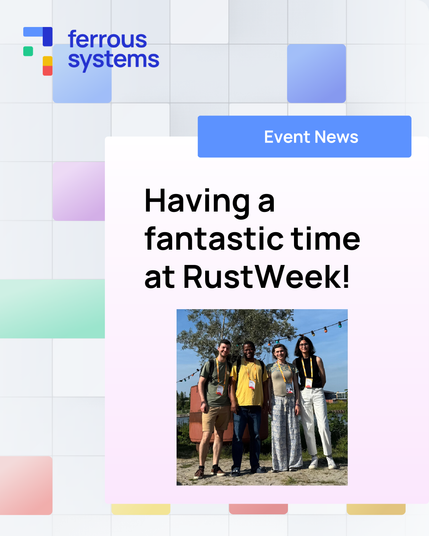
 Ferrous Systems
🦀 Having a fantastic time at RustWeek!
We’re sharing our knowledge through workshops, talks and table discussions. We also sponsored a Safety-Critical Rust Consortium room for the unconference and an Expert Table session on safety-critical Rust with our partner KDAB.
Throughout the week, we’ve had the chance to meet and talk with many amazing people. Great energy all around — thanks to everyone who joined us!
#RustWeek #rustlang #systemsprogramming #opensource #ferroussystems #kdab
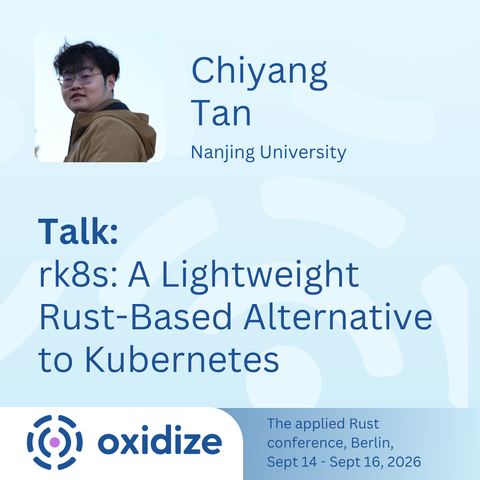
Do you really need half a dozen daemons and endless YAML just to run a few containers?
Chiyang Tan (Nanjing University) built rk8s - a lightweight Kubernetes alternative in Rust - to find out. At Oxidize 2026, he'll walk through its architecture: a state management and scheduling server, and a single binary that handles both CLI and worker runtime.
🔗 https://oxidizeconf.com/sessions/rk8s_a_lightweight_rust-based_alternative_to_kubernetes
#Oxidize2026 #RustLang #Kubernetes #CloudNative #SystemsProgramming