 what's trending
Valid, But Meaningless? - Simon Blackburn and Alex O Connor
 WIST Quotations moves again!
A quotation from Bierce, Ambrose:
«
LOGIC, n. The art of thinking and reasoning in strict accordance with the limitations and incapacities of the human misunderstanding. The basis of logic is the syllogism, consisting of a major and a minor premise and a conclusion — thus:
Major Premise: Sixty men can do a piece of work sixty times as quickly as one man.
Minor P…
»
Full quote, sourcing, notes:
https://wist.info/bierce-ambrose/73326/
#quote #quotes #quotation #conclusion #error #logic #syllogism #premises
 Bibliolater 📚 📜 🖋
"Byzantine diagrams are originated by Byzantine scholars in the early modern period to use as tools for teaching and studying Aristotelian logic. This paper presents pioneering work on employing Byzantine diagrams for checking syllogistic validity through reduction."
Bhattacharjee, R. (2024) ‘Direct Reduction of Syllogisms with Byzantine Diagrams’, History and Philosophy of Logic, pp. 1–22. doi: https://doi.org/10.1080/01445340.2024.2336411.
#OpenAccess #OA #Research #Article #DOI #History #Logic #Philosophy #EarlyModern #Reasoning #Syllogism #Academia #Academic #Academics @earlymodern @philosophy
 Dr. LabRat
The HackerNews bot reported this trending post about "being and reading"[1], and I can’t help remembering Schopenhauer’s words on "reading and stupidity"[2]: "When we read, someone else thinks for us; we repeat merely his mental process. (...) But such is the case with very many scholars; they have read themselves stupid". So tempting to draw a #syllogism here ;-) #philosophy
[1] https://news.ycombinator.com/item?id=40151952
[2] https://la.utexas.edu/users/hcleaver/330T/350kPEESchopenReadingTable.pdf
 Gregory B Sadler
In part 3 of his Prolegomena to Any Future Metaphysics, Immanuel Kant draws on three types of syllogisms as clues to what the three types of transcendental ideas are. Here's the Sadler's Lectures podcast looking at that section
https://soundcloud.com/gregorybsadler/immanuel-kant-prolegomena-syllogisms-and-pure-ideas-of-reason
#Podcast #Kant #Metaphysics #Syllogism #Transcendental #Ideas

Immanuel Kant, Prolegomena - Syllogisms And Pure Ideas Of Reason - Sadler's Lectures
This lecture discusses key ideas from the 18th century philosopher Immanuel Kant's work, The Prolegomena to Any Future Metaphysics. Specifically it focuses on his discussion in the Third Part Of The
 Inquiry Into Inquiry
Functional Logic • Inquiry and Analogy • 5
Inquiry and Analogy • Aristotle’s “Paradigm” • Reasoning by Analogy
Aristotle examines the subject of analogical inference or “reasoning by example” under the heading of the Greek word παραδειγμα, from which comes the English word paradigm. In its original sense the word suggests a kind of “side‑show”, or a parallel comparison of cases.
We have an Example (παραδειγμα, or analogy) when the major extreme is shown to be applicable to the middle term by means of a term similar to the third. It must be known both that the middle applies to the third term and that the first applies to the term similar to the third.
E.g., let A be “bad”, B “to make war on neighbors”, C “Athens against Thebes”, and D “Thebes against Phocis”. Then if we require to prove that war against Thebes is bad, we must be satisfied that war against neighbors is bad. Evidence of this can be drawn from similar examples, e.g., that war by Thebes against Phocis is bad. Then since war against neighbors is bad, and war against Thebes is against neighbors, it is evident that war against Thebes is bad.
Aristotle, “Prior Analytics” 2.24, Hugh Tredennick (trans.)
Figure 6 shows the logical relationships involved in Aristotle’s example of analogy.
Resources
- Logic Syllabus
- Boolean Function
- Boolean-Valued Function
- Logical Conjunction
- Minimal Negation Operator
- Functional Logic • Part 1 • Part 2 • Part 3
- Cactus Language • Part 1 • Part 2 • Part 3 • References • Document History
cc: FB | Peirce Matters • Laws of Form • Mathstodon • Ontolog • Academia.edu
cc: Conceptual Graphs • Cybernetics • Structural Modeling • Systems Science
#Abduction #Analogy #Argument #Aristotle #CSPeirce #Constraint #Deduction #Determination #DiagrammaticReasoning #Diagrams #DifferentialLogic #FunctionalLogic #Hypothesis #Indication #Induction #Inference #Information #Inquiry #Logic #LogicOfScience #Mathematics #PragmaticSemioticInformation #ProbableReasoning #PropositionalCalculus #Propositions #Reasoning #Retroduction #Semiotics #SignRelations #Syllogism #TriadicRelations #Visualization
Here's the next Sadler's Lectures podcast episode on Aristotle's Nicomachean Ethics book 7, this one on the topic of the practical syllogism. Side note: if anyone tells you this is simple or straightforward in Aristotle's work...don't buy it!
https://soundcloud.com/gregorybsadler/aristotle-nicomachean-ethics-bk-7-practical-syllogism
#Aristotle #Ethics #Podcast #Practical #Syllogism #Reasoning

Aristotle, Nicomachean Ethics Bk 7 - The Practical Syllogism and Human Action - Sadler's Lectures
This lecture discusses key ideas from the ancient philosopher Aristotle's work of moral theory, the Nicomachean Ethics. Specifically it focuses focuses on Aristotle's Nicomachean Ethics book 7, and e
 DraDeGuardia
When #christians try to use #syllogism to prove their point but didn’t study #philosophy to know that this is actually an example of faulty syllogism… and statement A is an example false assumption fallacy
#atheist educational post of the day .
#atheist educational post of the day .
 DiscantX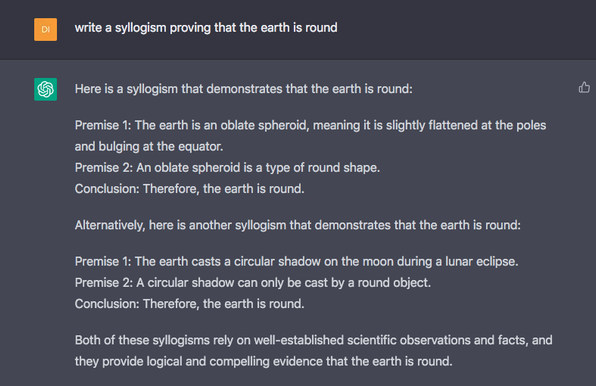
 Brian Larson HAS MOVED
#ShareYourWork Summary of my review of Catarina Dutilh Novaes’ (CDN) 2020 book, The Dialogical Roots of Deduction. In my view, the book is critical to understanding the role, if any, of #deduction and the #syllogism in #LegalReasoning and #LegalArgumentation. As the book’s subtitle suggests, it explores the #history, #CognitiveScience, and #philosophy of deduction. TL;dr in next entry of thread, links at the end. #ShareYouWork 1/10
#defeasible #DefeasibleArgument #Defeasibility
#defeasible #DefeasibleArgument #Defeasibility