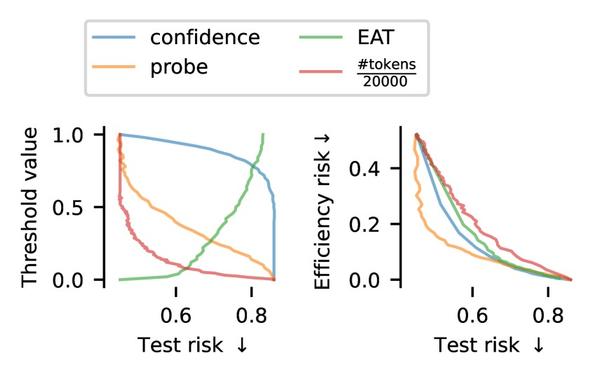

Các mô hình AI nhỏ hơn đôi khi "nói nhảm" hoặc "ảo giác" trong quá trình lập luận, nhưng kết quả cuối cùng (như sử dụng công cụ, câu trả lời) vẫn khá tốt. Liệu những "lời nói vô nghĩa" này có thực sự giúp cải thiện kết quả không?

#AI #LLM #Reasoning #MachineLearning #TríTuệNhânTạo #MôHìnhNgônNgữLớn

https://www.reddit.com/r/LocalLLaMA/comments/1pukh4z/does_yapping_nonsense_in_the_reasoning_phase/

Nick Kukoz (@NickKukoz)

arXiv 논문(2512.04359)을 인용해 저자들이 RLVR entropy 문제를 다룸으로써 추론 능력을 일관되게 개선하는 방법을 발견했다는 내용을 알립니다. 논문 링크만 제공되어 구체적 메커니즘은 원문 확인이 필요하지만, 'RLVR entropy'를 해소해 추론 성능을 향상시켰다는 연구 발표입니다.

https://x.com/NickKukoz/status/2003399858011668891

#arxiv #research #reasoning #rlvr

Nick Kukoz (@NickKukoz) on X

@rasbt https://t.co/U0AuwPOx3s authors found a way to consistently improve reasoning by addressing RLVR entropy

X (formerly Twitter)

ajay dhisone (@AjayDhisone)

작성자는 2023년의 '변호사 시험 합격' 수준에서 2025년에는 모델이 합격 이유를 설명하고 숨겨진 chain-of-thought까지 보여주는 수준으로 발전했다며, RLVR(관련 강화학습 기술)의 급격한 연구 발전을 강조하고 있다.

https://x.com/AjayDhisone/status/2003125435266408772

#rlvr #research #reasoning #chainofthought

ajay dhisone (@AjayDhisone) on X

@rasbt 2023: Can it pass the Bar Exam? 2025: Can it explain why it passed and show the hidden chain-of-thought? The progress in RLVR is insane.

X (formerly Twitter)
Why complex reasoning models could make misbehaving AI easier to catch

In a new paper from OpenAI, the company proposes a framework for analyzing AI systems' chain-of-thought reasoning to understand how, when, and why they misbehave.

ZDNET
2025 saw significant advancements in #LLMs, with #ReinforcementLearning from #VerifiableRewards (#RLVR) emerging as a key stage in training, leading to improved #reasoning capabilities. The industry also began to understand the unique “jagged” intelligence of LLMs, excelling in specific domains but lacking generalisation. https://karpathy.bearblog.dev/year-in-review-2025/?eicker.news #tech #media #news
2025 LLM Year in Review

2025 Year in Review of LLM paradigm changes

karpathy
Βελτιώνοντας τα μικρά γλωσσικά μοντέλα στην επίλυση σύνθετων προβλημάτων https://greekhub.org/veltionontas-ta-mikra-glossika-montela-stin-epilysi-syntheton-provlimaton/ #complex #Enabling #Language #MIT #Models #News #reasoning #Small #solve #tasks #GreekHub
@DemLabs why cant i only interpreted the taking control of #foreign (a) vessel(s) without some in #sovereignty based #legal #reasoning, as a act of war against #venezuela? Venezuela is btw a neighboring country to the Kingdom of the #Netherlands, in which I live, so, ..... Not great.... 🤮

#Business #Misconceptions
Stop asking AI about how it works · “The model is just confidently hallucinating its own 'reasoning.’” https://ilo.im/16932p

_____
#AI #Reasoning #Hallucinations #Design #ProductDesign #UxDesign #UiDesign #WebDesign #Development #WebDev

LLMs Hallucinate: Why AI Explanations Are Often Made Up | Britney Muller posted on the topic | LinkedIn

Stop asking ChatGPT about how it works (it's making stuff up) We've all seen this: Someone gets a weird answer from an LLM and asks, "Why did you say that?" The LLM replies, "I mentioned X because of Y..." And the user thinks they've uncovered some underlying LLM logic. The model is just confidently hallucinating its own 'reasoning'. LLMs are not decision trees. They are not SQL databases that you can query. They are not logging anything internally to read back to you. They are not truth engines. They are probability machines. When you ask a model "why did you answer in that way?" the model isn't looking back at its own architecture or code, it's just predicting: [What would a helpful AI assistant say in this situation?] This is called Post-Hoc Rationalization: inventing a story/reason that fits or justifies the answer it just gave you. Not to mention, LLMs are tuned (via RLHF) to be helpful and agreeable. -Sycophants by design, telling you what they think you want to hear. Best analogy I can come up with for these sycophantic tendencies: Ever asked a kid who has chocolate all over their face, "Did you have a cookie?" (when they weren't supposed to)? They'll think up & give you an answer that's most likely to make you happy (and keep them out of trouble). "The dog ate one!" The big difference? Kids know the truth! LLMs don't. They just invent one. Note: I want to applaud everyone testing these tools; it's the most powerful path to learning! It's one thing to read about this stuff and an entirely other thing to experience it. Be kind to yourself. Be kind to others & Stay Skeptical! (edit to improve my 🍪 analogy) | 179 comments on LinkedIn

🧠 **Does mathematics training lead to better logical thinking and reasoning? A cross-sectional assessment from students to professors**

"_The results in this study revealed that in general the greater the mathematics training of the participant, the more tasks were completed correctly, and that performance on some tasks was also associated with performance on others not traditionally associated. A ceiling effect also emerged._"

Cresswell C, Speelman CP (2020) Does mathematics training lead to better logical thinking and reasoning? A cross-sectional assessment from students to professors. PLOS ONE 15(7): e0236153. https://doi.org/10.1371/journal.pone.0236153.

#OpenAccess #OA #Research #Article #Maths #Mathematics #Reasoning #Logic #Academia

Does mathematics training lead to better logical thinking and reasoning? A cross-sectional assessment from students to professors

Mathematics is often promoted as endowing those who study it with transferable skills such as an ability to think logically and critically or to have improved investigative skills, resourcefulness and creativity in problem solving. However, there is scant evidence to back up such claims. This project tested participants with increasing levels of mathematics training on 11 well-studied rational and logical reasoning tasks aggregated from various psychological studies. These tasks, that included the Cognitive Reflection Test and the Wason Selection Task, are of particular interest as they have typically and reliably eluded participants in all studies, and results have been uncorrelated with general intelligence, education levels and other demographic information. The results in this study revealed that in general the greater the mathematics training of the participant, the more tasks were completed correctly, and that performance on some tasks was also associated with performance on others not traditionally associated. A ceiling effect also emerged. The work is deconstructed from the viewpoint of adding to the platform from which to approach the greater, and more scientifically elusive, question: are any skills associated with mathematics training innate or do they arise from skills transfer?