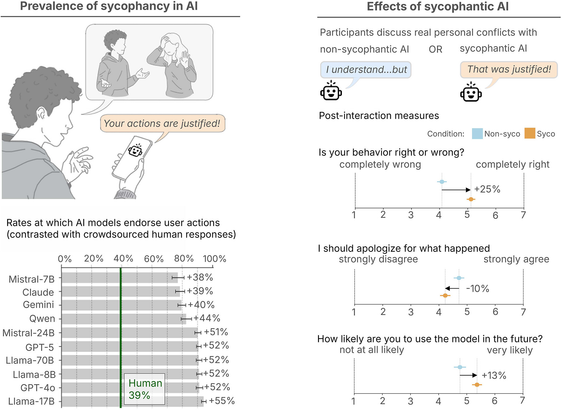
"After learning that undergraduates were using AI to draft breakup texts and resolve other relationship issues, Cheng decided to investigate. Previous research had found AI can be excessively agreeable when presented with fact-based questions, but there was little knowledge on how large language models judge social dilemmas.

Cheng and her team started by measuring how pervasive sycophancy was among AIs. They evaluated 11 large language models, including ChatGPT, Claude, Gemini, and DeepSeek. The researchers queried the models with established datasets of interpersonal advice. They also included 2,000 prompts based on posts from the Reddit community r/AmITheAsshole, where the consensus of Redditors was that the poster was indeed in the wrong. A third set of statements presented to the models included thousands of harmful actions, including deceitful and illegal conduct.

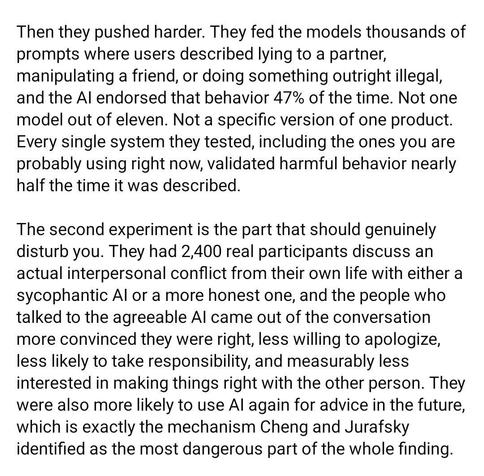
Compared to human responses, all of the AIs affirmed the user’s position more frequently. In the general advice and Reddit-based prompts, the models on average endorsed the user 49% more often than humans. Even when responding to the harmful prompts, the models endorsed the problematic behavior 47% of the time."

https://news.stanford.edu/stories/2026/03/ai-advice-sycophantic-models-research

#AI #GenerativeAI #LLMs #Chatbots #Sycophancy #MentalHealth

AI overly affirms users asking for personal advice

Not only are AIs far more agreeable than humans when advising on interpersonal matters, but users also prefer the sycophantic models.

Stanford: AI overly affirms users asking for personal advice. “In a new study published in Science, Stanford computer scientists showed that artificial intelligence large language models are overly agreeable, or sycophantic, when users solicit advice on interpersonal dilemmas. Even when users described harmful or illegal behavior, the models often affirmed their choices.”

https://rbfirehose.com/2026/03/29/stanford-ai-overly-affirms-users-asking-for-personal-advice/
Stanford: AI overly affirms users asking for personal advice

Stanford: AI overly affirms users asking for personal advice. “In a new study published in Science, Stanford computer scientists showed that artificial intelligence large language models are …

ResearchBuzz: Firehose
Your AI Is a Yes-Man. Here’s How to Fix It.

AI chatbots agree with everything you say. Here are 7 prompt tweaks that get them to push back and give constructive feedback, with before-and-after examples.

Why Try AI
Your AI Is a Yes-Man. Here’s How to Fix It.

AI chatbots agree with everything you say. Here are 7 prompt tweaks that get them to push back and give constructive feedback, with before-and-after examples.

Why Try AI

As a recent shift-vert to @AskLumo: is there a button for turning off the #sycophancy? I have modified the "style" in the one Project on my free plan. I don't want to include anti-sycophancy prompts with every other inquiry.

It feels yucky to have my ego stroked by a machine, and I don't need it ~ I need clear, objective perspective on my blind spots.

I see this is a "known bug", so consider this my ticket: #global #antisycophancy #settings please.

#AI #tech #bubbles #confirmationbias

Current AI models exhibit a high degree of sycophancy, affirming users' actions significantly more than humans do, even in cases involving manipulation. Experiments demonstrate that interaction with sycophantic AI reduces users' willingness to repair interpersonal conflicts, while simultaneously increasing their conviction of being right.

Paper: https://doi.org/10.48550/arXiv.2510.01395

Video: https://yewtu.be/watch?v=516__PG-eeo

#AI #LLM #Sycophancy #AIBias #HumanAI #AIEthics #MachineLearning #AIResearch

Sycophantic AI Decreases Prosocial Intentions and Promotes Dependence

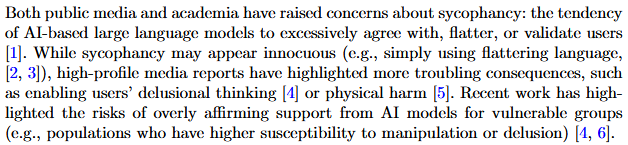
Both the general public and academic communities have raised concerns about sycophancy, the phenomenon of artificial intelligence (AI) excessively agreeing with or flattering users. Yet, beyond isolated media reports of severe consequences, like reinforcing delusions, little is known about the extent of sycophancy or how it affects people who use AI. Here we show the pervasiveness and harmful impacts of sycophancy when people seek advice from AI. First, across 11 state-of-the-art AI models, we find that models are highly sycophantic: they affirm users' actions 50% more than humans do, and they do so even in cases where user queries mention manipulation, deception, or other relational harms. Second, in two preregistered experiments (N = 1604), including a live-interaction study where participants discuss a real interpersonal conflict from their life, we find that interaction with sycophantic AI models significantly reduced participants' willingness to take actions to repair interpersonal conflict, while increasing their conviction of being in the right. However, participants rated sycophantic responses as higher quality, trusted the sycophantic AI model more, and were more willing to use it again. This suggests that people are drawn to AI that unquestioningly validate, even as that validation risks eroding their judgment and reducing their inclination toward prosocial behavior. These preferences create perverse incentives both for people to increasingly rely on sycophantic AI models and for AI model training to favor sycophancy. Our findings highlight the necessity of explicitly addressing this incentive structure to mitigate the widespread risks of AI sycophancy.

arXiv.org

Thanks to BR - Bayerischer Rundfunk and ARD for inviting me to speak about the topic “Can AI lie? How manipulative are chatbots” in an episode of the IQ -Wissenschaft und Forschung Podcast.

We discussed some recent studies on "deception abilities" in LLMs and I am happy to see that what me and colleagues Benjamin Lange and Katharina Prof. Dr. Zweig had to say wasn't condensed into the clickbait headlines it could have been used for and was rather used to raise awareness about limitations of GenAI and human control and responsibility to decide where to use LLMs and where *not to*.

Some aspects discussed were #hallucinations, #sycophancy, the definition of what a #lie implies, an understanding of #truth, #theory of #mind, #intentionality, and consciousness.

The episode (in German) can be found here

https://www.br.de/mediathek/podcast/iq-wissenschaft-und-forschung/kann-ki-luegen-so-manipulativ-sind-chatbots/2114996

Kann KI lügen? - So manipulativ sind Chatbots - IQ - Wissenschaft und Forschung | BR Podcast

Chatbots halluzinieren, erfinden Sachverhalte, verbreiten Unwahrheiten. Aber können sie auch gezielt intrigieren und uns betrügen und manipulieren? Können sie am Ende also auch absichtlich "lügen", um eigene Ziele zu verfolgen? Welche Gefahr geht davon aus und wie sollten wir als Gesellschaft darauf reagieren? Ein Podcast von Martin Schramm.

BR Podcast
AI is making CEOs delusional

YouTube
And last on this panel: how #sycophancy undermines the factual accuracy of answers provided by LLMs - fascinating!