 Carmelite Quotes
When God Feeds His Children — Silvio José Báez, ocd
Today, with gratitude and wonder, we celebrate the gift of the Risen Christ, present in the bread of the Eucharist to satisfy our hunger for life and love. Today’s first reading, from the book of Deuteronomy, recalls Israel’s experience as they journeyed through the desert toward the promised land. In that barren place, where there could be no harvest and no food, the book of Deuteronomy reminds Israel: “The Lord fed you with manna, which neither you nor your ancestors knew” (Dt 8:3). Forty years without fertile land, without certainties, without a clear path forward. And yet, in that desert, God was present, feeding his people.
In the deserts of life, when our human securities collapse and we come face to face with our own insufficiency, God remains beside us like a father who lovingly provides for the needs of his children. Let’s think of the personal desert of loneliness and sadness, of discouragement and fear. Let’s think of the desert of our people, subjected for years to an irrational and aging power that deprives them of freedom and a future. Let’s think of the desert of uprooting and exile, which many of us have experienced. And yet, there’s no desert where God leaves us abandoned to our own strength, without sustaining us and feeding us with the power of his love.
But the manna in the desert held an even deeper lesson: “One does not live by bread alone, but by every word that comes from the mouth of God” (Dt 8:3). The desert taught Israel that material bread isn’t enough. There’s a hunger no abundance can satisfy, a thirst no success can calm, a loneliness no noise can fill. The deepest longings and desires of the heart can be fulfilled only by God, who continually offers us the bread of his presence and love.
Using that same image of bread, Jesus speaks in the synagogue of Capernaum the boldest words ever heard: “I am the living bread that came down from heaven” (Jn 6:51). Jesus is bread. Bread is simple, but it’s effective: it satisfies the one who eats it, nourishes life, and sustains existence. That’s what Jesus was, and that’s what he remains: bread. He is the bread that came down from heaven, the one who offered his life to bring us into communion with the Father and make us his children. He is bread that strengthens and heals us, forgives us, and gives us life.
Jesus is the bread that can fill our life with meaning and constantly renew it with his love: “The bread that I will give is my flesh for the life of the world” (Jn 6:51). The bread that gives us life is his life handed over, his merciful love, his words that enlighten and set us free, his tenderness toward the poor, his faithfulness unto death, his glorious life risen from the dead. All of this is Jesus, the bread that came down from heaven, who wants to be the daily bread of our fragile existence. Let’s not forget his words: “Unless you eat the flesh of the Son of Man and drink his blood, you have no life in you” (Jn 6:53).
In a world full of broken promises and deceitful words that try to manipulate our conscience, Jesus is the bread that feeds us with light and truth. In the face of authoritarian regimes that subjugate people through fear and repression, Jesus is the bread that nourishes us with strength and hope. Before unhinged rulers who distort history, calling repression peace and slavery a blessing, Jesus is the bread that sustains our dreams of freedom and keeps us from being deceived. To feed on Jesus is to believe in him, to trust in his love, to be nourished by his words, by his way of living and loving, and to let ourselves be transformed by him.
This encounter of faith with Jesus, this feeding on him, reaches its fullest and most concrete expression in the Eucharist. In the broken and shared bread of the Lord’s Supper, Jesus truly comes to us: “My flesh is true food and my blood is true drink” (Jn 6:55). In the simplicity of the eucharistic bread, the real presence of Jesus becomes food that strengthens us and renews our hope. When we receive Jesus in the bread of the Eucharist, our life is born anew again and again. We know ourselves to be freely loved, and we’re impelled to love our brothers and sisters with the same intensity. We can’t receive Christ in the Eucharist and remain indifferent to the suffering of the poor, dismiss those who think differently, foster fruitless divisions, or close our eyes to injustice.
The eucharistic bread is like a fountain of living water that refreshes our withered life and waters our parched heart. As the Pope recalled today at the Corpus Christi Eucharist in Madrid, Saint John of the Cross, in a beautiful poem, imagined the Eucharist as bread from which there flows, in the middle of the night, the living fountain who is God:
“This eternal spring is hidden
in this living bread for our life’s sake,
although it is night.
It is here calling out to creatures;
and they satisfy their thirst,
although in darkness, because it is night.
This living spring that I long for,
I see in this bread of life,
although it is night” (Poetry 8, sts. 9–11).
Saint John of the Cross reminds us that Jesus is present in the eucharistic bread as he is present in the night: he can be recognized and welcomed only through the darkness of loving faith. There is Jesus, “in this living bread for our life’s sake, although it is night” (Poetry 8, st. 9). Jesus is truly present in the simplicity of this bread: humble, silent, and discreet. From this bread, he cries out his love, calls us, and waits for us:
“It is here calling out to creatures;
and they satisfy their thirst,
although in darkness, because it is night” (Poetry 8, st. 10).
Commenting on this poem by Saint John of the Cross, Pope Leo invited us today in Madrid to open ourselves to Jesus, who, by the grace of the Eucharist, “transforms us and makes us protagonists of the transformation of history, a sign of hope.” And he added:
“Let us return to him with sincere love. Let us open ourselves to the encounter with him, let us allow him to quench the thirst of our hearts, so that we may then go forth into the paths of life and history, bringing to the people this stream of fresh water, a stream of love, peace, justice and joy” (Leo XIV, Homily of the Holy Father, June 7, 2026).
Let’s draw near to the table of the Lord with the simple, trusting faith of Israel in the desert, knowing that what we need most isn’t something we make for ourselves, but something given to us by God. Let’s receive Jesus with gratitude. Let’s allow his love, “the fount that flows and runs, although it is night,” to nourish us and transform us into bread, broken and shared for the life of the world.
Bishop Silvio José Báez, o.c.d.
Auxiliary Bishop of Managua
Homily, 7 June 2026
John of the Cross, St 1991, The Collected Works of St. John of the Cross, rev. edn, Kavanaugh, K & Rodriguez, O (trans.), ICS Publications, Washington DC.
Leo XIV 2026, ‘Homily of the Holy Father: Holy Mass, Procession and Eucharistic Blessing in the Solemnity of the Body and Blood of Christ, Plaza de Cibeles, Madrid, Sunday, 7 June 2026’, The Holy See, 7 June, viewed 7 June 2026, https://www.vatican.va/content/leo-xiv/en/homilies/2026/documents/20260607-spagna-messa-madrid.html.
Translation from the Spanish text is the blogger’s own work product and may not be reproduced without permission.
Featured image: Adriaen van Ostade, Father Feeding his Child, 1610–85, etching. The Metropolitan Museum of Art (Public Domain). Image adapted for 16:9 format with parchment background.
#BishopSilvioJoséBáez #CorpusChristi #Eucharist #night #StJohnOfTheCross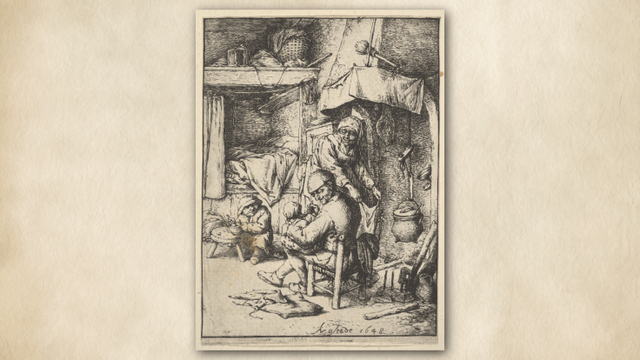


 Assembly Bethesda