Quote of the day, 6 April: St. John of the Cross

Where signs and testimonies abound, there is less merit in believing.

God never works these marvels except when they are a necessity for believing. Lest his disciples go without merit by having sensible proof of his resurrection, he did many things to further their belief before they saw him.

Mary Magdalene was first shown the empty sepulcher, and afterward the angels told her about the resurrection so she would, by hearing, believe before seeing. As St. Paul says: Faith comes through hearing [Rom. 10:17]. And though she beheld him, he seemed only an ordinary man, so by the warmth of his presence, he could finish instructing her in the belief she was lacking [Mt. 28:1-6; Lk. 24:4-10; Jn. 20:11-18].

And the women were sent to tell the disciples first; then these disciples set out to see the sepulcher [Mt. 28:7-8]. And journeying incognito to Emmaus with two of his followers, he inflamed their hearts in faith before allowing them to see [Lk. 24:15-32].

Finally, he reproved all his disciples for refusing to believe those who had told them of his resurrection [Mk. 16:14]. And announcing to St. Thomas that they are blessed who believe without seeing, he reprimanded him for desiring to experience the sight and touch of his wounds [Jn. 20:25, 29].

Thus, God is not inclined to work miracles. When he works them, he does so, as they say, out of necessity. He consequently reprimanded the Pharisees because they would not give assent without signs: If you do not see signs and wonders, you do not believe [Jn. 4:48]. Those, then, who love to rejoice in these supernatural works suffer a great loss in faith.

Saint John of the Cross

The Ascent of Mount Carmel, III, ch. 31, nos. 8–9

John of the Cross, St 1991, The Collected Works of St. John of the Cross, rev. edn, Kavanaugh, K & Rodriguez, O (trans.), ICS Publications, Washington DC.

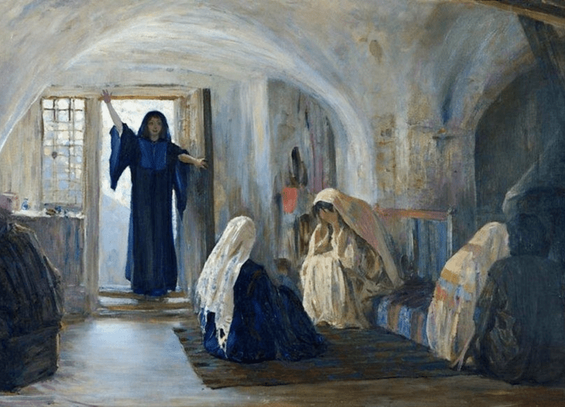
Featured image: Ushered in a Tearful Joy, Vasily Polenov (Russian, 1844–1927). Oil on canvas, c. 1900. Polenov captures the moment when Resurrection light breaks into the house of mourning. A woman—probably Mary Magdalene—stands in the doorway, clothed in blue, announcing news that will change everything. Seated in the shadows, one veiled figure turns to listen; another sits with head in hands, still bowed in grief. The painting evokes the Easter Monday Gospel (Matthew 28:8–10), in which the women, “fearful yet overjoyed,” run from the tomb to tell the disciples—and meet the Risen Lord along the way.

#faith #miracles #resurrectionOfChrist #signs #StJohnOfTheCross

Quote of the day, 22 April: Blessed Marie-Eugène

Mary, Mother of the Risen One

Yesterday, we contemplated the Risen Jesus, and in a sense, we were carried away by His light and by the joy of the apostles, who recovered all their hope as they beheld their risen Master.

Today, it is good for us to pause with Mary, the Mother of the Risen One. She is our mother, and we want to understand what was happening in her soul.

We are drawn to seek her in her solitude—to contemplate her there. She does not step into the foreground; she remains hidden, always in the background. We have to make an effort to find her, to draw close to her, but we feel this need.

Let us linger with Mary for a few moments on the day of the Resurrection.

It seems certain that the Lord revealed Himself to her. Her risen Son surely wanted her to share in His joy and in His triumph.

We last saw her on the evening of Good Friday and throughout Holy Saturday, immersed in a sorrow we can hardly imagine. Yes, she remained noble and serene, magnified by suffering, above all by the living word her Son had spoken. On Calvary, He had consecrated her motherhood: a divine motherhood that had become a motherhood of grace for the Mystical Body of Christ and for all humanity made new.

She was great, yet profoundly sorrowful. We have tried to grasp this. In her suffering—in that sea of grief that threatened to bury her in its bitter waves—there burned a flame: the small flame of hope. But it was strong and immense—a hope that sustained the Virgin and, through her, sustained the Mystical Body of Christ.

Beside the cross, beside the body of her dead and buried Son, Mary remained the one true hope—a living hope, rooted in the fruitfulness of a Mother who never ceased to give life.

And now, Jesus is risen. He reveals Himself to her. What joy must have flooded her soul!

At the Visitation, she sang: “My soul magnifies the Lord, and my spirit rejoices in God my Savior.” [Lk 1:46–47]. How much greater her exultation must have been on this morning! Her soul rejoiced. Her hope took hold of its object. Her whole being exulted.

Yes, the angel’s words at the Annunciation were true. The Son she bore was truly the Son of God, truly the Messiah. He had been put to death—for it was necessary that He pass through suffering and death—and now He was alive again, risen.

He was the promised King, the God-Man of incomparable human stature, radiant now in the full glory of His divine majesty.

Mary rejoiced—not only in her soul, but in her body. Her whole being responded with joy at the sight, the touch, the embrace—if we may put it that way—of the risen body of her Son.

This was her joy, her exultation—a movement of the Holy Spirit through her entire being. And all of it unfolded in an outward serenity, a purity, a beauty that already belonged to heaven.

St. John of the Cross speaks of the awakenings of the Word in the soul (cf. The Living Flame Of Love, stanza 4). Here was one of those awakenings—the Word, seemingly at rest, stirring again in the soul under the flame and breath of the Holy Spirit. He sings within it, exults within it, and causes not only the soul and grace to rejoice, but even the body itself.

So it is when the source of joy is spiritual: it reaches the furthest edges of one’s being and person.

Here, it was more than just a radiance in Mary’s body or flesh—her very flesh exulted at the sight and the embrace of the risen body of the God-Man, her Son.

Blessed Marie-Eugène of the Child Jesus

Homily for Easter Monday, 15 April 1963

Marie-Eugène de l’Enfant-Jésus 1986, Jésus, Contemplation du Mystère Pascal, Editions du Carmel, Toulouse.

Translation from the French text is the blogger’s own work product and may not be reproduced without permission.

Featured image: In Ushered in a Tearful Joy (c. 1890), Russian painter Vasily Polenov (1844–1927) captures the moment when Resurrection light breaks into the house of mourning. A woman—possibly Mary Magdalene—stands in the doorway, clothed in blue, announcing news that will change everything. Seated in the shadows, one veiled figure turns to listen; another sits with head in hands, still bowed in grief. The painting evokes the Easter Monday Gospel (Mt 28:8–10), in which the women, “fearful yet overjoyed,” run from the tomb to tell the disciples, and meet the Risen Lord along the way. Image credit: WikiArt (Public domain)

⬦ Reflection Question ⬦
How might I linger with Mary today, allowing her hidden joy to deepen my faith in the risen Christ?
Join the conversation in the comments.

#BlessedMarieEugeneOfTheChildJesus #BlessedVirginMary #embrace #hope #MotherOfChrist #MotherOfTheLiving #resurrectionOfChrist #solitude #sorrow #StJohnOfTheCross

Bible Gateway passage: Luke 1:46-47 - New Revised Standard Version Catholic Edition

Mary’s Song of Praise - And Mary said, “My soul magnifies the Lord, and my spirit rejoices in God my Savior,

Bible Gateway

Quote of the day, 24 December: Bishop Silvio José Báez, ocd

“Glory to God in the highest heaven, and on earth peace for those he favours” (Lk 2:14). These words conclude tonight’s Gospel reading for this holy night of Christmas. They are the joyful proclamation of the angels who praise God at the birth of Jesus, the Savior. Heaven lifts up its voice. The interpretation of what was unfolding that night in the humble inn of Bethlehem could only come from on high. Only God himself, through his angels, could lead us into the grandeur of this mystery of love and tenderness: “Glory to God in the highest heaven, and on earth peace for those he favours.”

The birth of the Child is a manifestation of God’s glory. In Scripture, God’s glory is his loving and saving power poured out for humanity. It is not vanity, not a self-centered display of greatness, nor a boastful show of power. God reveals his glory by loving us and giving us life. He revealed his glory in creating the universe for humanity’s sake, as the psalmist says: “The heavens declare the glory of God, the vault of heaven proclaims his handiwork” (Ps 19:1). Similarly, the Lord “covered himself in glory” when he liberated the Israelites from Pharaoh’s power, leading them through the sea on their way to the land of freedom (cf. Ex 15:1). God is glorified when he creates and when he saves. His glory is revealed in the universe and in history. He shows his glory by giving us space and time to live, but also by delivering us from every form of slavery so that we may live as free men and women.

The space of his glory is not only the heavens but, above all, a humble manger in the village of Bethlehem. His birth is not a resounding event like the Israelites crossing the sea. Yet tonight, from the modest inn of Bethlehem, God’s glory is revealed. This is the great mystery we celebrate at Christmas: the Almighty has made himself little; the Eternal has become mortal; the Omnipotent has become weak; the Holy One has become the friend of sinners; the Invisible has made himself visible. From the night of Bethlehem onward, God is not only present among us but he is one of us: sharing in our humanity, the brother of every human being in the world.

In the Child, we contemplate God’s glory—not the glory of a strong, powerful, and demanding God, but the glory of a God who is small, weak, vulnerable, and in need. He has come with great simplicity, humility, and meekness. God does not impose himself or dominate us. “He makes himself small, he becomes a child, so as to attract us with love, to touch our hearts with his humble goodness; to unsettle, with his poverty, those who scramble to accumulate the false treasures of this world” (Pope Francis, December 18, 2015).

God was born fragile, like us, in Bethlehem, to understand us and stand by our side, consoling us and filling us with joy. He was born full of tenderness to give us his forgiveness and to set us free from all our enslavements. He was born as our brother so that we might love our humanity and recognize that every human being is a brother or sister to be welcomed and loved, not a rival or enemy to be defeated and subdued. He was born bringing light to the night, instilling the hope that the injustice prevailing in our society today will not last forever. He was born poor so that we might welcome God in the poor, in those who weep, who are lonely, and those deprived of freedom and dignity. In them, God comes to meet us. For this reason alone, Christmas comes to us only if we are in solidarity with the most marginalized and forgotten people, the victims of injustice and the wickedness of worldly powers.

On the night of Bethlehem, the glory of the Lord shone brightly. We are no longer lost in immense solitude or submerged in total darkness. God has entered history to share our life. With him, we can be reborn; his presence rekindles joy, hope, and fellowship. Only the Child of Bethlehem, from his birth to his death, speaks to us of God and reveals God to us through his life, words, actions, and acts of tenderness. With his hands embracing and healing, with his body offered and surrendered to humanity, on the cross he became a victim of the unjust powers of this world. The Child of Bethlehem is the same Christ who was crucified on Calvary and rose in glory, conquering the world’s injustice, violence, and sin! This is why the night of Bethlehem points us to another night, the night of Easter. In both, God says the same thing: “Be not afraid.” He doesn’t want us to be afraid; he wants us to have no fear. In Bethlehem, the Child smiles at us, conveying his tenderness; at Easter, the Risen One looks at us with mercy, freeing us from despair, evil, and sin.

Let’s experience this Eucharist with the same gaze as the Virgin Mary, who—filled with wonder—contemplated the mystery and, with her heart overflowing with joy, embraced the child of her womb. May she, who “was able to turn a stable into a home for Jesus with poor swaddling clothes and an abundance of love” (Evangelii Gaudium 286), help us to welcome the glory of the Lord manifested in the Child of Bethlehem. He is “the Savior,” the only one in whom we can place our ultimate hope. May his glory enlighten our hearts and guide our steps.

Silvio José Báez, o.c.d.

Auxiliary Bishop of Managua
Homily, The Nativity of the Lord

Christmas 2018, Mass during the Night

Translation from the Spanish text is the blogger’s own work product and may not be reproduced without permission.

Featured image: This icon of the Nativity comes from St. Paul Orthodox Church in Dayton, Ohio. The iconographer is Dmitry Shkolnik. Image credit: Fr. Ted Bobosh / Flickr (Some rights reserved)

#Bethlehem #BishopSilvioJoséBáez #BlessedVirginMary #Christmas #God #humanity #humility #invisible #nativity #poverty #resurrectionOfChrist

Luke 2:14 - Bible Gateway