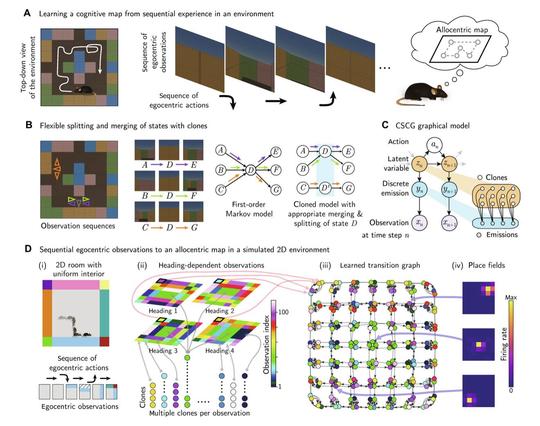
This paper by Raju et al. proposes a unified model – “clone‑structured causal #graphs” (#CSCG) – for #hippocampal #SpatialCoding. It suggests that #SpatialMaps arise from #learning #latent higher‑order sequences rather than representing #EuclideanSpace directly. The model elegantly explains phenomena like #PlaceFields, #SplitterCells, #contextual #remapping, and predicts when #PlaceFieldMapping may mislead.
🌍 https://www.science.org/doi/10.1126/sciadv.adm8470

#Hippocampus #CognitiveMaps #SequenceLearning #Neuroscience

@zotero of course sometimes there may be a few problems.. like here 😅
(The most obvious problem being that our recent review on #SplitterCells is not cited!!!)

(Source: Raju et al., 2024 #GeorgeLab)

@aheadofthenerve I don’t think that exists in a spontaneous (& consistent strategy) version! That’s not what the rats do…

Otherwise when the strategy is forced, there are several papers, for example place vs cued in a T-maze like: Memory Modulates Journey-Dependent Coding in the Rat Hippocampus

(See our review on #SplitterCells to find some more)

Memory Modulates Journey-Dependent Coding in the Rat Hippocampus

Neurons in the rat hippocampus signal current location by firing in restricted areas called place fields. During goal-directed tasks in mazes, place fields can also encode past and future positions through journey-dependent activity, which could guide hippocampus-dependent behavior and underlie other temporally extended memories, such as autobiographical recollections. The relevance of journey-dependent activity for hippocampal-dependent memory, however, is not well understood. To further investigate the relationship between hippocampal journey-dependent activity and memory, we compared neural firing in rats performing two mnemonically distinct but behaviorally identical tasks in the plus maze: a hippocampus-dependent spatial navigation task and a hippocampus-independent cue response task. While place, prospective, and retrospective coding reflected temporally extended behavioral episodes in both tasks, memory strategy altered coding differently before and after the choice point. Before the choice point, when discriminative selection of memory strategy was critical, a switch between the tasks elicited a change in a field's coding category, so that a field that signaled current location in one task coded pending journeys in the other task. After the choice point, however, when memory strategy became irrelevant, the fields preserved coding categories across tasks, so that the same field consistently signaled either current location or the recent journeys. Additionally, on the start arm, firing rates were affected at comparable levels by task and journey; on the goal arm, firing rates predominantly encoded journey. The data demonstrate a direct link between journey-dependent coding and memory and suggest that episodes are encoded by both population and firing rate coding.

Journal of Neuroscience

An entire paper on potential #SplitterCells in #RetrosplenialCortex - without ever mentioning the concept of splitter cells or the related literature 🙃
#SmithLab

From: @biorxiv_neursci
https://biologists.social/@biorxiv_neursci/112664236023259257

bioRxiv Neuroscience (@[email protected])

The Retrosplenial Cortical Role in Delayed Spatial Alternation. https://www.biorxiv.org/content/10.1101/2024.06.18.599656v1?med=mas

biologists.social

@macaskillaf This looks really cool! Were dorsal or intermediary #hippocampus not needed for the task? Dorsal hippocampus also has #SplitterCells for (potentially) latent state - but are you saying they originate from, or maybe reflect the activity of, ventral hippocampus?

(I can also go and read the paper)

Our latest review on #SplitterCells has been cited in the first intro sentence of this new paper from the #BuzsakiLab :
Working memory features are embedded in hippocampal place fields

my work here is done! 😮🙇

#Introduction of my #Neuroscience-oriented account! 🧠​

I am a postdoctoral researcher investigating #NeuroRats 🐀​ doing flexible #Navigation 🗺️​ and how their #Hippocampus might support this fascinating ability.
Is it #PlaceCells?
Is it #HippocampalReplay?
​Is it #SplitterCells?
Is it everything, everywhere (... yes, yes, all at once)?

This account will post, boost and follow specifically neuroscience content, don't hesitate to tag it when relevant.

Followers, please tell us about yourself under my pinned tweet!

4- More recently: thread on our review of #SplitterCells (a subset of #PlaceCells) where we try to summarize and make sense of many studies, asking if they might support decision-making, or which type of #ComputationalModel might support their firing:
https://elduvelle.github.io/ElDuvelle/status/1556036545223745538/

The associated paper:
Temporal context and latent state inference in the hippocampal splitter signal

It seems like a combination of two types of models - Latent State models and Temporal Context models - might best suit the hippocampal Splitter Signal.. but (IMO) it doesn't look like Splitter cells are really doing anything for actual, immediate decision-making.

4/x

El Duvelle 🌍 on Twitter (archived)

The rodent hippocampus is amazing: place cells, time cells, reward cells...Did you know about the puzzling #SplitterCells?We sought to understand them in an experimental & computational review on temporal context & latent state models!Preprint: https://psyarxiv.com/9z4wr/ 1/25

A little summary of #Neuroscience-related hashtags?
(Please add any you think of in answer and I’ll edit the list)

.#NeuroArt
.#Neuroscientist / #Neuroscientists
.#NeuroRat (yep, I’m pretty much the only one using this one)

.#NeuroJobs

The cell types:
.#PlaceCells / #GridCells / #HeadDirectionCells / #SplitterCells … (give me more)

And then we have the brain regions:

.#Hippocampus / #Striatum / #RetrosplenialCortex / #Cortex / #Cerebellum / …

Bonus:
.# NeuroBuzz: once a post takes off, anyone can add it as an answer and then the author can edit it in the original post (but don’t add it when writing the original post, that’s cheating)

@bwyble @marcwhoward Oh, he has papers / theories on replay?? I only know of the #SplitterCells aspects! I definitely want to know more