This paper by Raju et al. proposes a unified model – “clone‑structured causal #graphs” (#CSCG) – for #hippocampal #SpatialCoding. It suggests that #SpatialMaps arise from #learning #latent higher‑order sequences rather than representing #EuclideanSpace directly. The model elegantly explains phenomena like #PlaceFields, #SplitterCells, #contextual #remapping, and predicts when #PlaceFieldMapping may mislead.
🌍 https://www.science.org/doi/10.1126/sciadv.adm8470
#Hippocampus #CognitiveMaps #SequenceLearning #Neuroscience
Hot off the press! Lind, Ghirlanda and Enquist, the authors of the above-mentioned book ⬆️, have now published their study on
#SequenceLearning in
#bonobos , showing that the
#GreatApes struggle to tell short sequences apart
https://doi.org/10.1371/journal.pone.0290546:
https://doi.org/10.1371/journal.pone.0290546 We are currently conducting a study on
#Chimpanzees at the moment and hope to be able to contribute to the discussion soon.

A test of memory for stimulus sequences in great apes
Identifying cognitive capacities underlying the human evolutionary transition is challenging, and many hypotheses exist for what makes humans capable of, for example, producing and understanding language, preparing meals, and having culture on a grand scale. Instead of describing processes whereby information is processed, recent studies have suggested that there are key differences between humans and other animals in how information is recognized and remembered. Such constraints may act as a bottleneck for subsequent information processing and behavior, proving important for understanding differences between humans and other animals. We briefly discuss different sequential aspects of cognition and behavior and the importance of distinguishing between simultaneous and sequential input, and conclude that explicit tests on non-human great apes have been lacking. Here, we test the memory for stimulus sequences-hypothesis by carrying out three tests on bonobos and one test on humans. Our results show that bonobos’ general working memory decays rapidly and that they fail to learn the difference between the order of two stimuli even after more than 2,000 trials, corroborating earlier findings in other animals. However, as expected, humans solve the same sequence discrimination almost immediately. The explicit test on whether bonobos represent stimulus sequences as an unstructured collection of memory traces was not informative as no differences were found between responses to the different probe tests. However, overall, this first empirical study of sequence discrimination on non-human great apes supports the idea that non-human animals, including the closest relatives to humans, lack a memory for stimulus sequences. This may be an ability that sets humans apart from other animals and could be one reason behind the origin of human culture.
 Fabrizio Musacchio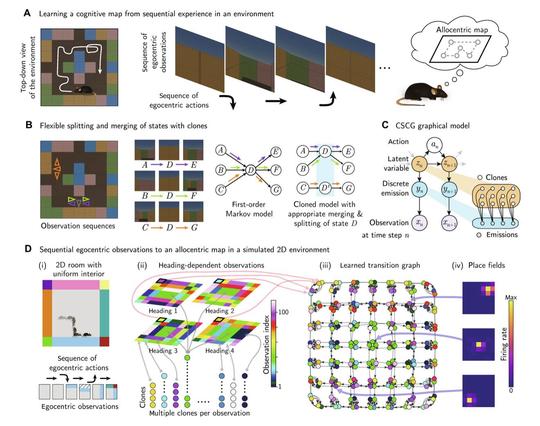
 Eva Reindl