Victoria Station: the thread abut a forgotten Royal rail halt you’ve probably never heard of

This thread was originally written and published in June 2020.

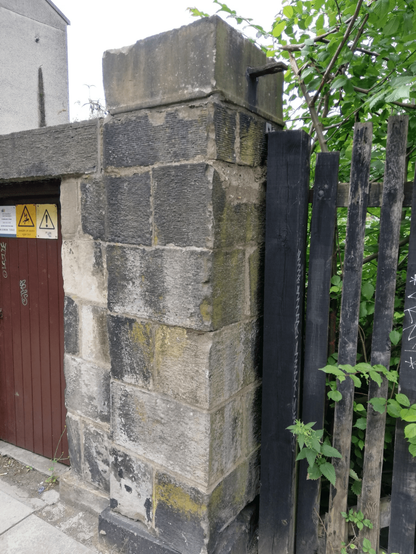
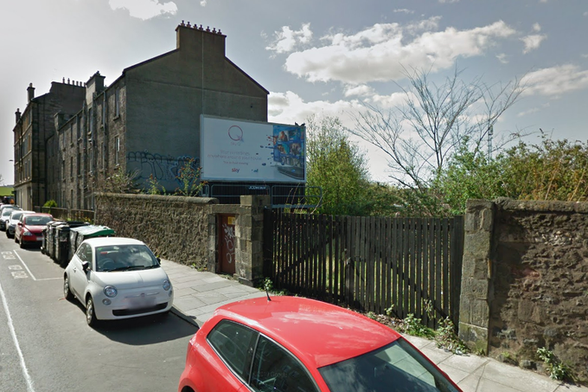
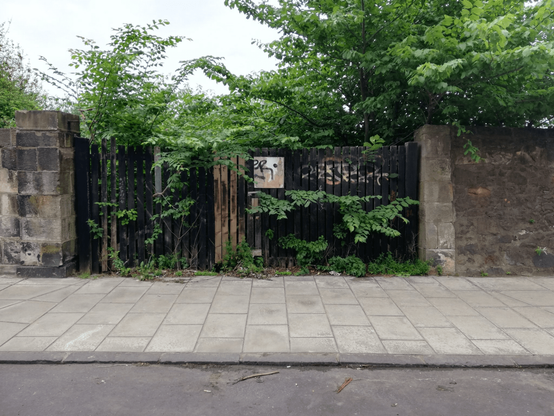
This is the sort of unexpected riddle that I like. You’re out for a walk and you see an old gateway that is rather too well made for the wall it sits in and doesn’t seem to lead anywhere.

Why is this gate so wide and why does it seem to go nowhere?Why is that gate pier so substantial and so well formed for something that leads nowhere?

Beyond the unimpressive wooden gate itself, there’s just a little wedge of grass and overgrowth beyond it, before it descends straight down towards the East Coast Mainline railway.

Incongruous walls and gates

So why is this old gate here? Well, if you rake around in the books and maps you’ll find out that this isn’t just any old railway access gate, this is an old Royal railway access gate. You see, these gate piers are all that remains of Queen Victoria’s personal, private railway station for when she was visiting Edinburgh and lodging in the Palace of Holyroodhouse. We can just see the station in the below photo taken looking east from “Muschet’s Cairn” in Holyrood Park in the 1880s; to the right of the tenement there is a projection, with a distant chimney above it. This is a covered walkway and an iron archway over the gate.

Muschat’s Cairn, entrance to Holyrood Park”. Thomas Begbie, 1887,© Edinburgh City Libraries

Through the gateway, it was just a short royal stroll down a flight of steps to a private platform for the royal train. Here it could be met by one’s personal carriage so that one could be whisked the short distance away to the back gate of the Palace of Holyroodhouse, far from the prying eyes of the Edinburgh crowd.

OS 1849 Town plan showing “The Queen’s Station”, the platform and the gates. Reproduced with the permission of the National Library of Scotland

In 1850 The Scotsman reported that the Directors of the North British Railway were “in the course of erection” of a platform at Meadowbank for the Royal Train to stop at following its inaugural run over the Tweed on the Royal Border Bridge.

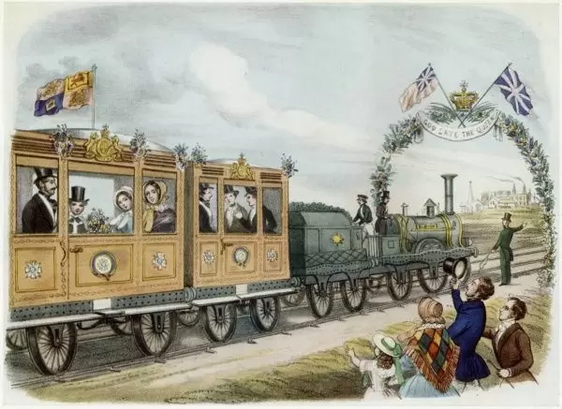
“The Queen, Prince Albert & the Royal Children departing in their Railway Carriage for Scotland”, 1850. CC-BY-NC National Galleries Scotland.

The newspaper described the new station was” to be tastefully ornamented for the occasion, there is to be a stair leading up to the old public road at Meadowbank, and distant only a few yards from the gate into Holyrood Park. Her Majesty’s private carriage will here be in waiting to receive her; so that, in the course of ten minutes are the arrival of the train, the Queen and the Royal Consort will, in all likelihood, be occupying the apartments that have been fitted up for their reception in Holyrood Palace. Fortunately for us, the London Illustrated News sent ahead an artist who was there to capture the scene and gives us the only known image of the station. Notice the crown atop the royal carriage.

London Illustrated News, 6th September 1852

For the Queen’s visit to Edinburgh in September 1852, the Scotsman went so far as to refer to the “Victoria Station at Meadowbank“. Ten horses and two royal private carriages were sent ahead from London to Edinburgh via York, arriving by the afternoon mail train for her Majesty’s personal use in travelling between Meadowbank and Holyrood. When the Queen arrived on September 1st, “The engine was beautifully decorated, having in front the words “God Save the Queen” in large gilt letters.” After the formalities were concluded with the greeting party, the Queen and Prince Albert ascended the stairs from the platform to their waiting carriages, where a guard of honour of the 7th Hussars from Piershill Barracks was waiting, their band striking up God Save the Queen.

The Royal Train behind the engine Albion for the journey to Scotland, 1850. CC-by-SA 4.0 Science Museum Group Collection, © The Board of Trustees of the Science Museum

Once the royal party were officially in residence at the Palace of Holyroodhouse, the Royal Standard was run up the flagpole and the gunners of Edinburgh castle fired a salute. This was however their second of the day; a signal hoisted earlier in the morning from the Nelson Memorial on the top of Calton Hill to a London steamer approaching Leith had been misinterpreted and an over-enthusiastic garrison had fired the royal salute. This created a minor panic amongst the dignitaries, railway officials and spectators of the city who suddenly feared that the Queen had arrived and nobody was there to greet her. One can only imagine the pandemonium until the railway telegraph office located the royal train outside Dunbar.

Queen Victoria and Prince Albert are shown onto a Royal carriage by George Hudson, a London Illustrated News image

For the 1860 visit, a description is given of how the station was decorated for such visits. “The stair leading from the platform to the road was covered with an awning of white and pink calico, and the recesses on either side contained a neatly arranged assortment of flowers, evergreens and heather. The stair-case was covered with a merled carpet, with a stripe of Stuart tartan in the centre“.

As far as is known, there was only one occasion when a regular passenger train stopped here; on August 22nd 1872 a London to Edinburgh express was temporarily halted to allow some of Queen Victoria’s children to disembark. The last use of the station was for the Royal visit to Scotland in 1881. Even the Victorians realised stopping trains on the mainline into Edinburgh from London just a mile shy of the final destination for Royal purposes wasn’t the best use of the railway. The practice of also loading wagons onto the back of the royal train carrying state coaches and horses incurred further delays, as these had to be brought down the line from North Bridge Station (what would later become Waverley).

In 1882, an irate letter was written to the green ink page of the Scotsman to complain that the Town Council were now using the platform as a collection point for the “ashes and dirt” of one quarter of the city before its onwards transport by rail for disposal. The station was only “open” for 31 years – and even then it was used only once or twice a year – but those gate piers have survived 141 years longer than that. There’s a planning application out though to build on this gushet*, so catch them while you still can. (* = gushet is a Scots term for a triangular portion of land). The same stretch of wall has another (unresolved) little secret too. The ghost of a small building that I can’t quite unravel. It looks like two wall ends (green) with the back of a fireplace or window (yellow) in between.

What have we here?

If there was something here, it’s missing from the 1817 and 1849 town plans, so either is older than both or came and went in between. The boundary wall pre-dates the railway and this road was widened on a number of occasions starting with the Royal Visit of George IV in 1822. No structure is marked but this could have been a gardener’s bothy removed when the road was widened.

Kirkwood’s 1817 Town plan showing the location where there was at one time a lean-too structure built into the wall. Reproduced with the permission of the National Library of Scotland

Note to readers: unfortunately in April 2026, a third-party plug-in more than exceeded its authority and broke many of the image links on this site. No images were lost but I will have to restore them page-by-page, which may take some time. In the meantime please bear with me while I go about rectifying this issue.

If you have found this site useful, informative or amusing then you can help contribute towards its running costs by supporting me on ko-fi. This includes my commitment to keeping it 100% advert and AI free for all time coming, and in helping to find further unusual stories to bring you by acquiring books and paying for research.
Or please do just share this post on social media or amongst friends and like-minded people, sites like this thrive on being shared.

Explore Threadinburgh by map:

Travelers' Map is loading...
If you see this after your page is loaded completely, leafletJS files are missing.

These threads © 2017-2026, Andy Arthur.

NO AI TRAINING: Any use of the contents of this website to “train” generative artificial intelligence (AI) technologies to generate text is expressly prohibited. The author reserves all rights to license uses of this work for generative AI training and development of machine learning language models.

#Lochend #Logan #Restalrig #StMargaret
14 Holy Helpers

In German: Vierzehn Nothelfer. In Latin: Quattuordecim auxiliatores.

These are a group of saints venerated together by Catholics because their intercession is believed to be particularly effective. Especially against various diseases.

This group of Nothelfer (“helpers in need”) started in the 14th century as the first in the Rhineland. Largely as a result of the epidemic (probably of bubonic plague) that became known as the Black Death.

Devotion to the 14 Holy Helpers began in Rhineland (now a part of Germany) in the time of the Black Death. Among the 14 were 3 virgin martyrs. There’s a German mnemonic device to remember the 3 virgins. Their names are: Margaret, Barbara, & Catherine. 13 of the 14 were accounted martyrs (Giles is the exception).

While each has a separate feast day, the 14 Holy Helpers, in some places, are celebrated as a group on August 8th. But the celebration never became part of the General Roman Calendar. When that calendar was revised in 1969, the individual celebrations of St. Barbara, St. Catherine of Alexandria, St. Christopher, & St. Margaret of Antioch were dropped.

The individual celebrations of all 14 are included in the General Roman Calendar in 1954, the General Roman Calendar of Pope Pius XII & the General Roman Calendar of 1960.

The 14 saints are:

  • Agathius/Acacius – Feast day: May 7. Patron against headaches.
  • Barbara – Feast day: December 4. Patron against fever & sudden death, against lightning & fire, against sudden & violent death at work, & patron of builders, artillerymen, & miners.
  • Blaise/Blase/Blasius – Feast day: February 3. Patron against illnesses of the throat & for protection of domestic animals.
  • Catherine of Alexandria – Feast day: November 25. Patron against sudden death & diseases of the tongue, philosophers, theologians, maidens, female students, preachers, the dying, wheelwrights, mechanics, potters, & other artisans who work with wheels, invoked by students, orators, preachers, & lawyers for wise counsel & for eloquence.
  • Christopher/Christophorus – Feast day: July 25. Patron against bubonic plague & dangers while traveling.
  • Cyriacus – Feast day: August 8. Patron against temptation on the death-bed, diseases of the eye, & demonic possession.
  • Denis/Dionysius – Feast day: October 9. Patron against headache & against demonic possession.
  • Erasmus/Elmo – Feast day: June 2. Patron against intestinal ailments, for domestic animals, & sailors.
  • Eustace/Eustachius/Eustathuis – Feast day: September 20. Patron against family discord, against fire (temporal & eternal), & the patron of hunters, trappers, & anyone facing trouble.
  • George/Georgius – Feast day: April 23. Patron for the health of domestic animals, against herpetic diseases, & the patron of soldiers.
  • Giles/Aegidius – Feast day: September 1. Patron against plague, mental illness, & nightmares, for a good confession, & patron of the disabled, beggars, blacksmiths, & breast-feeding moms.
  • Margaret of Antioch – Feast day: July 17. Patron of women in childbirth, invoked against backache, & invoked for escape from devils.
  • Pantaleon/Panteleimon – Feast day: July 27. Patron of physicians & midwives, invoked for the protection of domestic animals, & invoked against cancer & tuberculosis.
  • Vitus/Guy – Feast day: June 15. Patron against epilepsy, lightening, the bites of animals (especially those who were venomous or rabid), storms, & for protection of domestic animals.

Half of the saints are seen as actual historic figures (Blaise, Cyriacus, Erasmus, George, Giles, Pantaleon, & Vitus). While the others may be only legends. While the feasts of several of the 14 Holy Helpers were taken off the General Roman Calendar. None were decanonized, or denied to exist & their feasts are still on certain calendars.

One or another in the original set are sometimes substituted with: Anthony the Anchorite, Leonard of Noblac, Nicolas, Sebastian, Oswald the King, Pope Sixtus II, Apollonia, Dorothea of Caesarea, Wolfgang of Regensburg, or Roch. In France, an “extra” helper is added: the Virgin Mary.

The 14 Holy Helpers are honored in Bavaria as the vierzehn Heiligen. This literally translates to “14 Holy Helpers.”

The Basilica of the Vierzehnheiligen is dedicated to these auxiliary saints. It was built between 1743 & 1772 (29 years).

Devotion to these saints begin in this region on September 24, 1445 when Hermann Leicht, a young shepherd of a nearby Franciscan monastery, saw a crying kid in a field belonging to the nearby Cistercian monastery of Langheim.

As he bent down to pick up the kid, it suddenly vanished. A short time later, the kid reappeared at the same spot. This time, 2 candles were burning next to it.

In June 1446, Leicht saw the kid a 3rd time. This time, the kid wore a red cross on its chest & was accompanied by 13 other kids. The kid said: “We are the 14 helpers & wish to erect a chapel here, where we can rest. If you will be our servant, we will be yours!”

Shortly after, Leicht saw 2 burning candles descending to this spot. It’s alleged that miraculous healings soon began, through the intervention of the 14 saints.

The Cistercian brothers to whom the land belonged erected a chapel, which immediately attracted pilgrims. An altar was consecrated as early as 1448. Pilgrimages to the Vierzehnheiligen continue to the present day between May & October.

One-Time Monthly Yearly

Make a one-time donation

Make a monthly donation

Make a yearly donation

Choose an amount

$1.00 $5.00 $10.00 $1.00 $5.00 $10.00 $5.00 $10.00 $15.00

Or enter a custom amount

$

Your contribution is appreciated.

Your contribution is appreciated.

Your contribution is appreciated.

DonateDonate monthlyDonate yearly

#14HolyHelpers #14thCentury #1743 #1772 #1954 #1960 #1969 #24September1445 #Acacius #Aegidius #Agathius #AnthonyTheAnchorite #Apollonia #April23 #August8 #Barbara #BasilicaOfTheVierzehnheiligen #Bavaria #BlackDeath #Blaise #Blase #Blasius #BubonicPlague #CatherineOfAlexandria #Chapel #Christopher #Christophorus #Cistercian #Cyriacus #December4 #Denis #Dionysius #DorotheaOfCaesarea #Elmo #Eustace #Eustachius #Eustathius #February3 #France #Franciscan #GeneralRomanCalendar #George #Georgius #German #Germany #Giles #Guy #HermannLeicht #July25 #July27 #June1446 #June15 #June2 #Langheim #Latin #LeonardOfNoblac #MargaretOfAntioch #May #May7 #Nicolas #Nothelfer #November25 #October #October9 #OswaldTheKing #Pantaleon #Panteleimon #Pilgrims #PopePiusXII #PopeSixtusII #Rhineland #Roch #Saints #Sebastian #September1 #September20 #VierzehnHeiligen #VierzehnNothelfer #VirginMary #Virgins #Vitus #WolfgangOfRegensburg

Memberships

Visit the post for more.

It’s not just a new month—it’s your next chapter.
#September1 #FreshStart #KeepPushing
Fresh month. Fresh energy. Fresh focus.
#September1 #NewBeginnings #StayMotivated
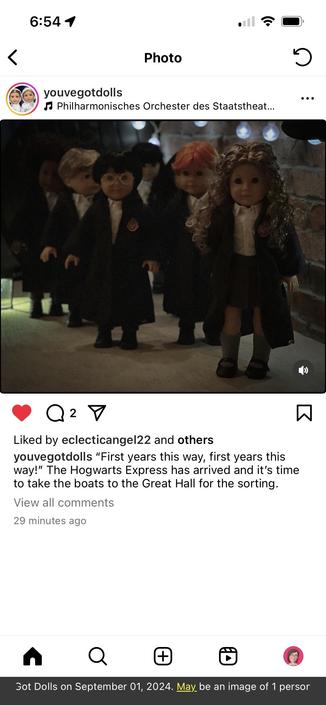
Came accross this pic while browsing my IG.... and I just had to share here too!!!
Happy return to Hogwarts! ✉️🚆🏰🪄📚🧙‍♂️🧙‍♀️💛🦡🧡🦁💙🦅💚🐍 #September1 #ReturnToHogwarts #WelcomeHome #HarryPotter #dolls #18inDolls #dolldisplay

September 1

This day in history:

  • 1983 – Cold War: Korean Air Lines Flight 007 is shot down by a Soviet jet fighter after the commercial aircraft strayed into Soviet airspace, killing all 269 on board, including Congressman Lawrence McDonald.
  • 1961 – TWA Flight 529 crashed shortly after takeoff from Midway Airport in Chicago, killing all 78 people on board. At the time, it was the deadliest single plane disaster in U.S. history.
  • 2008 – Iraq War: The United States Armed Forces transfers control of Anbar Province to the Iraqi Armed Forces.
  • 1804 – 3 Juno, one of the largest asteroids in the Main Belt, is discovered by the German astronomer Karl Ludwig Harding.

Births:

  • 1975 – Cuttino Mobley, American basketball player
  • 1851 – John Clum, American journalist and agent (d. 1932)
  • 1973 – J.D. Fortune, Canadian singer-songwriter

Deaths:

  • 1715 – Louis XIV of France (b. 1638)
  • 1990 – Edwin O. Reischauer, American scholar and diplomat (b. 1910)
  • 1599 – Cornelis de Houtman, Dutch explorer (b. 1565)

Holidays:

  • Knowledge Day (Former Soviet Union)
  • Wattle Day (Australia)
  • Anniversary of Al Fateh Revolution (Gaddafists in Libya)

Random Article of the day:

Iulia Campestris Babba

Iulia Campestris Babba is a Mauretanian city created as Roman colony around 30 BC by emperor Augustus. Its actual location is currently unknown, though its existence is confirmed by the literature.

September 1 - Wikipedia

#WritersCoffeeClub
#september1
#Chapter13ALongExpectedParty

What have been your writing-related achievements in the last year?

The last year has been really rough for writing anything I plan to publish, but i have made a lot of strides on morning pages... they are becoming more consistant. I have been trying to answer daily writing prompts, but life intervened again... I spent 14 days in the hospital with my kiddo... again.

#postitnoteart #writingprompt

Mastodon Writers' Coffee Club Daily Challenge September 2024

          Writers' Coffee Club September 2024 Chapter 13: A Long Expected Party 1. What have been your writing-related achievements in the l...

Song of the Day September 1 2024

In honor of the birth of Zendaya Maree Stoermer Coleman bka Zendaya

https://en.wikipedia.org/wiki/Zendaya

Zendaya - “Neverland” (From Finding Neverland The Album)

https://youtu.be/O3VPs9b_HZE?si=31FD3juRIz205SWb

#SongOfTheDay #SOTD #SOTD2024 #September1 #ZendayaMareeStormerColeman #Zendaya #Neverland #FindingNeverland #Broadway #Music #MusicVideo #JMBarrie #PeterPan #Showtunes #2010s

Zendaya - Wikipedia

Song of the Day September 1 2024

In honor of the birth of Zendaya Maree Stoermer Coleman bka Zendaya

https://en.wikipedia.org/wiki/Zendaya

Zendaya - “Neverland” (From Finding Neverland The Album)

https://youtu.be/O3VPs9b_HZE?si=31FD3juRIz205SWb

#SongOfTheDay #SOTD #SOTD2024 #September1 #ZendayaMareeStormerColeman #Zendaya #Neverland #FindingNeverland #Broadway #Music #MusicVideo #JMBarrie #PeterPan #Showtunes #2010s

Zendaya - Wikipedia