 Alex@rtnVFRmedia Suffolk UK
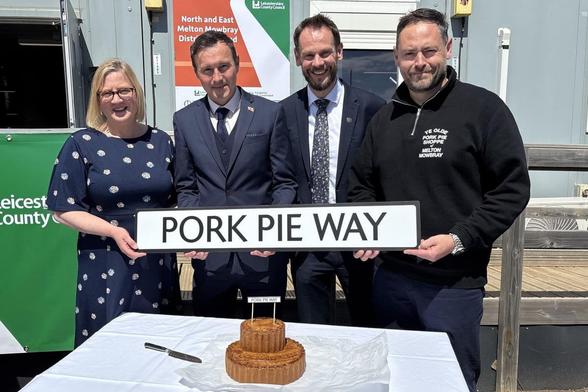
TBH it makes sense to call the new #road in #MeltonMowbray #Leicestershire #England "Pork Pie Way" - not just for the popular #food item made there, but the amount of #roundabouts along the route 😁
 J.P.
J.P.Roundabouts.
I will never understand why so many U.S. drivers get annoyed by roundabouts. The manage traffic very well and are simple to navigate. They reduce rear-end collisions and pedestrian incidents, there’s less emissions from folks sitting at a red light, and their design is optimal for traffic calming measures.
Unlike their old school traffic circle and rotary counterparts, roundabouts are a slow speed, simple way to manage traffic at an intersection. They’re not complicated and they’re not scary.
I would really like to see more roundabouts and less traffic lights in the United States, but drivers seem unreasonably opposed to them.
#motorists #roundabouts #traffic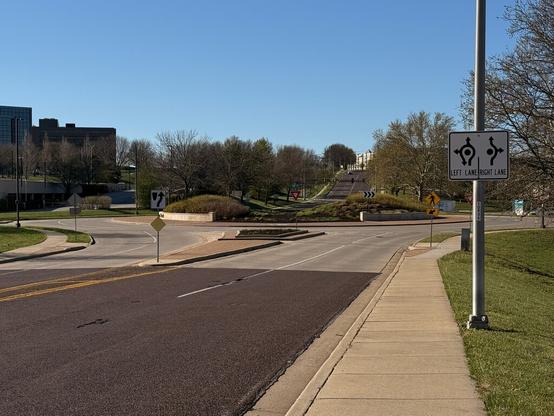
 😀🚲
😀🚲RE: https://zpravobot.news/@Rainmaker1973/116237556188358545
We could also plant flowers in the #stroads #roundabouts
 Colin
ColinHuh, there's an interactive map of every roundabout (and related) in the world.
https://roundabout.kittelson.com/Home/Map
#Maps #Roundabouts #SingleServingSite
(Ok I don't know about 'every'.. the US coverage seems good but just looking around elsewhere.. like UK seems kinda low. Curious what folks find)
RE: https://kolektiva.social/@igd_news/115996952466436740
#tacticalUrbanism popup #roundabouts -- when people come together in public space outside of their cars, we see the same patterns over and over. Why is this completely unlike the #SafeStreets projects proposed by #trafficEngineers? (& shelved pending $30m+ budgets 💸) It's not blinkinlights on 5-lane #stroads, it's impediments to platoons of SUVs rolling through at speed (which is exactly what the "traffic model" thinking tries to preserve at all costs.) #acab #AbolishICE #VisionZero #BanCars
 usbs-usa
 Panethos
American and Canadian Cities with the Most Roundabouts – UPDATE #2
Guest post by Dan T. – Thank you, Dan!
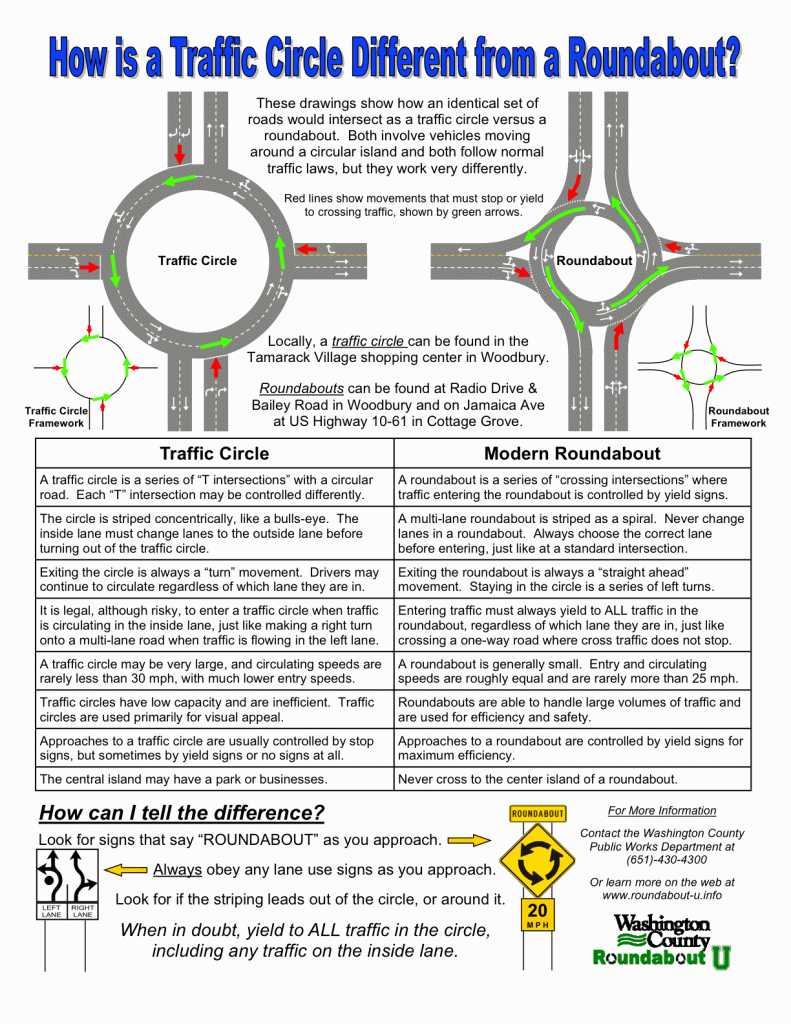
[Note: To most people, the terms traffic circle, rotary, and roundabout are synonyms, but not to traffic engineers. Engineers usetraffic circle as a generic term for all circular intersections, while rotaries and roundabouts (sometimes modern roundabouts) are subsets that have specific features as discussed in the article. This article will use the traffic engineers’ definitions.]
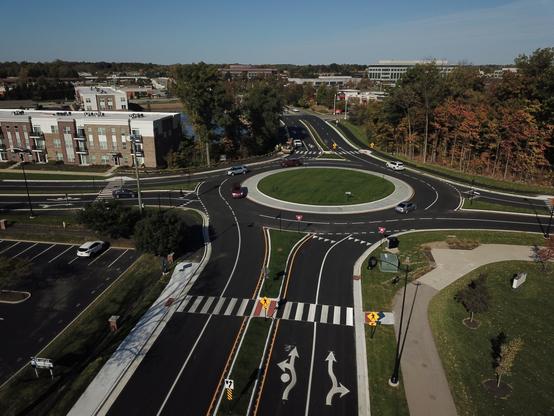
Roundabout in Carmel, IN – Source: eri.iu.eduTraffic engineers love roundabouts. These circular intersections do several things to make traffic better. They cause drivers to slow down, but without forcing them to a complete stop, at least not all the time. They reduce the number of conflict points in an intersection. And where those conflict points do occur, the traffic is intersecting at a shallow angle, rather than a right angle as at traditional intersections. All these drastically reduce the number of serious accidents where injuries or fatalities result.
Circular intersections have a long history. For example, Columbus Circle (which is by no means the first one) in New York was first formed about 1870, although it didn’t get its name until the 1890s when the statue of Columbus was erected. In those horse-and-buggy days, people went around the circle both directions. In 1905, William Phelps Eno, a proto-traffic
engineer, suggested that all the traffic in Columbus Circle should go around the same direction. This was a step towards the modern roundabout, but there were more steps to be made. (Columbus Circle, by the way, is classified by traffic engineers as a signalized traffic
circle and not a roundabout. Modern roundabouts do not have signals.)
The earliest traffic circles had the legs meeting the circle at right angle intersections. They also often had parking allowed along the circular road and allowed pedestrians to access the central island. Some even had buildings in the center. These features didn’t do much to
improve traffic, so during the 1930s, the rotary was developed.
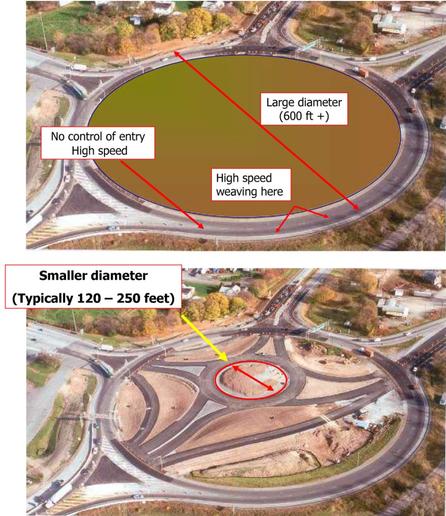
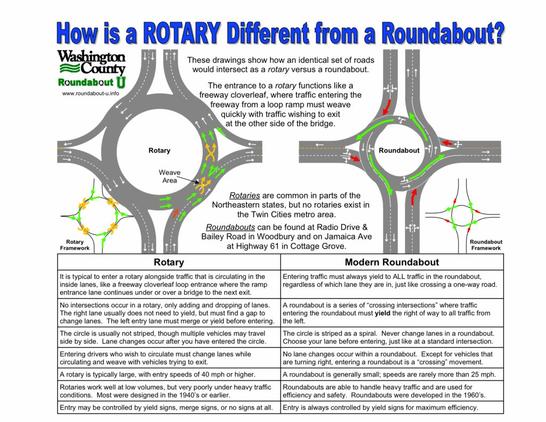
Rotaries are large (some as much as 600 feet across) and initially had no traffic controls. The nearside priority rule, where drivers yield to a vehicle coming from the right, was the most common rule. This meant that vehicles within the circle had to yield to incoming vehicles. Under heavy traffic, this resulted in gridlock. When traffic control signage was installed, they were often designed to speed traffic between two of the legs. Those two approaches had no stop or yield signs as they entered, the traffic already in the circle had to yield to them. Again, gridlock would occur under heavy traffic loads.
Source: co.washington.mn.usThe incoming lanes of rotatries were angled so they met the circle at close to a perfect tangent, but then the incoming vehicles would have to change lanes to get in the circle. The traffic would not be expected to slow down at all, but then have to change lanes again to exit. The high speeds (as much as 40 mph) and lane changes tended to cause serious
accidents. Because of the gridlock and high accident rate, rotaries lost favor in the US in the mid-1950s.
The modern roundabout was developed in Britain in 1966 by Frank Blackmore. The big improvement was that the traffic already in the circle always gets the right-of-way (offside priority rule) and anyone trying to enter it should yield to them. They also are smaller and
require drivers to slow down. Further refinements have been made over the years: the shape of the splitter islands was optimized to angle the incoming traffic in the right direction while still giving drivers a good view of the traffic they must yield to, truck aprons provide for
large vehicles to use them, and subtle curves in the incoming lanes as well as the final curve at the splitter island slow the incoming traffic.
The UK and western Europe in general quickly adopted modern roundabouts and now there’s well in excess of 100,000 there. The US and Canada were slow to adopt the modern roundabout. Traffic circles still had the bad reputation, so even the improved version from Britain was not looked on favorably. The first two modern roundabouts in the US were not built until 1990. Those two were in Summerlin, Nevada, a planned community in Las Vegas. Following that, there was a very slow adoption in the rest of the country. By the turn of the century, there were still only a couple hundred in the entire US. They started to take off in the oughts to the point where there are now about 8,000 with 450 to 500 new ones being built every year.
The following list is based on an extensive database of circular intersections maintained by Kittelson and Associates, an engineering firm based in Portland OR (see the link at the end of the article). The entries in the database are divided into five categories: Roundabouts,
Rotaries, Traffic Calming Circles, Signalized Circles, and Other. The counts in the lists below are only of Roundabouts, and not of the other categories.
[Note: Kittelson doesn’t make any money from hosting the database and all the entries are contributed by volunteers. If you know of a roundabout not in the database, feel free to submit it for inclusion.]
Source: carmel.in.govThe city with the most roundabouts (possibly the most in the entire world) is Carmel, Indiana, a suburb of Indianapolis. In the late 1990s, their mayor, James Brainard, who’d learned of them at school in England, started pushing the city to replace all of its traffic lights with roundabouts. The Kittelson database contains all of them, but some are classified as Other for various reasons. Several allow pedestrian access to the central island, some do not have splitter islands, one has parking along the circular roadway. The counts in this list are only of those classified as Roundabouts in the database.
- Carmel IN = 155 – updated 8/5/25
- Colorado Springs CO = 61
- Columbia MO = 55 – updated 12/9/25 – thank you, Cindy!
- Bend OR = 55 – updated 4/14/26 – thank you, Megan
- Loveland CO = 47
- Austin TX = 47 – updated 8/5/25 – thank you, J. Lee!
- Frisco TX = 45
- Charlotte NC = 44
- Lincoln NE = 43
- Conway AR = 38 – updated 4/22/26 – thank you, Landen
- Durham NC = 37
- Raleigh NC = 37
- Las Vegas NV = 37
- Fort Worth TX = 35
- Omaha NE = 35
- Noblesville IN = 34
- Kansas City MO = 33
- The Villages FL = 32
- Miami FL = 31
- Fishers IN = 28
- Sarasota FL = 27
- Howard WI = 25
- Ladera Ranch CA = 25
- Lenexa KS = 25
- Kennewick WA = 24
- Lawrence KS = 24
- Chattanooga TN = 23
- El Paso TX = 23
- Westfield IN = 23
- Dublin OH = 22
- McKinney TX = 22
- Tallahassee FL = 22
- Mount Pleasant SC = 21
- Toledo OH = 21
- Billings MT = 20
- Gainesville FL = 20
- Wilmington NC = 20 – added 3/21/22
- Woodbury MN = 20
- Cary NC = 19
- De Pere WI = 19 – added 3/21/22
- Fort Wayne IN = 19
- Olathe KS = 19
- Reno NV = 19
- Anchorage AK = 18 – added 3/21/22
- Brighton CO = 18
- Columbus GA = 18
- Lacey WA = 18
- Neenah WI = 18
- Olympia WA = 18
- Roseville CA = 18
- St George UT = 18
- Santa Fe NM = 18
- Spokane WA = 18
- West Jordan UT = 18
- Jacksonville FL = 17 – added 3/21/22
- Orlando FL = 17
- Oxford MS = 17 – added 3/21/22
- Rogers, AR = 17 – added 4/22/26 – thank you Landen
- Tampa FL = 17
- Topeka KS = 17
- Wake Forest NC = 17
- Alpharetta GA = 16
- Grand Junction CO = 16
- Indianapolis IN = 16
- Madison WI = 16
- Modesto CA = 16
- Overland Park KS = 16
- Appleton WI = 15
- Jacksonville FL = 15
- Lee’s Summit MO = 15
- Little Rock, AR = 15 – added 4/22/26 – thank you, Landen
- Scottsdale AZ = 15
Canada similarly got off to a slow start in building modern roundabouts.The first was built in Montreal in 1998. But they also took off in the oughts (2000-2009) and now there’s over 1000 in the entire country, with 60 or 70 new ones every year.
- Calgary AB = 55
- Ottawa ON = 51
- Winnipeg MB = 47
- Lethbridge AB = 29 – added 3/21/22
- Cambridge ON = 25
- Kitchener ON = 21
- Waterloo ON = 20
- Kelowna BC = 17
- Whitchurch-Stouffville ON = 14
- Markham ON = 13
- London ON = 12
- Milton ON = 12
- Victoria BC = 12
- Aurora ON = 11
- Gatineau QC = 11 – added 3/21/22
- St John’s NL = 11
- Saskatoon SK= 11
- Surrey BC = 11
- Terrebonne QC = 11
- Sherbrooke QC = 10
- Richmond Hill ON = 9 – added 3/21/22
- Whitehorse YT =9 – added 3/21/22
- Windsor ON = 9
- Charlottetown PE = 8
- Chilliwack BC = 8
- Hamilton ON = 8
- Saguenay QC = 8
- St Thomas ON = 8
- West Kelowna BC = 8
[Note: When submitting a new roundabout to the Kittelson database, the city name provided by the software is actually the name of the post office that serves where the roundabout is. While that can be changed by the submitter, it usually is not. What this means is that many cities get credit for roundabouts outside their city limits. Unfortunately there’s no simple way to fix this, so the city counts above are not perfectly accurate.]
SOURCES:
- https://roundabouts.kittelson.com/ Kittelson’s database
- https://www.carmel.in.gov/department-services/engineering/roundabouts – Carmel’s roundabout page, which has a link to a map of all Carmel’s roundabouts.
- How Stuff Works: Roundabouts – https://science.howstuffworks.com/engineering/civil/roundabouts.htm
- A HISTORY OF ROUNDABOUTS IN THE UNITED STATES AND FRANCE – https://babel.hathitrust.org/cgi/pt?id=mdp.39015023846507&view=1up&seq=629
- Personal knowledge
- https://www.carmel.in.gov/home/showpublisheddocument/22960/638775633694530000
 antoniovr
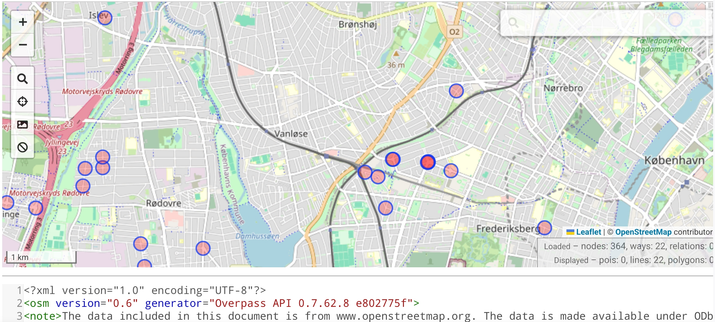
#Roundabouts usually improve car traffic and make it safer but under typical design criteria, they lead to negative impacts to 🚲, as they increase risks and difficult cycleways integration, and to 🚶 that need to walk longer due to pedestrian crosses setbacks. The only exception to this are the"dutch roundabout" (low curvatureR+just a single lane out). In the images we can see the differences between the number of roundabouts in a(ny) Spanish city and Copenhagen.
#sustainableMobility
#sustainableMobility

 The Current
UL interim president appointment to Cajundome Commission, polling place consolidation
The parish is looking to consolidate polling locations. UL Lafayette switches Cajundome appointment after public outcry over former president’s appointment.Former UL President to be appointed to Cajundome Commission, last-minute polling place changes
LCG is rushing to officially change polling places from a now-closed elementary school to Lafayette High before Saturday's election. UL President Joseph Savoie is set to be appointed to the Cajundome Commission.