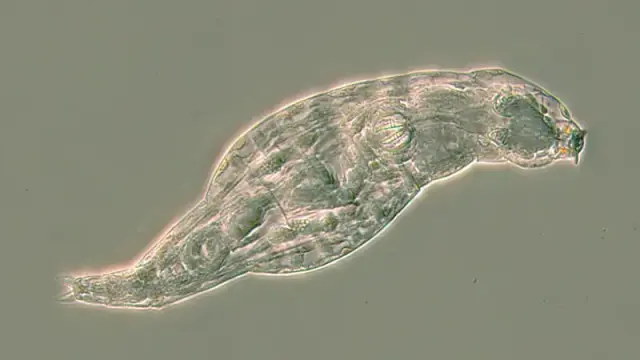
Weekend #Plankton Factoid 🦠🦐
Bdelloid rotifers are a microplankton that reproduce using parthenogenesis (female clones), but when environmental conditions become adverse (e.g. pond dries up), they can turn themselves into an extraordinaryly resistant inert "tun" through a process called cryptobiosis (like brine shrimp). Recently, Russian scientists thawed out #rotifers from 24000 year old permafrost. They revived and immediately started reproducing themselves.
https://doi.org/10.1016/j.cub.2021.04.077
#science
Filinia is a genus of #rotifers in the family #Trochosphaeridae. The genus was #firstDescribed by #JeanBaptisteBoryDeSaintVincent in 1824. The genus has a #cosmopolitanDistribution.
🌡️🦠 #LimnoScenEs (#BiodivScen) shows how climate warming impacts tiny zooplankton (#rotifers) in temperate shallow lakes, altering composition and dominance patterns.
https://link.springer.com/article/10.1007/s10750-024-05744-7
Warming of shallow temperate lakes: consequences for rotifer community composition and population dynamics - Hydrobiologia

Taxa specific responses to climate warming may shape aquatic communities, dominance patterns, biotic interactions, and related ecosystem processes and functions. As climate warming effects on smaller zooplankton are less understood than larger zooplankton, we focused on rotifers to study their response to a future climate warming scenario in outdoor mesocosms. Our year-long experiment (14 July 2020 to 13 July 2021) included present temperature conditions as controls and a treatment simulating a future warmer climate involving occasional heatwaves. Total rotifer abundance increased with warming, with Keratella spp. and Polyarthra spp. benefiting the most, while the Kellicottia spp. population collapsed. Filinia spp. were negatively affected by warming in the summer of 2020, but increased during winter and the following summer. Our findings suggest that thermophilic or eurytherm rotifers such as Keratella and Polyarthra may increase in a warmer future, while heat-sensitive Kellicottia may be negatively affected in the temperate region. Milder winters may allow some rotifer genera to proliferate while allowing others to recover from high summer temperatures, thereby considerably changing the composition and dominance patterns of rotifer assemblages.

SpringerLink
Small animals acquire genes from bacteria that can produce antibiotics

A group of small, freshwater animals (bdelloid rotifers) protect themselves from infections using antibiotic recipes “stolen” from bacteria, according to new research by a team from the University of Oxford, the University of Stirling and the Marine Biological Laboratory, Woods Hole. This raises the potential that rotifers are producing novel antimicrobials that may be less toxic to animals, including humans, than those we develop from bacteria and fungi.

EurekAlert!

Small #animals use 'stolen' genes from #bacteria to protect against infection
https://phys.org/news/2024-07-small-animals-stolen-genes-bacteria.html

Bdelloid #rotifers deploy horizontally acquired biosynthetic genes against a fungal pathogen https://www.nature.com/articles/s41467-024-49919-1

"When these rotifers are exposed to fungal infection, they switch on hundreds of genes that they acquired from bacteria and other #microbes. Some of these genes produce resistance weapons, such as #antibiotics and other antimicrobial agents, in the rotifers"

Study shows small animals use 'stolen' genes from bacteria to protect against infection

Certain small, freshwater animals protect themselves from infections using antibiotic recipes "stolen" from bacteria, according to new research by a team from the University of Oxford, the University of Stirling and the Marine Biological Laboratory (MBL), Woods Hole.

If one accepts that (a) #God really did create all #species on #Earth....do you think that the #Bdelloid #Rotifers were just like the proof of concept for like....the entire initiation of the New Testament?

Like...that's a logical presumption right?

#Zooplankton in #ocean and freshwater are rapidly escalating the global environmental threat of #plastics, finds study
#rotifers, a kind of microscopic zooplankton common in fresh and ocean water around world, are able to chew apart #microplastics, breaking them down into even smaller, and potentially more dangerous, #nanoplastics—particles smaller than one micron. Each #rotifer can create between 348,000–366,000 per day, leading to uncountable swarms of nanoparticles. https://phys.org/news/2023-11-zooplankton-ocean-freshwater-rapidly-escalating.html
Zooplankton in ocean and freshwater are rapidly escalating the global environmental threat of plastics, finds study

A collaborative research team lead by the University of Massachusetts Amherst has recently revealed that rotifers, a kind of microscopic zooplankton common in both fresh and ocean water around the world, are able to chew apart microplastics, breaking them down into even smaller, and potentially more dangerous, nanoplastics—or particles smaller than one micron. Each rotifer can create between 348,000–366,000 per day, leading to uncountable swarms of nanoparticles in our environment.

Phys.org
Weekend #Plankton #Factoid 🦐🦠
A bit of a strange one. Rotifers can increase #microplastics particles by their feeding mechanism. #Rotifers feed by a ciliated corona, which looks like a wheel spinning (thus "wheeled animacules") into a pharynx with calcified trophi. When plastic particles are eaten, they are broken up into smaller bits. Rotifers are very common in #freshwater where most microplastics are deposited, potentially making the situation worse. #zooplankton
https://www.theguardian.com/environment/2023/nov/09/microplastic-eating-plankton-worsening-crisis-oceans-plastic-pollution
Microplastic-eating plankton may be worsening crisis in oceans, say scientists

Rotifers could be accelerating risk by splitting particles into thousands of potentially more dangerous nanoplastics

The Guardian
A type of #zooplankton found in marine and fresh #water can ingest and break down #microplastics scientists have discovered. But rather than providing a solution to the threat #plastics pose to aquatic life, the tiny creatures known as #rotifers could be accelerating the risk by splitting the particles into thousands of smaller and potentially more dangerous #nanoplastics.
https://www.theguardian.com/environment/2023/nov/09/microplastic-eating-plankton-worsening-crisis-oceans-plastic-pollution
Microplastic-eating plankton may be worsening crisis in oceans, say scientists

Rotifers could be accelerating risk by splitting particles into thousands of potentially more dangerous nanoplastics

The Guardian

#Microplastics have contaminated every corner of the planet, from the top of #MountEverest to the depths of the #MarianaTrench, and research has shown they are in many humans’ blood and heart tissue and the placentas of unborn babies. They cause harm in human cells in the laboratory at levels known to be eaten by people via food.

https://www.theguardian.com/environment/2023/nov/09/microplastic-eating-plankton-worsening-crisis-oceans-plastic-pollution

#nanoplastics #fossilfools #plasticpackaging #Rotifers

Microplastic-eating plankton may be worsening crisis in oceans, say scientists

Rotifers could be accelerating risk by splitting particles into thousands of potentially more dangerous nanoplastics

The Guardian